
Discover how sustainability is woven into the fabric of research at the University – empowering staff and students to drive positive change through innovative, responsible inquiry.
Our objectives
- Ensure that all relevant laboratory spaces reach Bronze LEAF accreditation by the end of the 2025/26 academic year
- Ensure that all relevant laboratory spaces reach Silver LEAF accreditation by the end of the 2027/28 academic year
- To include data from LEAF calculators regarding CO2e emissions in our annual reporting
- Include sustainability-related considerations into all research funding bids – ongoing
- Taking a Living Lab approach across the University
Living Laboratories
A Living Lab approach is about working together. It brings students, staff and external partners together to try out ideas, share what they know, and find practical solutions to real world challenges, especially around sustainability.
At Edge Hill we look to take a Living Lab approach where feasible to support students develop key skills and knowledge. This is done in a variety of ways as outlined below.
- Students are encouraged to access University Living Lab to look for projects of interest that they can undertake outside of their academic studies; to support students wishing to undertake projects they are able to apply for the EHU Student Sustainability Initiative Fund.
- Undertaking relevant projects alongside the Sustainability team as part of a placement or internship – case studies for this can be found below.
- Signing up for one of the projects listed below that have been developed by EHU staff.
- Undertaking relevant projects as part of their degree – case studies for this can be found below.
Case Studies
- In the 2025/26 academic year, third year social marketing students were given a brief by a water supplier to develop an awareness and behaviour change campaign to engage residential students around what should and shouldn’t be flushed down the toilets and put down sinks in halls of residence to reduce drain blockages. Students used their knowledge and skills to research the topic and present their approach to the brief and demonstrate how they would do so via a Freshers Fair stand. Work from these projects is being incorporated into plans for future campaigns at Edge Hill.
- How do students perceive sustainability at Edge Hill University and how can we use feedback to improve student engagement with sustainability? During the 2025/26 academic year our Corporate Sustainability Intern used survey data to study this topic and write a report summarising key ways in which the University can ensure students are engaged in sustainability and understand what sustainability means.
- How can more students be encouraged to engage with the annual sustainability fair? During the 2024/25 academic year a third year student supported with organising the annual sustainability fair at Edge Hill and look at how themes and new activities could be use to improve student engagement.
Projects
- Circular Economy at Edge Hill
- This project looks to have students investigate how a circular economy approach can be implemented at Edge Hill University in support of the Waste and Resource Strategy.
- More information on this project can be provided by emailing [email protected]
- Decarbonising field trips
- This project looks to take the data collected as part of the field trip carbon calculator to develop ways to decarbonise student field trips undertaken at Edge Hill.
- More information on this project can be provided by emailing [email protected]
Laboratory Efficiency Assessment Framework (LEAF)
LEAF is a standard set by UCL which focuses on improving the sustainability and efficiency of laboratories. Edge Hill University have been members of LEAF since 2023 and currently are working towards our objectives around Bronze and Silver level for our laboratories.
Laboratory research plays a vital role in driving scientific and societal progress, bit it comes with a significant environmental impact. Laboratories are estimated to generate around 2% of global plastic waste and consume 3 to 10 times more energy per square meter than standard office spaces. For this reason, it is vital to Edge Hill that we ensure these spaces are as sustainable as possible and support our Environmental Sustainability Strategy.
Edge Hill University staff can sign up to the LEAF programme through the UCL LEAF website, where you’ll also find detailed information about the scheme and a range of helpful resources.
Below is a list of the current LEAF accreditations that the University holds:
Bronze
- Electronics Lab
- Tensile Tester Lab
- Electrical Machines Lab
- Fluid Mechanics Lab
- GEO Research Laboratories
- Ormskirk CSSC
- St James’ CSSC
Gold
- BioSciences
- Tech Hub
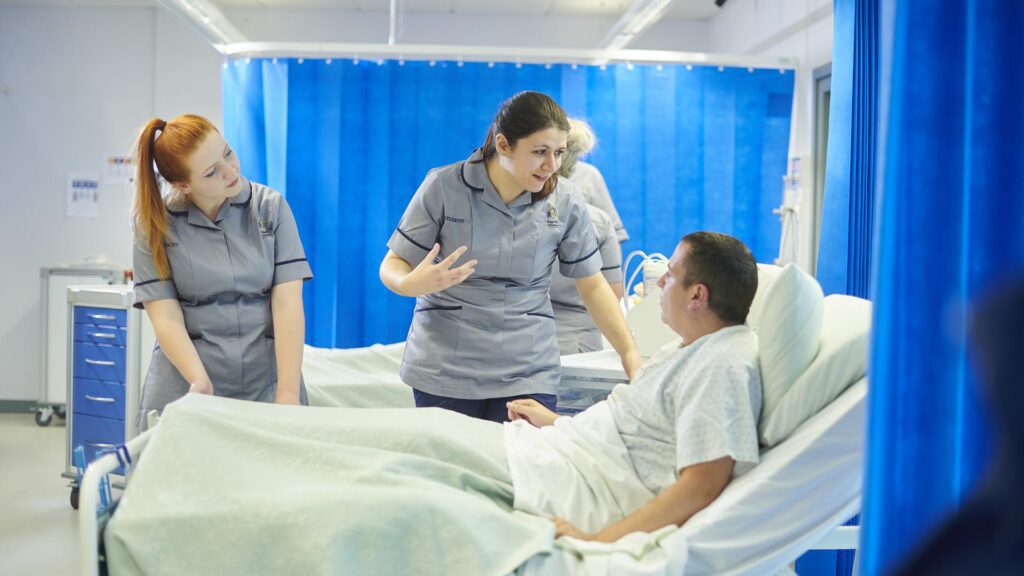
Sustainability Practices in Clinical Skills and Simulation Training
In our commitment to sustainability, we have implemented several innovative practices to reduce waste and promote the efficient use of resources in our clinical skills and simulation training. These practices not only contribute to environmental conservation but also enhance the cost-effectiveness of our training programs.
1. Reusing Consumables
We have established protocols to safely reuse consumables in simulation training. By cleaning items such as syringes, Cathers and other medical supplies, we minimize waste and reduce the need for new materials. This practice ensures that our simulations remain realistic while promoting sustainability, the great thing is within simulation we only use on simulated part task trainers, this makes it easier to clean and reuse with certain consumables.
2. Repackaging Consumables
To further extend the life of consumables, we explore ways to repackage them for reuse. We have recently purchased heat sealers with a vision to reseal certain items to practice opening techniques. By doing so, we reduce the environmental impact associated with the disposal of single-use items.
3. 3D Printing
Utilizing 3D printing technology, we are in the process of striving to create 3D printed equipment to utilise within simulation, one recent innovative idea created successfully is simulated paramedic O2 canisters made from 3d printed materials. This approach allows us to produce customized, reusable items on-demand, reducing the reliance on traditional manufacturing processes and minimizing waste.
4. Purchasing Out-of-Date Consumables
We procure out-of-date consumables from medical auction sites for use in simulations and skills training sessions. These items, which are no longer suitable for clinical use, are perfect for training purposes. By using these consumables, we reduce the demand for in-date stock, thereby decreasing waste and promoting resource efficiency.