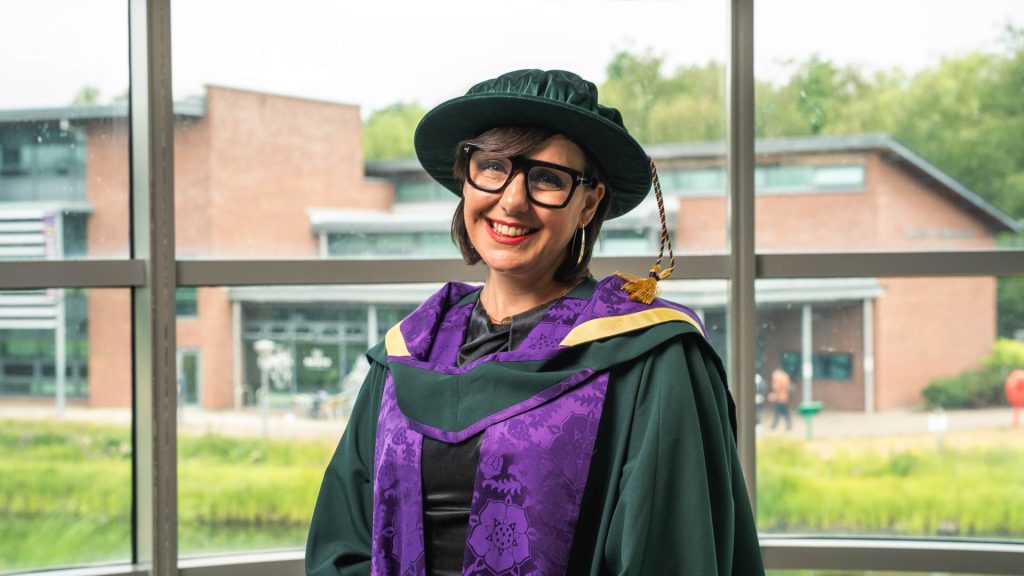
Edge Hill is the kind of place that makes you want to keep coming back. The scenic campus and course content are what initially attracted Ellen to Edge Hill as an undergraduate student. The support and encouragement she received as a neurodivergent student, along with being made to feel like a person, not just a number, is what made her stay. And now she’s here to tell us more about her journey from undergraduate student to Lecturer in Child and Adolescent Mental Health.
“Edge Hill gave me the confidence to step forward into my career, and now I want to help other people to do the same. I hope that by sharing my journey, others can see that neurodivergence isn’t a barrier to success in higher education. In fact, it can be a real asset.”
“Before I came to university I didn’t know what I wanted to do. I knew I wanted to work with children so I did a BTEC in health and social care. My tutors encouraged me to think about university, so I started researching courses and found one at Edge Hill that felt right. I applied and was very quickly made an offer.”
I have ADHD and Edge Hill suited me. It’s accessible, supportive and the campus is so scenic. I did struggle with concentration, but this was never seen as a barrier. You can fight against the stereotype of ADHD, I see it as your own special superpower. I ended up doing really well in my dissertation through the support of the staff around me. Even if you don’t think you can sit in a lecture hall all day it’s still possible to get a degree. We as a faculty aspire to make learning accessible for everyone.
As a lecturer having ADHD has been both a challenge and a strength. It brings a unique energy and creativity to my teaching and research, and I’ve found it helps me connect with students in a more empathetic and dynamic way. Of course there are moments where organisation and focus can be tricky, but I’ve developed strategies that work for me and I think being open about that helps normalise different ways of working in academia.”

Ellen’s career journey
“My undergraduate degree was in what is now BSc (Hons) Child & Adolescent Mental Health & Wellbeing. The lecturers that I had inspired me, you could tell they were passionate about what they taught. It made me think I’d love to come back into higher education and for this to be my career one day.
I then did a postgraduate teaching degree in further education and training, also at Edge Hill. During my placement year I realised that some students needed so much more emotional support than I could offer them in the classroom. So I started looking into jobs that would help me to do this, and that’s how I came across a trainee job for a Mental Health Practitioner role. I loved being able to make a difference in young people’s lives.
l reached out to some of my old lecturers at Edge Hill and offered to do some guest lectures. Shortly after this a job was advertised, and I thought why not go for it? It wasn’t part of my plan so soon, but it felt like divine timing. I always wanted to share my passions and get as many people as inspired as I was when I was studying.”

Ellen now teaches on both the BSc (Hons) Child & Adolescent Mental Health & Wellbeing and PGDip Education Mental Health Practitioner for Children and Young People.
“A lot of staff have been in practice, so we know what students need to make them employable, and how to make learning meaningful and fun. I truly understand what they’re going through from recently being a student myself, so I strive to make things more impactful and accessible. I train people to be Education Mental Health Practitioners, which is like a low intensity therapeutic role. They would be employed by the NHS but work in education. This involves going into schools and supporting young people with mental health.”
January 14, 2026