Considering a degree in Psychology?
Find answers to some of the common questions our department gets asked about studying at Edge Hill University. From choosing the right course to career prospects and settling into student life, we’ve heard it all. We’d also encourage you to join us at an Open Day, where you can meet our staff and students, explore the facilities and get a feel for what your life at Edge Hill could be like.
A Psychology degree gives you a strong understanding of people, behaviour and research, which can be applied in many different careers. You’ll develop transferable skills in communication, data analysis, critical thinking, problem-solving and understanding how people think, feel and behave. These skills are valued across a wide range of sectors, including health and social care, education, research, business, marketing, HR, public services and the charity sector.
Many students also use their degrees as a stepping stone to postgraduate study or professional training in areas such as Clinical Psychology, Forensic Psychology and Educational Psychology. As our Psychology degrees are accredited by the British Psychology Society (BPS), this ensures students have the essential qualifications for post-graduate training programmes.
Edge Hill Psychology graduates have gone on to a wide range of roles across healthcare, education, research, criminal justice, social care, charities and business. Recent graduates have secured roles with companies like HMCTS, Communicourt, NHS Cheshire and Wirral Partnership, Manchester Metropolitan University, The Lancet, Muscular Dystrophy UK, Disability Advocate, The College of Policing, Pulse Fitness, Barclays, A Wilderness Way, Applied Behaviour Analysis and Laureate House .
The wide range of opportunities that our graduates enter show how the skills developed through a psychology degree can be applied in many different settings from supporting people and communities to working in research, communication, public service and professional practice. You can read about our alumni career paths from their profiles: Alex Thomson, Hollie Wilkinson, Alex Lynch and Beth Gannon.
Psychology here at Edge Hill combines scientific understanding of human behaviour with practical learning opportunities and career-focused development. You’ll learn from academics who are actively involved in research and professional practice while studying topics that explore how people think, feel and behave. Throughout your degree, you’ll have opportunities to develop research, analytics and employability skills that can support a wide range of career paths.
Depending on your course, you may study areas such as cognitive psychology, social psychology, developmental psychology, biological psychology, mental health, wellbeing, personality, psychological research methods and statistics. You’ll also develop practical research skills and learn how psychological theory can be applied in real-world settings.
We recommend all students attend one of our Open Days, where you can meet our lecturers and speak to students. We will talk through every course, giving you the chance to ask any questions. While you are here, you can also explore our facilities, accommodation and take a walking tour around the campus. It’s one of the best ways to visualise your future and discover which course is the best one for you.
Edge Hill University offers five undergraduate Psychology courses. Each course has their own course page on the website containing lots of useful information including the course content and modules for each year. Ask yourself whether the subjects covered are topics you would enjoy studying for the next three or more years. You can also explore our student and alumni profiles to learn about different experiences and career journeys.
No. You do not need an A-Level in Psychology to apply for most Psychology courses at Edge Hill.
Specific entry requirements do vary between course, so please check the course page for the latest information.
Alternately, if you do not meet these entry requirements, you can study our STEM Foundation Year to help you develop specific skills that will enable you to progress onto the first-year of the course.
As a Psychology student, you’ll have access to specialist laboratories and equipment designed to support teaching and research. These facilitates provide opportunities to gain experience with the methods and technologies used by psychologists to investigate behaviour, cognition and wellbeing. You will also benefit from studying in our three-storey Law and Psychology building, which includes a 250-seat lecture theatre, seminar and tutorial rooms.
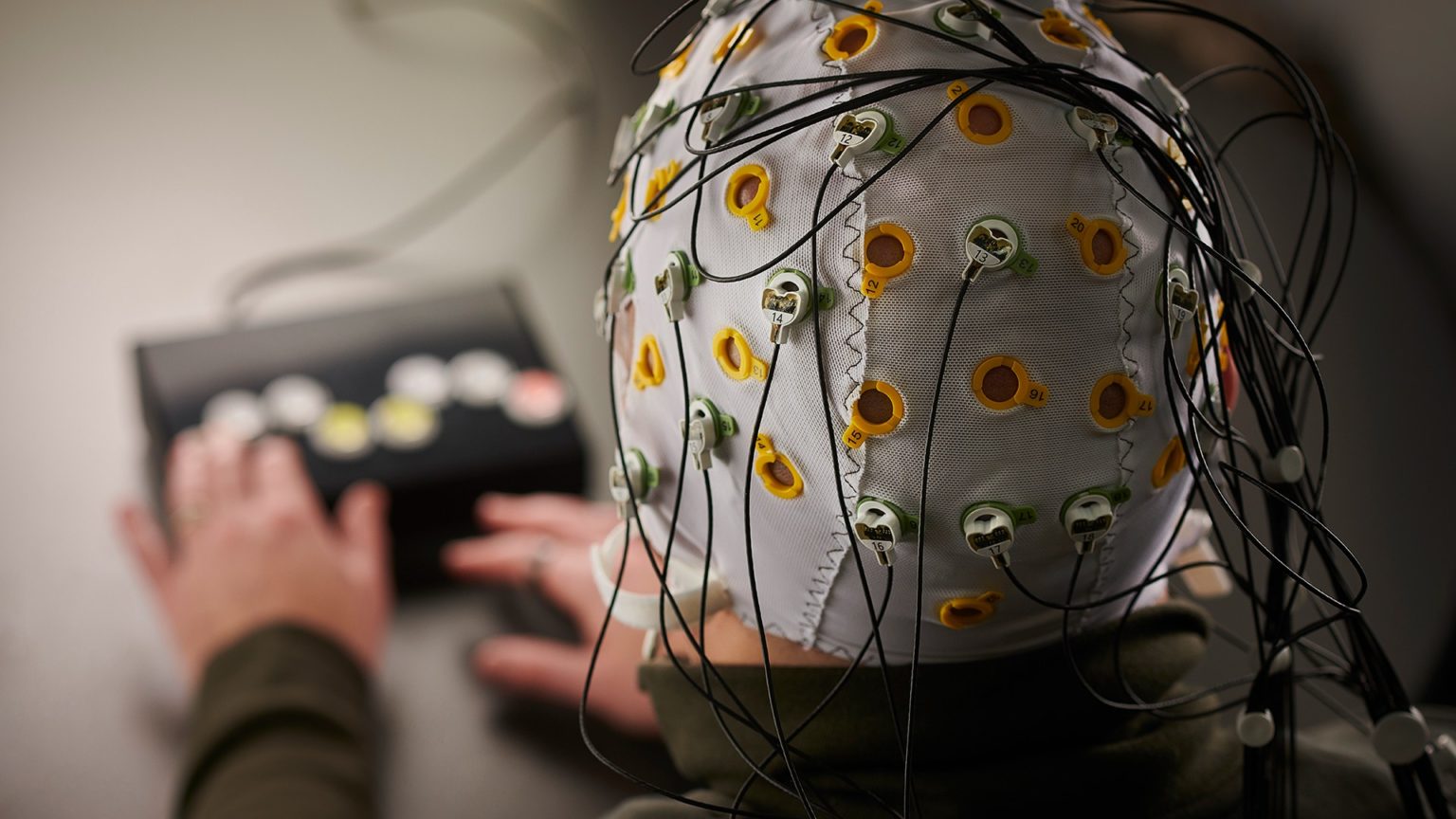
Psychology resources include state-of-the-art eye trackers, transcranial direct current stimulation (tDCS) methods, transcranial magnetic stimulation (TMS) and near-infrared spectroscopy (NIRS) for examining cognitive functioning and brain activity. Other specialist laboratories include a group testing laboratory, a ‘bar simulation laboratory’ (for alcohol research), health psychology suite, coaching clinic, audio-visual suites and dedicated IT facilities equipped with subject specific software installed to support experimental work.
Outside of the Psychology building, you can enjoy our award-winning 160-acre campus. Halls of residence, top facilities, sustainable teaching spaces and landscaped grounds. We’ve invested £300m over the last decade. Many of our students spend their time outside of the classroom utilising our impressive Catalyst building, expansive library and 60 acres of sport and leisure facilities.
Preparing students for a successful career is a key priority within the Department of Psychology, by teaching students the skills necessary to give them that competitive edge in their chosen career paths. We therefore provide students with degrees that are accredited by the British Psychology Society (BPS). This provides GBS (Graduate Basis for Chartered Membership), which is an essential qualification for those wishing to enter professional post-graduate training programmes. In these jobs personal qualities and transferable skills are the most significant factors, rather than the specific subject studied at degree level.
Edge Hill University is 2nd in the North West for career prospects (The Guardian University Guide 2026 – Psychology) with 97.7% of our Psychology students in further study 15 months after graduation (Graduate Outcomes data released 2026 from 2023/24 graduates).
We have a number of annual events to support the employability of our students. One is our Mock Assessment Centre event. This is designed for our second year undergraduate psychology students, to help them prepare for real situations when applying for graduate roles or sandwich year roles. This actively engages our students in the process of writing job application forms, psychometric testing and being interviewed.
This not only helps our students develop key employability and transferable skills but supports them to effectively articulate them to employers. We actively work with employers who support the delivery of our Mock Assessment Centre Day. Some of the organisations who have previously supported us on this include Enterprise, West Lancashire Borough Council, Royal Air Force (RAF), Autism Initiatives, and AEC – Airborne Environmental Consultants Ltd.
Psychology students can gain valuable industry experience through a wide range of work experience opportunities. These include sandwich year placements, summer placements, Easter placements, part-time internships and voluntary work experience.
Many of our partners offer placements, volunteering, part-time roles and graduate opportunities to our students. We have a Psychology Work Placement module in which our students are required to do a minimum of 50 hours of work and then reflect on how psychological theory relates to professional workplace practices.
Previous placements providers have tasked our students with placement projects such as designing, delivering and evaluating inclusive educational provision for SEN learners in mainstream schools. This not only supports our students to gain experiential ways of applying their subject knowledge and skills but has also ensured they have contributed added significant value to these organisations. You can find out more about these opportunities here: Partnerships and Opportunities – Edge Hill University
Psychology is more than what happens in the classroom. Alongside your studies, you can get involved in PsychSoc a society “by students, for students” to help provide a supportive community for students. Unlike other Universities, here at Edge Hill, we offer all our Psychology students use of our bespoke Coaching Psychology Clinic, to help them tackle common challenges. Outside of Edge Hill, our students also have the opportunity to learn psychology off campus. For example, the British Psychological Society Cyberpsychology Section conference.
Student life at Edge Hill University is about more than just studying. Alongside your Psychology degree, you’ll become part of a welcoming campus community with opportunities to make friends, join societies, gain new experiences and develop connections for your future career.
Our award-winning campus has benefited from more than £350 million of investment in facilities and the student experience over the last 15 years. You’ll find modern accommodation, special spaces, specialist learning environments, sport facilities and outdoor areas designed to help you feel at home.
The Students’ Union provides social spaces for everything from daytime catch-ups to evening events. Many students also meet friends and build new connections by joining one of our 100+ clubs or societies.
Ormskirk where Edge Hill University is located, has a lot to offer: bars, boardgame bars, restaurants, cafes, pubs, a food market, shops and much more. You also have the option to venture out further as the vibrant cities of Liverpool and Manchester are just a short train ride away.
Attending an Open Day is one of the best ways to decide whether Psychology at Edge Hill University is right for you. While course pages and prospectuses can tell you what you’ll study, an open Day gives you the opportunity to experience the subject and the University for yourself.
At an Open Day, you can:
- Meet the lecturers who will teach you and ask questions about the course.
- Speak to current Psychology students about their experiences and what university is really like.
- Compare our different Psychology courses to help you decide which one bets matches your interests and career goals.
- Explore the Law and Psychology building, home to our specialist Psychology facilities and laboratories.
- See the technology and equipment used by our students, including state-of-the-art eye trackers, transcranial direct current stimulation (tDCS) methods, transcranial magnetic stimulation (TMS) and near-infrared spectroscopy (NIRS) for examining cognitive functioning and brain activity.
- Learn about placement opportunities, sandwich years, study abroad options and the support available from our employability team.
- Discover student societies and extracurricular activities, including PsychSoc.
- Explore our award-winning campus, accommodation and student facilities. Edge Hill University is ranked 1st in the UK for accommodation and 4th in the UK overall by Uni Compare 2027.
An Open Day also gives you the opportunity to get a feel for the atmosphere on campus. You can explore the facilitates, talk to the people who could be supporting you over the next three or more years, and leave feeling confident that you’ve chosen the right course and university for your future.
For many students, visiting an Open Day is the moment they realise which course feels like the right fit. That’s why we strongly encourage anyone considering Psychology at Edge Hill University to come and see it for themselves.
Yes. Many of our undergraduates choose to continue their studies at Edge Hill University after completing their undergraduate Psychology degree, especially if they want to train as a psychologist or move into specialist professional roles. Edge Hill offers a range of postgraduate pathways, which you can explore on our postgraduate psychology pages. Psychology alumna Kayla Mclnnis shares in her profile how she has continued to develop her qualifications after graduating. She is currently working towards this PhD, as a PhD researcher and Postgraduate Teaching Assistant (PGTA) at the University College London, working in collaboration with Network Rail.
Yes. Our undergraduate Psychology degrees are accredited by the British Psychological Society (BPS), the professional body for psychology in the UK.
Graduating from BSP-accredited course gives you eligibility for Graduate Basis for Charted Membership, often known as GBC, which is an important first step if you want to continue towards professional psychology training after your degree.