BA (Hons) Geography course preparation
To help you feel confident and ready to begin your BA (Hons) Geography studies, we’ve put together everything you need to start preparing. Below you will find key department contacts, where you’ll be learning, useful resources and practical tips to help you make a smooth transition to university. Read on to find out what’s waiting for you.
Where your learning will take place:
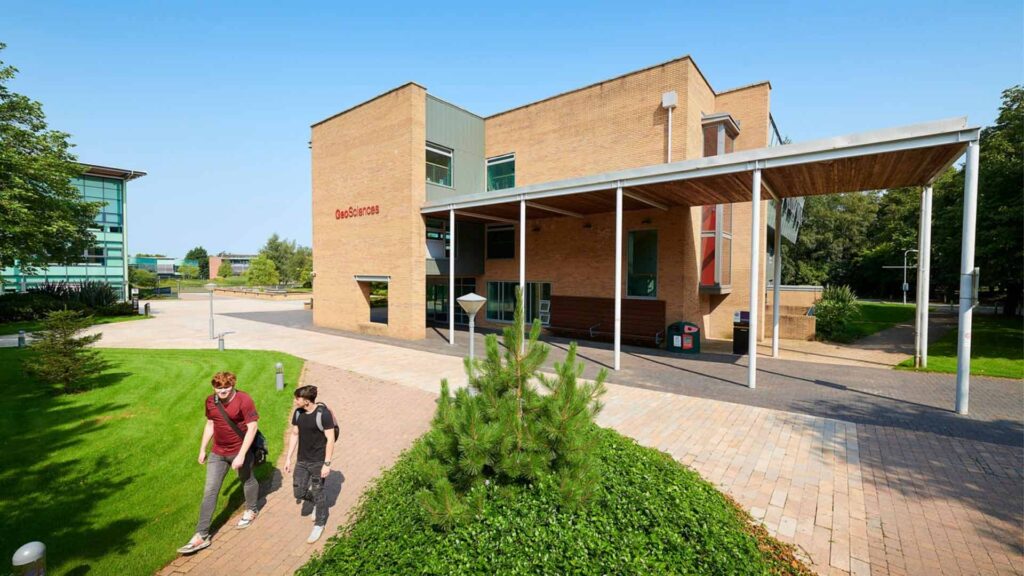
You’ll mainly be based in our GeoSciences building. In here, you’ll find contemporary facilities combined with a friendly and supportive learning environment to ensure that you have a rich and rewarding experience.
In the GeoSciences building, there are facilities like:
- a large lecture theatre
- small group teaching rooms
- IT facilities
- smaller tutorial spaces
- a larger social area for a more informal and interactive style of learning
Prepare for university
We know that you’re aware that you’ll be putting in hard work to study for your course when you arrive. But it’s not just academic skills that you’ll be using once you’re here. And there are a few skills that you might want to start to build now so that you’re a pro when it comes to the start of your studies in September.
- Time management – you may have conflicting deadlines as well as other personal activities to consider. So you’ll want to make sure that you manage your time well so that you can do everything you’d like to do. But, there may be times when you can’t do it all but managing your time well will help you to prioritise which activities are necessary and which you have to miss out on.
- Critical thinking – it’s important to show your true understanding of the topics you cover in lectures. And for some of this, you’ll need to critique the work you’re studying in a professional, academic manner. You may already be completing tasks like this in your current studies, so university will be a chance to enhance these skills. Don’t be afraid to share your opinions.
- Teamwork – some modules may require you to work with others on your course to complete tasks and discuss analytical findings.
- Independent work – in contrary to the above, it’s also important to be able to work independently. The majority of your work will need to be submitted individually so it’s important to take ownership of your learning. And if there is something that you don’t understand, make sure to ask your tutor.
- Self-motivation – you’ll be encouraged to work more independently which means that you won’t have a teacher that chases you up to make sure you’ve completed a piece of work on time. So it’s important that you hold yourself accountable and make the decision to put the work in.
To remind yourself of your modules, please visit your course page:

If you’d like to complete any preparatory reading, you can search for any reading related to your course on our online reading list.
Royal Geographical Society
If you’re thinking about a future career in Geography take a look at the Royal Geographical Society website.
Your Timetable
You will receive full timetable information from your department during Induction Week.
Ahead of this you can access the provisional course timetable on Student Calendar. You will need to select Courses from the drop-down menu, search for your course in the Resource(s) box and find the year one timetable from the list. Then just use the arrows to scroll forward to your course start date.
If you are going to be studying part-time with us, please look at the individual module timetables according to your planned curriculum.
Please note that all timetables on Student Calendar are subject to change. Check back regularly for updates.
Materials you may need:
It’s a good idea to wait until you start your course to buy any books or specific equipment as your tutor will be able to provide more details about what is essential. And our library may be able to provide you with reading materials. But there are a few things you may want to consider.
- Academic diary – a staple to help you with your time management as well as upcoming tasks in both your academic and personal life. You’ll need to add in your first residential field class – your tutor will share these dates with you when you join us.
- Notepads and pens – some people prefer to do this digitally rather than on paper, whichever you prefer, make sure you have the resources to complete any notes you’d like to take. If you like to write on a physical notepad, consider an A5 size so that it’s easier to carry around.

And of course, anything else that you like to use for your academic studies, like highlighters, flashcards and folders.
Before you arrive, check out our UniSkills workshops. These sessions are designed to help you to build the academic skills that you’ll use throughout your time with us and beyond. Keep an eye on your emails for more information.
Making friends

Starting somewhere new can feel daunting and that is completely normal. Once you arrive, you’ll be able to find out what activities and clubs/societies are available for you to get involved with. These are the perfect way to meet like-minded individuals who share your passions.
Make sure to use our Students Life portal keep up to date with all the student events happening at Edge Hill.
Your department contact
Accessibility
At Edge Hill, we want you to feel supported and comfortable so that you can thrive. To help you achieve your goals, we offer a wide range of resources, both online and on campus.
Through our Assistive and Accessible Technologies Toolkits, all students have access to software and apps on their devices, including Mind Mapping, Text-to-Speech, Help and learn, and Note-taking on their devices. You can find out how to use these toolkits here:
Assistive technology | Library and Learning Services | Edge Hill
We pride ourselves in being accessible to all, helping you make the best out of your university experience. With over £350m invested, Edge Hill offers state-of-the-art facilities, dedicated study spaces and on-campus accommodation.
We also have created a range of guides to help you plan and navigate life at Edge Hill. You can gain access to these guides here:
Accessibility on Campus – Edge Hill University
Our Brand
Earlier this year, Edge Hill’s brand evolved, introducing a fresh, modern look while continuing to represent our suffragette roots and pioneering spirit. The rebrand is not a reinvention, but a progression. An evolution of our identity, not an erasure of our past.
It builds on what has always made Edge Hill distinctive, expressing who we are today with greater clarity, confidence and ambition. Our brand honours our heritage while looking decisively to the future.
We are excited to introduce our rebrand to you and you can learn more about our brand story here: