Eleni Liami
MBChB Medicine with Foundation Year
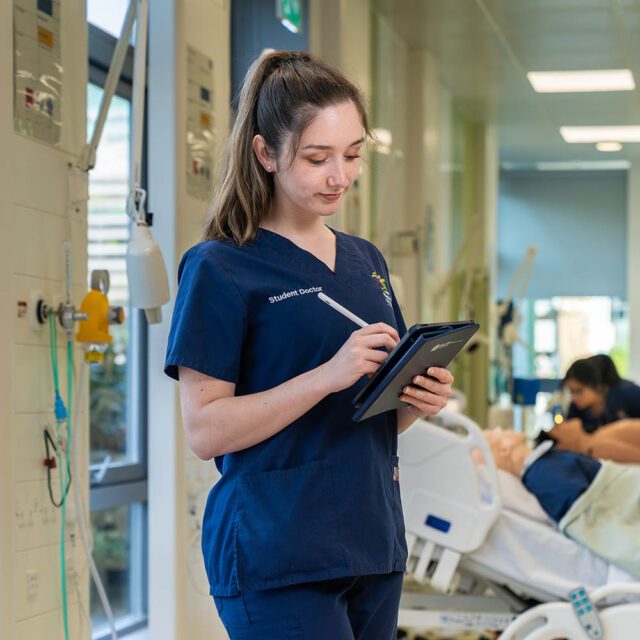
In Year 1 you have multiple one-day placements. These focus on different aspects of the healthcare system, from mental health services to home-care services. In Year 2 you have four one-week placements. These include GP, psychiatry, general medicine and general surgery. It was really cool being in theatre for the first time.
I’m passionate about helping people. I grew up on the same island as [Father of Medicine] Hippocrates – Kos, Greece. It inspired me to look into medicine. I’m fascinated by the biology, and I like the idea of being able to make decisions and as a leader, having the responsibility of someone’s care.
Studying Medicine is about constantly adapting and figuring out what works for you. Medicine is very content heavy, and I think a lot of students learned that what worked for them in high school/college, might not work for them at university. Even the jump from Year 1 to Year 2 (physiology to pathophysiology) may mean you have to change your revision strategies, but we help each other out, and our teachers have shown us different ways to revise.
I want to be a paediatrician. Looking into the career path for this, you have to learn all of medicine and then specialise. I’m determined to become a paediatrician, but I’m keeping an open mind as I’m enjoying exploring all specialties.
I had a good gut feeling that Edge Hill University was the place I was meant to be. I researched every possible university online, but the biggest part of my decision-making was Open Days. I didn’t know Edge Hill offered medicine – it’s a very new course – but when I found out I could study here close to home, I added it to my list of Open Days. Some universities were top of my list, but after going to an Open Day I changed my mind. When I came to the Edge Hill Open Day I fell in love with the beautiful campus.
Edge Hill has an impressive Clinical Skills building where we have the opportunity to run life-like simulations to play out scenarios, and practice examinations on each other. The health building, where all our lectures are, is very welcoming, with a foyer where conferences take place, classrooms with loads of windows to let the light in, and microwaves for all the people that meal prep. The Catalyst is my favourite library; open 24/7 for students, very modern and designed with students in mind, and a pretty rooftop.
Edge Hill placements range from hospitals to GP practices to prisons and fire stations. I’ve enjoyed them all. From Year 1 they make sure you observe various aspects of the patient journey from different perspectives, and in Year 2 you have a deeper understanding of patients’ pathologies, so your placements are slightly longer.
In Year 1 you have multiple one-day placements. These focus on different aspects of the healthcare system, from mental health services to home-care services. In Year 2 you have four one-week placements. These include GP, psychiatry, general medicine and general surgery. It was really cool being in theatre for the first time. And Last year I successfully applied for a summer research internship and now I have two publications on the way, which should help with job applications.
You’re mainly based in one hospital in Years 3-5. Unlike other universities which switch you around every month, at Edge Hill you’re based in the same hospital for three years. You still get to do specialty rotations at different hospitals, but you’re mainly based in one. It means you get to familiarise yourself with the hospital and the staff.
The University ensures that we have the best quality of teaching. We have the same teachers for recurring themes such as anatomy and public health, so we’re familiar with our lecturers. However, because medicine is so vast, when going through the different systems we have a consultant specialist for example, when studying the heart we’re taught by a cardiologist.
I did a summer internship at the University.
Edge Hill medical school has small class sizes. It’s unusual and has a lot of advantages. My class has less than 30 students, and there’s such a friendly environment, and a closer relationship between staff and students. Now that the medical school is accredited it’s expanding, however it’s still not as big as other universities. I imagine in the next few years the classes might grow to 100, but still smaller than the 300-500 cohorts at other universities.
When I graduate I want to stay in the North West. Edge Hill encourages students to graduate and return to help the community that they grew up in. I’m very passionate about paediatrics, however general practice is slowly growing on me. I’ve always said the end-goal is to work at Alder Hey, however I’m trying to just take it one step at a time.
I’ve lived on campus for three years and I love it. The accommodation is modern, spacious, LOADS of storage space, you get a cleaner coming in for the communal spaces, and the kitchens are so big. I’d say the only downside is there aren’t any options for a double bed. I’ve stayed in Graduates Court and Palatine. This year I was in my favourite, Woodlands. They call them town-houses, with the kitchen/living area downstairs and bedrooms upstairs (as opposed to rooms and kitchen on each floor). The best thing is it includes its own washing machine.
When the sun is out the best place to be is on the grass right outside the library. When the weather is nice they leave out games for students, but it’s also a pleasant place to revise while getting some vitamin D.
I’d advise anyone doing medicine to have at least one hobby, even if it’s just an hour a week. As the academic side has got more difficult, I’ve focused on maintaining one society, which is my favourite: dance. The society hosts free dance classes every week, and a showcase at the end of the year. I take part in the commercial and heels routines every year, as well as choreographing my own pieces. During my foundation year I was involved in the British Sign Language (BSL) society which was useful, as well as the volleyball society which was fun. It’s important to maintain a work/life balance. People have different beliefs, but as a Greek Orthodox, it’s important to me to try to read the Bible once a week. There are a lot of different religious societies on campus that people can join. Check them out during Welcome Week or on the SU website.
I’m president of MedSoc this year, which I’m excited about. Other medical societies include paediatric and neuropsychiatry. We host parties and events throughout the year where different year groups get to mix, such as weekly badminton, and the Medball where everyone gets to dress up. We’re planning on expanding our events next year as well as teaching sessions. And everyone loves to wear our merch, especially our MedSoc fleeces on placement.
I’m most productive in the mornings. I make sure I go to the campus gym in the morning before class. I spend a lot of my time revising, but I manage a decent social life outside of med school. I tend to see my partner once or twice a week, and I like to arrange pub nights with friends every now and again. I also have a part-time job over the weekend at home, and spend time with my family afterwards.
The new SU looks really modern. I don’t have that much spare time, but I can see myself going a lot more if they continue to implement the street food market – Laros Greek food has my heart. During Welcome Week Freshers they always put on really cool events – my favourite being the foam party.
I’ve not seen a show in the Arts Centre yet, but I have performed there with the dance society for our end-of-year showcase. It’s also where we have our dance classes throughout the year, and you can also book out your own studio whenever you want to work on your choreography. Going out with my friends, we tend to put on 2000s girl pop to get us in the mood. My ideal festival line-up? I’m a fan of Ariana Grande, but even icons like Shakira would be cool, or some artists from Greece like Eleni Foureira.
I went swimming with manta rays. I went to Hawaii for a couple weeks during my gap year. That was pretty cool. I also went up Mauna Kea and saw the milky way, and danced at a luau. I want to explore as many places as possible. As a doctor I’m going to be really busy, so I’ve been cramming in loads of holidays and solo trips round Europe throughout med school.
How do you know if studying Medicine is right for you? You need to consider how long the course is, and why you want to do it. So get some exposure. If you know anyone in healthcare see if you can shadow them, or try and arrange a placement through your college. Say yes to every opportunity to expand your personal statement. The application process can be stressful, so if you get an offer make sure you prepare properly for Multiple or Mini Interviews (MMIs), they’re important, but there are plenty of resources on YouTube. Money shouldn’t be the main drive for studying the subject.