
If you’re thinking of the next step after your undergraduate degree or you’re ready to upskill or change your career, then postgraduate study should be on your radar. You can choose from a taught course, research degree or postgraduate teacher training. Whatever route you choose, you’ll have a lot to gain from postgraduate study, and you don’t have to take our word for it, you can hear it straight from some of our students.
Follow your interests
Many students choose to continue their studies because they enjoyed their undergraduate degree and want to explore their chosen subject in more depth or specialise in a particular area. With postgraduate study you’ll take your subject knowledge to the next level, learning from academics with proven expertise and extensive experience. Many of our taught Masters include work placements or work experience as a central part of the course, which means combined with our industry connections you’ll be well prepared when it comes to applying for jobs.
“I was looking for a Masters degree that offered me a theoretical background combined with practical experience. A firm in Newcastle wanted someone with a degree, but who also had skills and experience within the industry, which is what this MSc has given me. The course really is second to none in terms of skills preparation and real-world experience. Without that opportunity to get hands-on experience, I don’t feel I’d have got my job.”

Boost your career
A Masters degree can enhance your CV and help you stand out from the crowd in a highly competitive job market. It demonstrates dedication, commitment, and a passion for your field. And you’ll gain an important range of skills including teamwork, problem solving, critical thinking and data analysis. All of which are desired by employers and can springboard you into more senior or specialist roles that have a higher pay scale. A postgraduate research degree can lead into an academic career and if you have the passion to inspire others, by studying a PGCE you can expect a minimum starting salary of £32,916 as a primary or secondary school teacher.
A relevant postgraduate degree may give you an advantage over graduates without advanced qualifications when applying for jobs. 97.7% of taught Masters graduates at Edge Hill are in work or further study 15 months after graduation (Graduate Outcomes data released 2025 from 2022/23 graduates). And 98.1% of our PGCE graduates are in work or in further study 15 months after graduation too (Graduate Outcomes data released 2025 from 2022/23 graduates).
As well as enhancing your employability, postgraduate study also increases your earning potential, particularly your lifetime earning potential. So, not only are you likely to earning more than those with just an undergraduate degree, but the amount you’ll earn over your whole career is likely to be higher too.
Start something new
Sometimes we find ourselves in job roles or career paths that aren’t necessarily what we want to do. For those whose undergraduate degree is a more distant memory, career dreams may have been put on hold. Postgraduate study gives you the chance to retrain for that job you’ve always wanted, or you can study a subject that has interested you since childhood. Whatever your motivation, a postgraduate qualification gives you the opportunity to reset your career.
You don’t always have to have an undergraduate degree in a specific subject either. Conversion courses are designed to get those new to a subject area up to speed and ready for careers in the sector. In addition, we offer courses with flexible entry criteria including courses that accept experience in lieu of an undergraduate degree. Conversion courses include, our MSc Psychology (Conversion) which is ideal for those wanting to take the first step to becoming a psychologist. If you’re more drawn to cutting edge technology than human behaviour, our MSc Computing will ensure you’re ready for a career in IT, no matter what your first-degree background. You also have the option of choosing a postgraduate course related to your undergraduate degree, specialising in a particular area or deepening your understanding of the subject.

“I fell in love with solving technical problems and I decided to look for courses online. I was fortunate enough to find the MSc conversion course at Edge Hill University. My course is for people who don’t have a technical background. I have studied topics like software engineering and computer architecture. In one year, you can literally turn your life around through postgraduate study, but you need to make it count. After graduating, I would love to apply the knowledge that I have gained from my degree into real world applications.”
Make a contribution
Postgraduate study can also provide the opportunity to move into academic research, either after a Masters or directly from an undergraduate degree.
If you are fascinated by a particular subject, and have an enquiring mind, a postgraduate research degree is your opportunity to transform your passion into the foundation of a professional career.
Studying an MRes or PhD means you’ll be focused on research. You’ll systematically investigate a specific subject matter with the purpose of gaining new knowledge, establishing new insights and reaching new conclusions. Depending on your chosen topic, you might conduct research in the field, in archives or museums, or in laboratories. By the time you’ve completed your postgraduate research degree, you’ll have made an original contribution to the knowledge and understanding of your chosen subject.
Personal progression
One of the greatest benefits of postgraduate study is your own personal development as you take on the intellectual challenge. Self-discipline, self-motivation, time management, and adaptability are just some of the transferable skills you’ll secure during your studies.
For most postgraduate courses, a dissertation or research project forms part of your final grade. While it may seem challenging at first, this means you can showcase your knowledge and understanding, as well as your ability to think critically. Don’t worry, you’ll be allocated a personal tutor who will assist you throughout the process. It’s a great opportunity to set your mind to something and reap the benefits when it’s complete.
Developing your expertise and immersing yourself in a subject you’re passionate about can be extremely rewarding. You’ll learn with motivated course mates that bring their own perspectives and experiences. Developing and gaining new insights throughout the learning process.
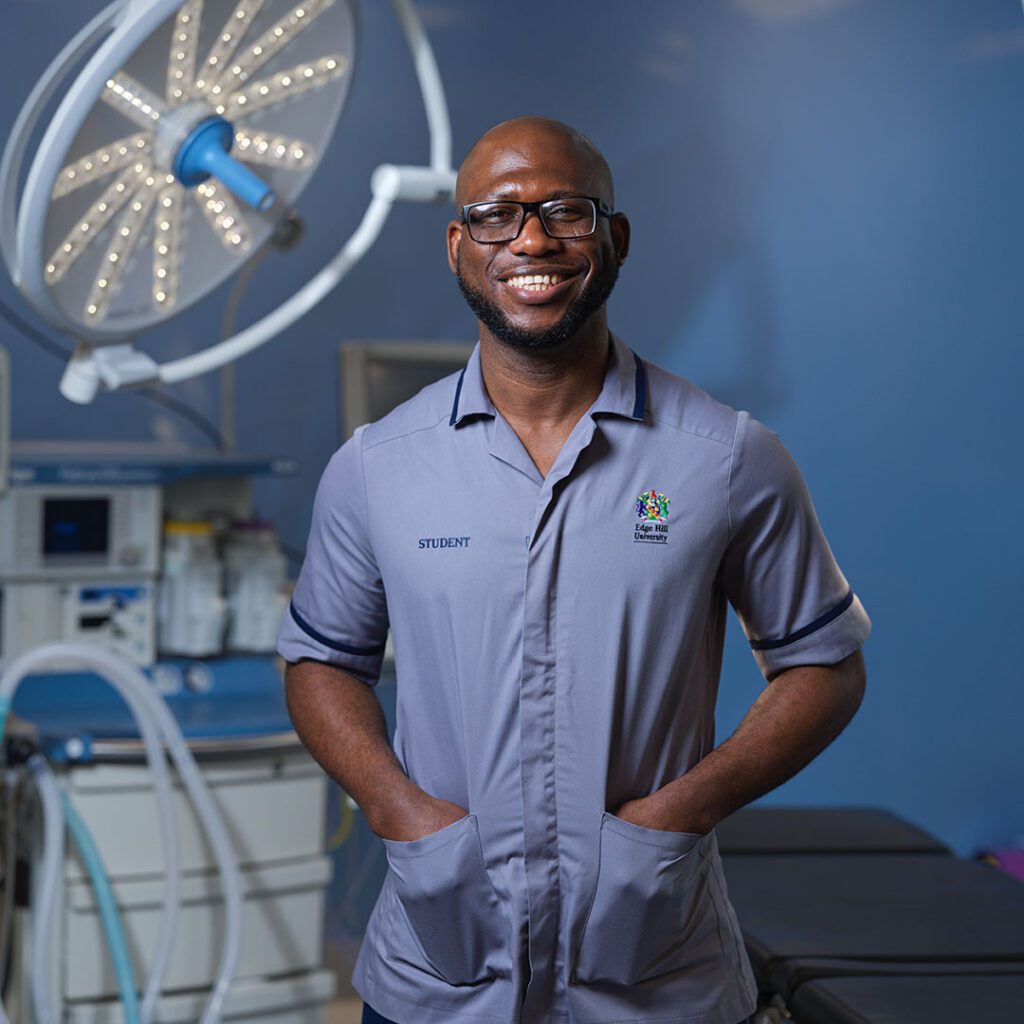
“You’re always assured of continuous learning which makes nursing unique –It isn’t a walk in the park, but in the end, when you look back on the great difference and the positive impact you make in people’s lives and the smiles you put on the faces of your patients, you’ll be glad you did take up the challenge of being a nurse. I’ve started thinking about how we improve the nursing profession in the 21st century. I want to use my expertise and valuable skills to contribute to the body of knowledge in the nursing profession. How do we ensure that our nurses are well cared for, in the same way we care for our patients?”
Choose your next move
You’ll be able to find a postgraduate study option that fits around any existing commitments you have. Most of our provision at postgraduate level offers both full-time and part-time routes and, in some cases, online study options too. Studying full-time doesn’t necessarily mean students are expected to be on campus five days per week, many full-time routes can be as little as two half-days of teaching, but this will vary depending on the course.
Find out more about your postgraduate study options.
Visit us
Contact us
For further information about any of our postgraduate courses, please get in touch with our Course Enquiries Team, who will be happy to assist you.
February 26, 2026