Criminology BA (Hons)
UCAS code: M900
There’s never been a better and more exciting time to study criminology- the UK has a skills shortage of social scientists with critical understanding of social harm and social justice issues. You will be guided by staff whose research and policy expertise provides critical perspectives on fascinating wide-ranging criminological issues. Our criminology programme ensures that you develop the knowledge and skills you need to make a positive contribution to society in the graduate career of your choice.
Overview
| Course length: | 3 years full-time |
|---|---|
| Start dates: | September 2026 September 2027 |
| Location: | Edge Hill University |
| Example offers: | BBC-BBB (A Level) or DMM (BTEC)112-120 UCAS Tariff points View full entry criteria |
| Subject(s): | Criminology |
| Faculty: | Arts and Sciences |
| Department: | History, Geography and Social Sciences |

What are the role and functions of the criminal justice system in contemporary societies? How do factors such as ethnicity, gender or class impact on the way in which it works for individuals and communities? Are the harms caused by corporations or governments ever seen as ‘crimes’? Join us to explore real-world questions from both theoretical and practical perspectives.
Our criminology degree shines a light on policing, punishment and the courts but goes much further. You’ll explore the full spectrum of crime, from antisocial behaviour, domestic violence and abuse to corporate crime, genocide and state crime while gaining the opportunity to challenge authority and develop ‘critical empathy’ for those that are marginalised.
We’ve been teaching criminology since 1987, making us one of the UK’s most experienced universities in the subject. Our research has shaped debates on issues like Hillsborough, crime and music, criminology and popular fiction, and pharmaceutical harms. As we approach our 40th anniversary in 2027, our teaching and research continue to break new ground.
You’ll learn from criminology experts with decades of teaching experience, many of whom also bring insights from professional backgrounds in policing, prisons, and children’s rights. Our research-led teaching brings their specialisms directly into the classroom, creating a vibrant, engaging, and contemporary curriculum that challenges you to think critically about crime, power and social justice.
We’re also dedicated to helping you shape your own learning journey. As you progress through the course, you can tailor your studies to match your interests and career ambitions. You’ll also have the chance to select innovative modules, including those that explore the fascinating link between crime and music.
By the time you graduate, you’ll be well-equipped to challenge dominant narratives, advocate for meaningful change and make a real impact in your chosen career.
Course features
-
International students can apply
-
Sandwich year option available
-
Studying abroad option available
-
Work placement opportunity

What you'll study
In the first year of your criminology degree, we’ll introduce you to the key concepts and perspectives in criminology. This includes studying and understanding how ‘crime’ and harm are generated in contemporary societies, as well as examining historical developments in crime, policing, and punishment. We’ll help you to analyse official responses to ‘crime’ and you’ll develop your all-important critical thinking skills, which will set you on the right path for your next two years of study.
Take a closer look at the wider social, historical, political and theoretical context of the laws relating to crime, including how serious harms are – or are not – criminalised. In your second year, you’ll be able to apply critical theory to contemporary debates around criminal and social justice and debate its relevance to issues such as climate change. Optional modules cover diverse subjects including how ideas about ‘race’ and ethnicity help shape and determine societal responses to perpetrators and victims of crime; how violence – including political violence – presents as a spectrum, and how media shape our understanding of what ‘crime’ is. Finally, we will help you to gain skills for undertaking your independent research in preparation for Year 3 dissertation.
The final year of your criminology degree gives you the opportunity to choose from a variety of modules and you can shape your study by delving into topics such as the politics of imprisonment, crimes of the powerful, understanding justice, rights and the state, and exploring the concept of the ‘criminological imagination’.
You will also complete a dissertation that allows you to research a topic of your choice in great detail under the supervision of one of your course tutors.
How you'll study
As well as lectures, tutorials, independent study, seminars and workshop groups, you will have the opportunity to carry out research through fieldwork and a dissertation on your criminology degree. You also have the option to embark upon a work placement to develop your employability skills and enhance your career prospects.
How you'll be assessed
Methods of assessment vary across individual modules, with a combination of coursework, presentations, article reviews, examinations, case studies and personal reflections. Methods of assessment are linked to developing key skills such as research, writing, public speaking and critical thinking.
Who will be teaching you
You will be taught by tutors whose research and teaching has a well-established national and international reputation. Our teaching is research-led, which means that it is reflective of the current state of criminological knowledge and linked to contemporary societal issues.
Where your course includes optional modules, these are to provide an element of choice within the course curriculum. The availability of optional modules may vary from year to year and will be subject to minimum student numbers being achieved. This means that the availability of specific optional modules cannot be guaranteed. Optional module selection may also be affected by timetabling requirements. Some restrictions on optional module choice or combinations of optional modules may apply.
Entry criteria
Typical offer 112-120 UCAS Tariff points. You will also need at least 3 GCSEs at Grade C or Grade 4 or above (or equivalent), including GCSE English.
Example offers
| Qualification | Requirement |
|---|---|
| A Level | BBC-BBB. |
| UCAS Tariff points | 112-120 points. |
| BTEC Extended Diploma (or combination of BTEC QCF qualifications) | Distinction, Merit, Merit (DMM). |
| T Level | Overall grade of Merit. |
| International Baccalaureate (IB) | We are happy to accept IB qualifications which achieve the required number of UCAS Tariff points. |
| Access to Higher Education Diploma | 45 credits at Level 3, for example 15 credits at Distinction and 30 credits at Merit or 24 credits at Distinction and 21 credits at Merit. The required total can be attained from various credit combinations. |
Please note, the above examples may differ from actual offers made. A combination of A Level and BTEC awards may also be accepted.
If you have a minimum of two A Levels (or equivalent), there is no maximum number of qualifications that we will accept UCAS points from. This includes additional qualifications such as Extended Project Qualification (EPQ), AS Levels that haven't been continued to A Level, and General Studies AS or A Level awards.
English language requirements
International students require IELTS 6.0, with a score no lower than 5.5 in each individual component, or an equivalent English language qualification.
Fair Entry Criteria
Our new Fair Entry Criteria is a Contextual Admissions Policy that takes an applicant’s personal and educational background into account. This policy will allow eligible applicants to receive up to a two-grade reduction in their entry requirements for this course. Find out more and see if you qualify.
How to apply
Apply full-time
Read our guide to applying through UCAS to find out more about the application process.
International
Please see our international student pages for further information about how to apply as a prospective international student.
Should you accept an offer of a place to study with us and formally enrol as a student, you will be subject to the provisions of the regulations, rules, codes, conditions and policies which apply to our students. These are available at www.edgehill.ac.uk/studentterms.
If you join a full time undergraduate degree at Edge Hill University, we will guarantee you the offer of a room in our halls of residence for the first year of your course.
Discover our accommodation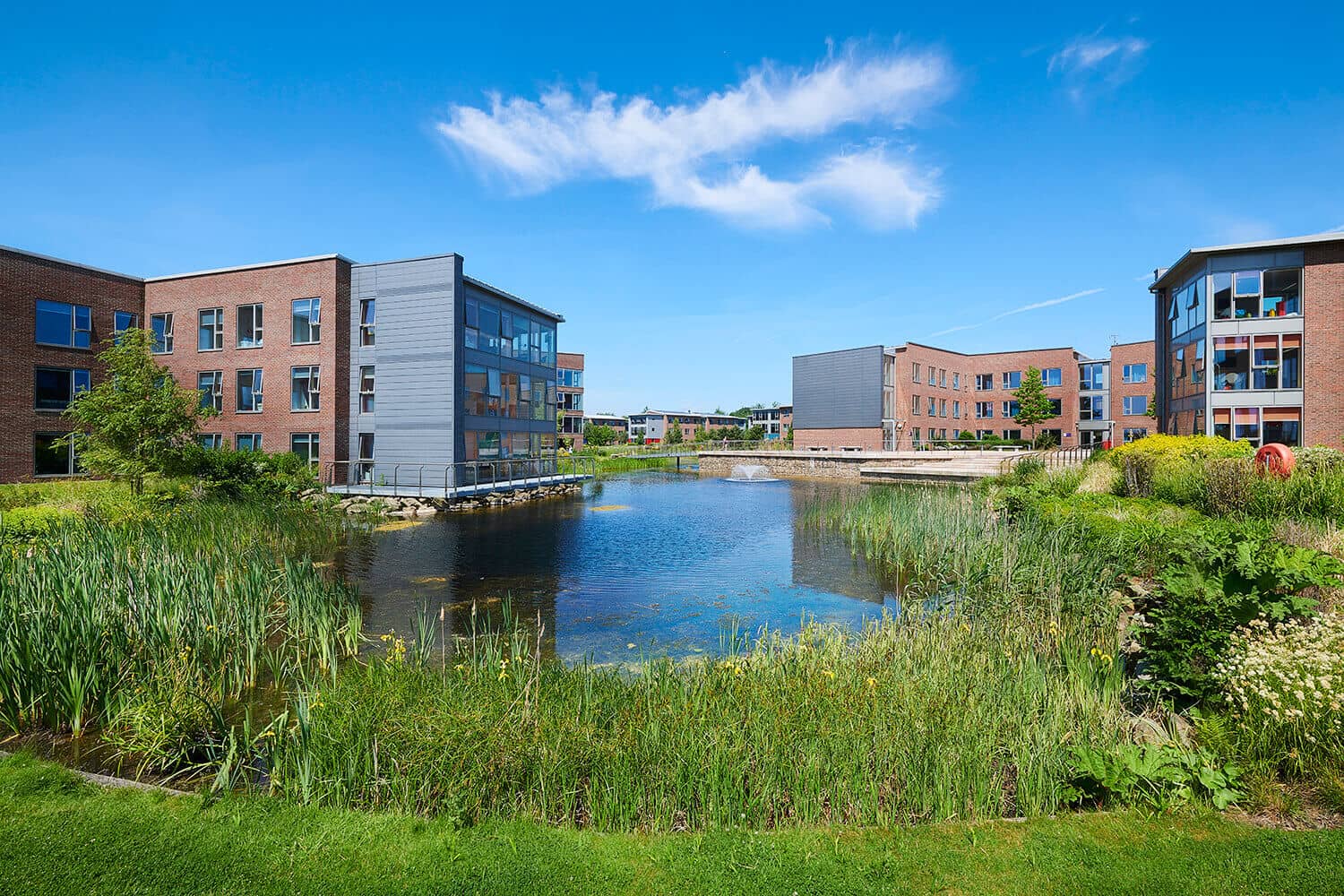
Facilities
The Department of History, Geography and Social Sciences is based in the Geosciences building. The contemporary facilities combine with a friendly and supportive learning environment to ensure that your studies are a rich and rewarding experience.
The Geosciences building features a large lecture theatre, small group teaching rooms, IT facilities and smaller tutorial spaces. There is also a large social area which encourages a more informal and interactive style of learning.
Where you'll study
Finance
Tuition fees
UK Full-Time
£9,790
a year
International
£18,000
a year
EU/EEA and Swiss students who have settled or pre-settled status under the EU Settlement Scheme, as well as Irish nationals, may be eligible for the UK tuition fee rate.
Financial support
Subject to eligibility, UK students joining this course can apply for a Tuition Fee Loan from the Government to cover the full cost of tuition fees. UK students enrolling on the course may also be eligible to apply for additional funding to help with living costs.
Scholarships
We offer a range of scholarships, which celebrate the determination, commitment and achievement of our students. Many of our scholarships are awarded automatically. There are some however, where you will need to be involved in an application or nomination process. To find out more about our scholarships and check your eligibility, please visit our dedicated scholarships pages.
Money Matters
Please view the relevant Money Matters guide for comprehensive information about the financial support available to eligible UK students.
EU/EEA and Swiss students who have settled or pre-settled status under the EU Settlement Scheme may be eligible to apply for financial support. Irish nationals can ordinarily apply to Student Universal Support Ireland (SUSI). If you are an EU student who does not have settled or pre-settled status, or are an international student from a non-EU country, please see our international student finance pages.
Tuition fees
UK Full-Time
£9,535
a year
International
£17,000
a year
EU/EEA and Swiss students who have settled or pre-settled status under the EU Settlement Scheme, as well as Irish nationals, may be eligible for the UK tuition fee rate.
Financial support
Subject to eligibility, UK students joining this course can apply for a Tuition Fee Loan from the Government to cover the full cost of tuition fees. UK students enrolling on the course may also be eligible to apply for additional maintenance loan funding to help with living costs.
Scholarships
We offer a range of scholarships, which celebrate the determination, commitment and achievement of our students. Many of our scholarships are awarded automatically. There are some however, where you will need to be involved in an application or nomination process. To find out more about our scholarships and check your eligibility, please visit our dedicated scholarships pages.
Money Matters
Please view the relevant Money Matters guide for comprehensive information about the financial support available to eligible UK students, together with details of how to apply for potential funding.
EU/EEA and Swiss students who have settled or pre-settled status under the EU Settlement Scheme may be eligible to apply for financial support. Irish nationals can ordinarily apply to Student Universal Support Ireland (SUSI). If you are an EU student who does not have settled or pre-settled status, or are an international student from a non-EU country, please see our international student finance pages.
Your future career
Our Criminology degree is incredibly flexible and provides excellent preparation for further study or a variety of careers, including:
- Adult guidance worker
- Charity officer
- Community development worker
- Counsellor
- Detective
- Housing manager/officer
- Lecturer
- Local government officer
- Independent Domestic Violence Adviser (IDVA)
- National Crime Agency
- Offender Mentoring
- Police officer
- Prison officer
- Probation officer
- Paralegal
- Policy worker
- Social researcher
- Solicitor
- Social worker
- Teaching
- Youth worker
Course changes
Every effort has been made to ensure the accuracy of this information, however our courses are subject to ongoing review and development. Changing circumstances may necessitate alteration to, or the cancellation of, courses.
Changes may be necessary to comply with the requirements of professional bodies, revisions to subject benchmarks statements, to keep courses updated and contemporary, or as a result of student feedback. We reserve the right to make variations if we consider such action to be necessary or in the best interests of students.