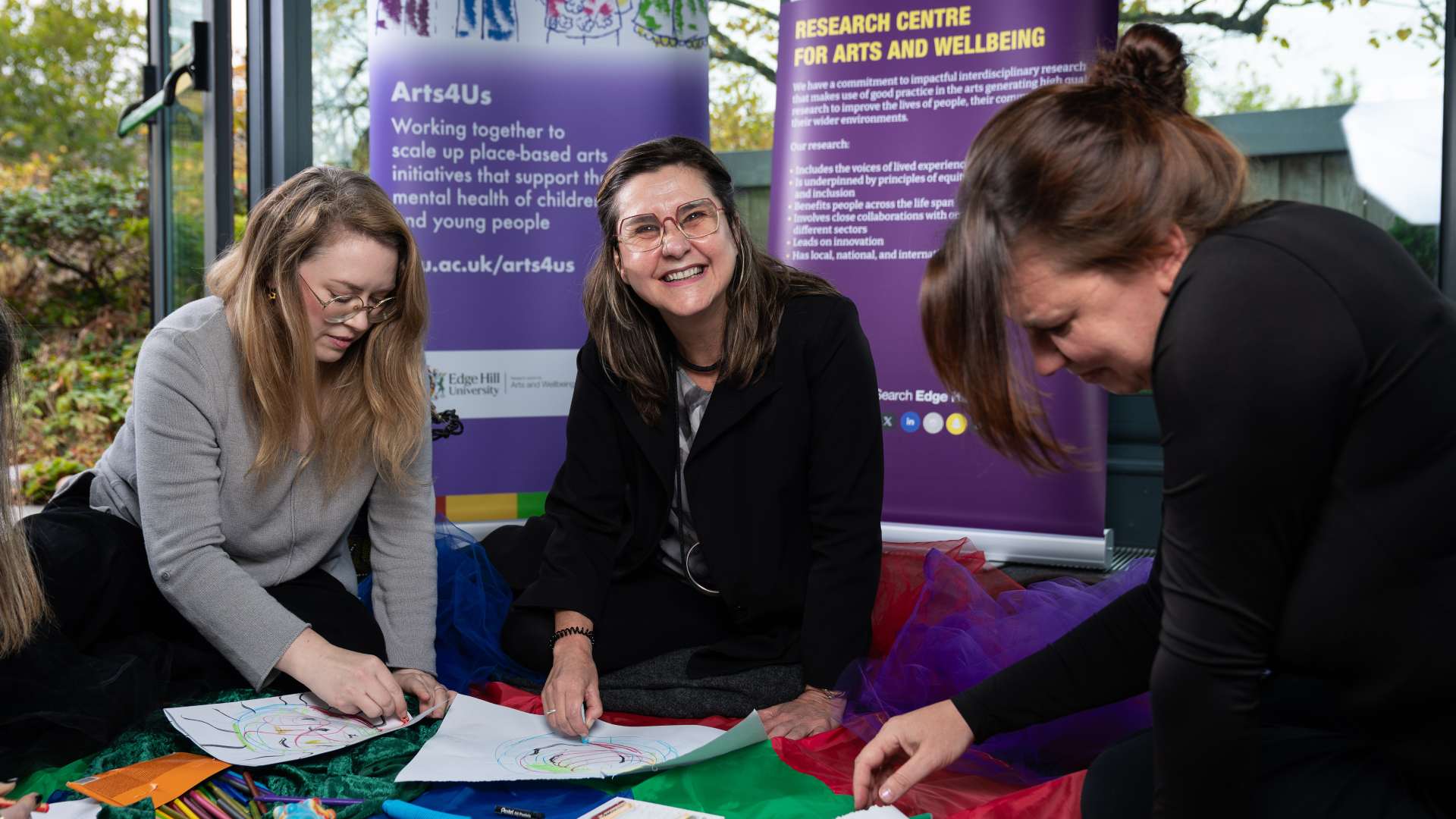
This impact story tells us about the importance of a body of research taking place here at Edge Hill University centred around ‘How the arts can boost your mood: Improving mental health and wellbeing through arts-based interventions’.
One in five people in the UK are faced with mental health problems. With similarly high rates internationally, the World Health Organisation (WHO) have declared an ‘urgent global public health crisis’ (the Lancet Public Health 2025). The Research Centre for Arts and Wellbeing (RCAW) team are leading efforts to deepen our understanding of how we can improve mental health and wellbeing through the arts. Their work is having a direct impact on mental health provision through two important projects:
- Arts for the Blues, a group therapy programme that uses the arts to help children, adults and professionals who need psychological support. The model, which has had a positive impact on people’s mental health, is developed in collaboration with the University of Salford with funding of over £2m from AHRC, ESRC, NIHR, and the EU.
- Arts4Us is creating a user-friendly digital directory of the best arts activities and arts therapies support for young people and their families living in some of the most deprived areas in the UK. With £2.5m investment from UKRI, the RCAW team is collaborating with a range of academic institutions and over 50 partners including health services, community organisations, schools, and local authorities to tackle health inequalities, enabling access to arts activities for as many young people and their families as possible wherever they live.
The Impact
Research from the Arts for the Blues and Arts4Us projects has had a direct impact on the wellbeing of many children and young people, adults with mental health struggles, and healthcare staff in urgent need of mental health support.
Prof Karkou explains how evidence-based arts projects of the RCAW are improving the mental health and wellbeing of children across the UK right now:
“Our research has transformed the lives of over 650 vulnerable children and young people, and over 300 adults with mental health problems, reducing depression anxiety, heart rate and blood pressure. We have also seen improvements to sleep quality, wellbeing and quality of life. And I’m pleased to say this positive impact lasts for up to six months after sessions finish, a clear indication that the arts, when delivered appropriately, can have lasting effects.”
Children and young people
Arts for the Blues is now:
- Part of routine delivery in Children and Young People Mental Health Services in three NHS trusts in Greater Manchester: Greater Manchester Mental Health NHS Foundation Trust, Manchester NHS Foundation Trust, and Pennine Care NHS Foundation Trust.
- Implemented in Mersey Care and Alder Hey trusts.
- Offered to ten schools in the Northwest as part of two different PhD studies, reaching 237 children aged 7-11.
- Engaging pupils in areas of high deprivation, through the charity Curious Minds. Over 200 pupils from five more secondary schools have been reached so far.
Prof Karkou adds:
“Participants really value their time in the therapy groups because of the creative experience, the friendships they make, the sense of belonging they gain, and the opportunities they have to embrace change. It’s so wonderful to see.”
A young person involved in one of the projects explained what this meant for them:
“I liked the sessions that started and finished with the same song to know that I am not in the class anymore, and to prepare me to go back to the class. The song in the end was my favourite; it made me happier and ready to go back to class.”
– 8-year-old on music rituals
Others clarified how engaging in arts therapy sessions enabled them to talk about their mental health struggles, but to also find ways in which they can be supported for their education as a whole.
“I was sharing things that I was not used to sharing with anyone else.”
– 9-year-old on movement work
They were able to also learn how to use creative activities to support their mental health after the groups finished:
“I can tell my own story through my own puppet, but nobody knows if it’s a true story or if I made it all up.”
– 8-year-old on puppet play
Since 2021, the Arts for the Blues project team has offered training in the Baltic countries, New York and Dubai, kick starting the delivery of Arts for the Blues internationally.
In 2025, training was offered to psychology students with theatre background and their tutors at the University of Coimbra, Portugal; they have since delivered several Arts for the Blues groups in local services.
Training of creative therapists, psychologists and medics from Nepal, India, and Bangladesh has been included in an extensive multi-site evaluation funded by ESRC and led by Queen Mary University of London. This study reviews how effective Arts for the Blues is as mental health support in care homes for rescued child labourers.
Discussions with WHO Europe have led to securing European Union funding to implement creative work in Eastern Europe in 2027; the first countries are Armenia and Moldova.
“When I do abstract [painting] it just brightens the colour and my mood and makes everything feel bright.”
– 10-year-old, using a local charity
Arts4Us has amplified the voice of over 120 participants including young people and their families, highlighting their needs and their arts preferences as well as their concerns and aspirations. Most of the young people the project has engaged come from underserved communities including those identifying as neurodivergent, looked-after children and young people, and those belonging to a minority gender or ethnic group.
Adults using mental health services and healthcare staff needing wellbeing support
Close collaboration with the University of Salford and support from UK Council for Psychotherapy (UKCP) allowed us to deliver the model to over 300 adults, leading to diverse applications in adult mental health services.
“You create whatever you want on the sound tree and then when you’re explaining it you’re more or less talking about yourself. That can actually get people talking about things that they wouldn’t have been able to talk about before.”
– Arts for the blues participant
From August 2023 to December 2023, over 20 Arts for the Blues groups have been delivered in different settings including:
- The Greater Manchester Mental Health Foundation Trust, NHS Talking Therapies (2 groups).
- The Liverpool University Hospitals NHS Foundation Trust (4 group).
- Manchester University NHS Foundation Trust (2 groups).
- Avon and Whiltshire Mental Health NHS Partnership (1 group).
- The Counselling Clinic of the University of Salford (4 groups).
- The Student Service of Edge Hill University (1 group).
- Five charities supporting adults with mental health concerns (8 groups).
Participants reported that their depression and anxiety reduced and their wellbeing and quality of life improved, enabling them to successfully meet their personal therapy goals. Clients also expressed satisfaction with the model and the delivery, while reporting they were more present with emotions, more aware of emotional states, less self-judgmental, and developed better connection with their bodies. They also reported better emotional regulation, better coping mechanisms, and felt more resilient and positive about the future.
“As soon as you let it in, you become a far better person because you understand yourself more. I actually like me now. I’ve found an inner strength.”
– Arts for the Blues participant
RCAW continues offering training on Arts for the Blues through new in person and online programmes available for practitioners and supervisors; in the last four years over 400 therapists, artists and arts therapists have completed these training programmes.
“I’ve seen shifts in people’s ability to be more themselves and to accept themselves and accept others and feel accepted by others. And that seemed to be a magical ingredient I think.”
– Arts for the Blues Psychotherapist
Impact on policy
The RCAW team’s research clearly outlines the ongoing barriers to accessing arts activities and arts therapies at a time when they are needed more urgently. Prof Karkou, with her team, continues to work with policy makers to ensure considerable steps are taken to remove these barriers, whilst promoting the importance of the arts and arts therapies in Parliament.
Evidence from Arts for the Blues and Arts4Us demonstrate the effectiveness and cost efficiency of arts activities and arts therapies and have achieved major impacts not only in the Northwest of England but also in influencing national policy at scale. Professor Karkou presented evidence on arts activities and arts therapies at the All-Party Parliamentary Group on Creative Health, chaired by Dr Simon Opher MP. Arts4Us and Arts for the Blues provided evidence in a roundtable discussion at the House of Lords and was featured in a question raised in the parliament during Prime Minister Question Time that sought the Prime Minister’s support for the group’s campaign for creative health. Both projects were featured in a Policy Briefing that was shared to all members of the houses of Lords and Commons.
In addition, the RCAW team’s economic evaluations of the benefits from arts-based interventions for health and wellbeing have generated an important economic argument for the value of creative interventions. For example, through commissioned research by the Arts Council of Wales the centre evaluated the economic benefits of arts for the population of Wales through productivity. Every £1 invested in the arts saw an £11 return on investment. Soon after the publication of the economic evaluation commissioned by the Arts Council of Wales, the Welsh Government announced an increase in funding for the arts sector of £8.94 million.
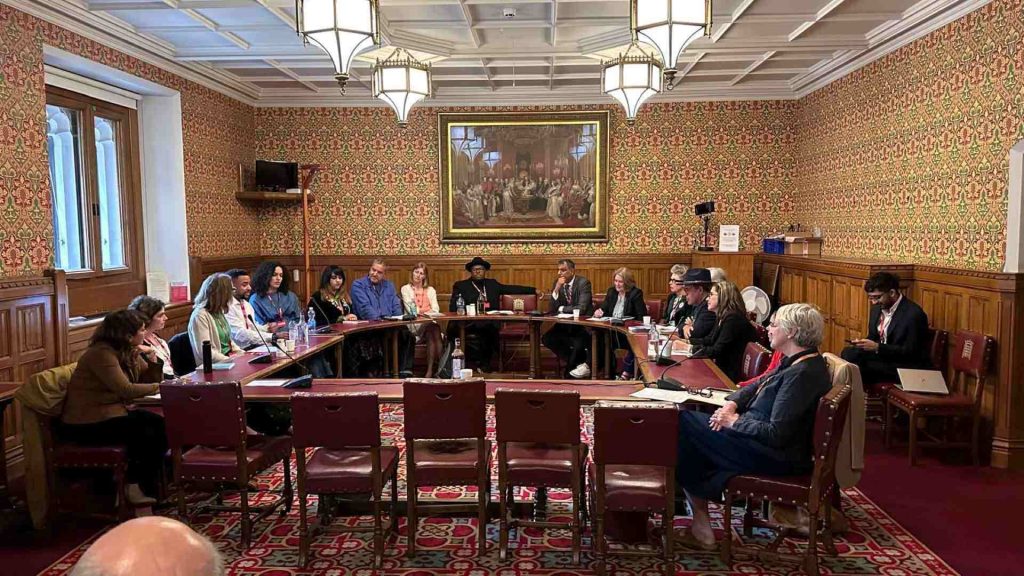
The RCAW team’s economic evaluation studies featured at the National Centre for Creative Health webinars on the 27th March 2026, which are expected to create a strong argument for the economic value of investing in the arts as a health resource.
Key research findings are also currently contributing to two additional UK policy reports with national impact:
- An independent review into mental health conditions, ADHD and autism, prepared for the UK government in the form of a policy report.
- The NHS England CYP Call for Evidence: Evidence-Based Interventions to Improve Quality and Performance in Child Health.
Findings have also been part of the report briefings circulated through the All-Party Parliamentary Group on Creative Technologies to all Parliamentary members, and featured in a roundtable discussion.
While Professor Karkou and her team continue to influence national policy on the integration of arts and arts therapies in mental health provision, additional strides are also being made in international policy change:
- Professor Karkou is co-authoring the new policy briefing from WHO Europe on Youth, Mental Health and the Arts, making a significant contribution to this report through the work of RCAW on evidence synthesis produced under the Arts4Us project.
- In early 2026 Professor Karkou presented Arts for the Blues and Arts4Us at the Arts on Prescription conference organised by the Ministry of Culture in Greece to celebrate legislation changes to enable arts on prescription and continues to work with the Ministry of Culture on arts and therapy-related policy.
The Research
Arts for the Blues
This evidence-based creative psychological group intervention has been developed following the Medical Research Council (MRC) guidelines on complex interventions. It draws on clients’ views of helpful factors from NICE-recommended approaches to psychotherapy (cognitive behavioural therapy, person-centred therapy and psychodynamic psychotherapy). These helpful factors are married with key literature and practice in arts psychotherapies, utilising music, dance and movement, drawing and drama, creative writing and poetry. As a manualised model, it has a particular structure organised around eight ingredients and four group phases, but this structure remains flexible to allow for personalised delivery that can address the needs of the participants and utilise the skills of the facilitators.
Since its original development, Arts for the Blues been tested and scaled up extensively in NHS services (see the feasibility studies in 2022 and in 2024), schools and charities, nationally (e.g., Northwest, Newcastle, Bristol) and internationally (e.g., Portugal, Nepal, Bangladesh and India).
Arts4Us
With funding from UK Research and Innovation and the Arts and Humanities Research Council through the mobilising community assets to tackle health inequalities call, not only could the Arts for the Blues scale up, but the RCAW team also expanded their research with the Arts4Us project, a collaborative £2.5m investment aiming to scale up and improve access to the arts and arts therapies as mental health support for children and young people. The first year of this large collaborative project with over 50 partners, has brought together evidence of the effectiveness and economic benefits of the arts and arts therapies. It has also helped improve our understanding of the barriers in accessing these interventions as experienced by young people, their families, especially those coming from underserved groups. To support improved access, Arts4Us is developing a digital platform that will allow children and young people, their families and different professionals from health, education, the voluntary sector and local authorities, to link to good quality arts-based interventions available in the community.
Affiliated researchers
Researchers
- Dr Robyn Dowlen, Research Centre for Arts and Wellbeing
- Dr Pui Sze Cheung, Research Centre for Arts and Wellbeing
- Dr Anna Smirnova, Research Centre for Arts and Wellbeing
EHU staff
- Dr Joanne Powell, Department of Psychology
- Dr Shaun Liverpool, Department of Social Work and Wellbeing
- Prof Michelle Howarth, Department of Nursing
- Prof Ella Pereira, Department of Computing
- Prof Andy Smith, School of Education
- Dr Helen O’Keeffe, School of Education
External collaborators
- Dr Joanna Omylinska-Thurston, counselling psychologist, University of Salford
- Prof Scott Thurston, poet, University of Salford
- Prof Nisha Sajnani, drama therapist, New York University
- Prof Daisy Fancourt, epidemiologist, University College London
- Dr Sarah Rhodes, statistician, University of Manchester
- Prof Rhiannon Edwards, health economist, Bangor University