We’re 4th in the North West (The Complete University Guide 2026 – English).
Ready to immerse yourself in language, critical thinking and linguistic discovery? Want to explore new worlds in the pages of celebrated works of literature? Sharpen your skills in communication, research and self-expression in language and literature on our English degree.
If you’re interested in applying for 2025 entry, please visit BA (Hons) English.
Our BA (Hons) English degree is designed to investigate central themes and concepts across both English literature and language. From the Brontë classics to the origins of dialects, we’ll cover over 3,000 years of literary history. You’ll also delve into areas such as sociolinguistics, grammar, discourse analysis, the history of English and gender and sexuality.
Do you want to evaluate and examine topics from literary history to language change? The flexibility of our English degree gives you the power to shape your studies. Choose modules such as Enterprise and Innovation, Modernisms or Forensic Linguistics from Year 2 onwards.
You’ll also get the chance to focus on a single author and study them extensively. Understand their writing against the historical, cultural and literary context in which they were written. In English language, you’ll examine key aspects, including its structure, sound system, history and real world applications.
Course features
International students can apply
Sandwich year option available
Studying abroad option available
The English department creates a supportive environment where you can express opinions and explore ideas without judgement. The sense of calm at Edge Hill University means I never feel lost or overwhelmed.
You’ll study a number of language and literature modules in Year 1. We’ll introduce you to the sounds and structures of English and the organisation of its vocabulary. You’ll also learn the difference between reading for understanding and interpretative reading, while delving into the development of English literature, from Old and Middle English to Renaissance drama, significant poetry and prose.
Reading will introduce you to the key skills and approaches necessary to successfully engage with academic study in the twenty-first century, providing a foundation for the exploration of English at university level. You will be introduced to a range of influential key theories from the 20th and 21st centuries, and learn how to apply these to literary and linguistic texts and approaches. You will make practical applications of these approaches to the primary and secondary texts studied on the module, including in the wider context of decolonisation.
Module code: ECW1001
Credits: 20
Assessment:
100% Coursework
An introduction to working within Arts and Humanities
An introduction to working within Arts and Humanities seeks to develop your knowledge and understanding of concepts and issues within the context of arts and humanities and the creative industries. You will develop both your understanding of contemporary employability contexts and your research skills and will also gain insight into the practice of industry speakers through presentations and workshops. The module covers a wide range of specialisms, as arts and humanities professionals operate in an industry that is constantly changing and evolving. You will also be given the opportunity to engage with career planning, in accordance to your aspirations, skills and talents.
Module code: ECW1002
Credits: 20
Assessment:
100% Coursework
Listening
Listening enables you to gain a basic understanding and knowledge of the description and classification of speech sounds and the sound system of English through study of poetry and prosody. It will also allow you to focus on associated employability skills and gain knowledge and understanding of the ways in which phonetics are directly relevant to several fields, such as speech and language therapy, second language learning, education, literary stylistics, forensic phonetics and artificial intelligence.
Module code: ECW1004
Credits: 20
Assessment:
100% Coursework
The Structure of English
The Structure of English introduces you to the structure of the English language. You will learn to use grammatical terminology to label words, clauses, sentences and structures.
Module code: LNG1016
Credits: 20
Assessment:
100% Coursework
Language and Meaning
Language and Meaning explores the different aspects of meaning as expressed through lexis and grammar. The module examines meaning in relation to the world, society, culture and attitude, and looks into how words and their meanings relate to one another. You will also investigate meaning, expressed directly or indirectly, and consider how meaning arises from the combination of lexis and grammatical structures.
New Venture Creation introduces you to business planning and the development stages in business start-up. You will organise and evaluate theoretical perspectives in a practical setting, informing your future learning processes and outcomes. A key element of the module is a review of entrepreneurial skills and small business development through theoretical concepts of enterprise, self-employment and small business management. This module creates an awareness of emergent business types and their markets, the factors behind small business start-ups, entry routes, funding, and barriers. A practical element includes foundational steps towards a business start-up project which will require you to demonstrate key skill areas such as the development stages of business planning, communication, negotiation, self-management, and problem solving. The combination of these aspects will enable you to critically engage in academic thinking and writing about enterprise, evaluate business ideas, choose one main idea, strategically conceptualise that idea, and prepare a business plan and pitch for how the idea could be brought successfully to market.
Module code: BUS1054
Credits: 20
Assessment:
50% Coursework
50% Practical
Theorising
Theorising is based around the study of key theories and methodologies which have had a lasting impact on the disciplines of English and Creative Writing. It introduces you to significant ideas in contemporary criticism which shape scholarship in the twenty-first century. You will engage with some philosophical and some linguistic approaches which reflect changing ideas about the text and which will implement your understanding of these ideas in your interpretive, critical and analytical writing. You will enhance your existing key transferable skills of reading, writing and comprehension, verbal communication and presentation and listening and information retrieval through completing this module. You will acquire a wide range of subject-specific and transferable skills, including the ability to read and apply challenging, ambitious and complex ideas.
Module code: ECW1003
Credits: 20
Assessment:
60% Practical
40% Coursework
Exploring Variation in English
Exploring Variation in English introduces how the English language is used in different ways by varied speakers. The module enables you to explore the diversity of English at the regional, national and global level. You will also focus on the methodology of linguistic research and carry out your own, small-scale sociolinguistic research project.
Module code: LNG1018
Credits: 20
Assessment:
100% Coursework
Language 1
Language 1 is ideal if you want to learn a new language, or further develop your current language skills, as an integrated part of this degree. The module will be taught in an interactive, communicative manner, using authentic materials in the target language. Emphasis will be placed on all four areas of reading, writing, speaking and listening. You will play an active role in the classes, engaging in role-plays, short conversations, videos, authentic texts and listening materials. You will also be encouraged to reflect on your own learning needs. The module accommodates varying language levels and you will be divided into groups accordingly. On enrolment to the module, you will complete a language induction form and be placed into a language level group appropriate for your prior knowledge of the language. Please note, while we will endeavour to accommodate varying language levels per module, this is not always possible. While you can join the module with some prior experience of your target language, you will not be able to study a language you are already fluent or proficient in.
Module code: TLC1010
Credits: 20
Assessment:
85% Coursework
15% Practical
In Year 2 you’ll shape your studies, selecting from both literature and language modules, or choosing to specialise in either discipline. In literature you’ll build your skills and confidence in analysing poetry, prose and drama from key literary periods. We’ll also look at fiction from across the pond in contemporary American literature. In language you’ll learn about its history and development, and may choose to explore areas such as discourse analysis or the history of English. You’ll also have the option of developing and carrying out your own research into an area of language that interests you.
Romanticism provides an introduction to texts, authors, genres and central themes from the first stirrings of what has been traditionally conceived of as the Romantic age in the 1760s, until the dawn of the Victorian age seventy years later. Poetry, the prose essay and the novel are all studied on this module.
Module code: LIT2050
Credits: 20
Assessment:
100% Coursework
Special Author 1
Special Author 1 focuses on a single author (such as Hardy or Dickens) or a related group of authors (such as the Brontës) whose works are sufficiently extensive to merit a whole semester’s study. You will examine the author’s work in the light of recent critical and theoretical approaches to authorship and canonicity and develop an ability to theorise the relationship between an author and their literary work. You will acquire a specialist knowledge of a literary period and a major writer through examination of the author’s development in relation to relevant historical, cultural and literary contexts.
Module code: LIT2051
Credits: 20
Assessment:
60% Coursework
40% Practical
History and Development of English
History and Development of English introduces you to the historical development of the English Language. The module provides an overview of English from its origins up to the present day, including changes in words and the meanings of words, grammatical behaviour, and pronunciation. You will consider the interaction between language variation and change and societal developments, including ideas of standards and purity in language, 'global Englishes', and the impact of technology, from the printing press to the Internet.
Module code: LNG2130
Credits: 20
Assessment:
100% Coursework
Analysing Discourse
Analysing Discourse takes a linguistic approach to the examination of texts, both written and spoken. You will explore the patterns of spoken interaction and the structure of written texts, and consider the importance of context in communicating meaning beyond words and sentences (known as discourse meaning).
Entrepreneurship and Innovation explores characteristics, behaviours, attributes, and skills of entrepreneurship as well as the whole process of innovation from idea to product development and the conditions that must be fulfilled for innovation to thrive. The module explores research from a number of areas to highlight the importance of factors such as social and economic capital, local and regional infrastructure and the role of government in enabling (or disabling) innovation. You'll develop your entrepreneurial skills, identifying opportunities and developing ventures. On top of this, you'll consider the risk environment including legal issues, funding issues, start-up and growth strategies. This module provides you with the ability to act entrepreneurially to generate, develop and communicate ideas, manage and exploit intellectual property, gain support, and deliver successful outcomes.
Module code: BUS2229
Credits: 20
Assessment:
50% Coursework
50% Practical
Project Module
Project Module introduces you to various employability possibilities (commercial, trade and independent publishing), fields of contemporary literary production and the role(s) possible for working in the arts and humanities. The module offers you the opportunity to engage in professional practice via an independent (group) project (assessed through individual assignments) where you will negotiate the creation of a cultural artefact and/or cultural or arts and humanities service or take an unpaid internship, that you have organised, in a professional environment. All activities will be developed and encouraged via tutorials, lectures, seminars and workshops.
Module code: ECW2000
Credits: 20
Assessment:
100% Coursework
Working with Children
Working with Children offers an overview of British children’s literature alongside an overview of stages involved in child language development. It explores theoretical and methodological approaches to the history and representation of childhood in literature and describes how children learn first through listening and speaking, being read to by caregivers and how this leads to pre-literacy and later literacy skills. The module also introduces and examines theories relating to the topics of children’s literature and child language development, including literacy.
Module code: ECW2001
Credits: 20
Assessment:
100% Coursework
In Year 3 you’ll choose from a broad range of modules to help hone your literature and language abilities. Take a step back in time with the Victorians or explore how key factors like cognition and society can affect language. Carry out independent research or examine the work of a single author. You’ll expand your critical thinking skills and understand the power of creative communication.
Independent Literature Research Project allows you to undertake an extended piece of research, on a topic of your own selection. Extended research is at the heart of English Literature as an academic subject, and, at this point in the academic programme this module provides you with an opportunity to deploy, independently, the skills and knowledge they have acquired in the first two years of the course.
Module code: LIT3015
Credits: 40
Assessment:
100% Coursework
English Language Dissertation
English Language Dissertation offers students the opportunity to undertake an in-depth personal project, under supervision, and explore and apply a range of research methodologies to your programme of study. The dissertation will require a consideration and discussion of methodological and theoretical approaches as part of the submission. The module will incorporate methodological training to develop appropriate research skills.
Language Change centres around the key question of how and why does language change. Language change can be a way through which to explore not only language and its structure, but also human (pre)history, society, cognition and psychology. Historical linguistics is therefore one of the most dynamic fields in linguistics. It deals with many of the same issues and questions as other areas of the field, such as sociolinguistics, but takes a diachronic approach to them, looking at change over time. The module will introduce you to the methods and models used in historical linguistics and you will gain an understanding of the nature and varieties of linguistic change. You will also develop an awareness of the cross-disciplinary links between historical linguistics and other disciplines such as archaeology, anthropology and genetics.
Module code: LNG3155
Credits: 20
Assessment:
100% Coursework
The Victorians at Work
The Victorians at Work recognises that Victorians saw literature as a form of social commentary. This period survey module explores Victorian prose and poetry that addressed the pressing social and cultural questions of the period, such as the impacts of industrialisation, urbanisation, scientific advance and secularisation. You will examine the work of a range of canonical and popular Victorian authors and place their writing in the relevant literary, cultural and historical contexts.
Critical Discourse Studies focuses on the critical analysis of texts (spoken or written) and shows how discourse analysis can uncover implicit attitudes, ideologies and power relations. The module examines in detail the core theoretical approaches, concepts and constructs which underlie critical discourse studies. You will gain an insight into the communication and understanding of meaning beyond the conventional sense of words and structures. The module will develop your understanding of the power of discourse to construct identities and enable you to carry out critical discourse analysis of different types of texts in a variety of contexts.
Module code: LNG3154
Credits: 20
Assessment:
100% Coursework
Modernisms
Modernisms develops your understanding and appreciation of the key features of early 20th century movements in the literary arts. Discover the writers who tried to breathe fresh life into literature for an altered fast-paced world. You will examine periodicals, short stories, fiction and poetry as new styles of writing designed to reflect the realities and hopes of a modern world.
Sexualities, Genders and Identities explores literary, linguistic and creative representations of same-sex desire and gender diversity, particularly those that challenge, disrupt or queer normative expectations, including in the wider context of decolonisation. Queer linguistic approaches, as well as those based on third-wave feminism, allow you to critique earlier linguistic analysis of language and gender which are based on hegemonic, dichotomous gender ideologies. The module will place a range of text types, such as transcripts of spoken language, historical and contemporary novels and autobiographical writings in their social and political contexts to examine the changes and continuities in queer textual representation across time and place. The language used to describe queer lives and experiences, both within the set texts and beyond them, will form an integral part of this module. You will have the opportunity to respond critically and creatively to these texts, using relevant literary, cultural and linguistic theories to inform their interpretations.
Module code: ECW3000
Credits: 20
Assessment:
100% Coursework
Greening
Greening will explore recent ecocritical approaches to literature, exploring how writing both represents and reimagines the environment. The module begins with Romantic representations of nature and its connection to human creativity. It then examines literary responses to the environmental impact of imperialism and colonialism in the Victorian period as well as twentieth-century engagements with climate change, and contemporary imaginings of ecological collapse and its aftermath. The module engages you in thinking about the impact of literary representation on significant global challenges such as biodiversity loss, climate change, and sustainability.
Module code: LIT3018
Credits: 20
Assessment:
60% Practical
40% Coursework
Forensic Linguistics
Forensic Linguistics recognises that the law is overwhelmingly a linguistic institution. Laws are coded in language and the concepts that are used to construct law are accessible only through language. Legal processes, such as court cases, police investigations, and the management of prisoners take place almost exclusively though language. Forensic linguistics concerns the application of linguistics to describe and analyse language and discourse in the legal process. This module takes a broad view of the subject in order to examine a wide interface between language and the law.
Module code: LNG3152
Credits: 20
Assessment:
100% Coursework
Enterprise Management
Enterprise Management cultivates entrepreneurial skills, fostering innovation, creativity, and strategic thinking. It immerses you in real-world business contexts, promoting adaptability and resilience. Emphasising practical application you'll develop an understanding of the intricacies of entrepreneurship. You will refine your problem-solving and decision-making capabilities and explore theoretical frameworks with hands-on experiences. The module emphasises collaboration, communication, and risk management, equipping you with the skills and mindset needed for success in the ever-evolving landscape of entrepreneurship and enterprise.
Module code: BUS3079
Credits: 20
Assessment:
50% Coursework
50% Practical
How you'll study
Teaching and learning is by lectures and seminars, workshops, group activities, independent research projects and through our online Virtual Learning Environment (VLE). We have tutors and personal tutors on hand to provide support when it is needed.
How you'll be assessed
Assessment involves coursework and formal tests or examinations. Emphasis is placed on work produced in your own time or formally presented in class. You can expect to be assessed by critical essays, short analyses, individual/group oral presentations, poster presentations, research projects, blogs and group work. In your final year you may opt to write a dissertation on a specialised linguistic or literature theme, which you will research independently with one-to-one support from an expert supervisor.
Who will be teaching you
You will study in a large department with well qualified tutors who are recognised experts in their field. You will be carefully guided, no matter what area of English you decide to study. When you choose an option module, your tutor will be an active specialist in this area, producing and publishing current research. Our staff are active in research in all taught subject areas, publishing books and articles on a regular basis. Several have been successful in winning national research awards from bodies such as the British Academy, the Arts and Humanities Research Council and the Leverhulme Trust.
Timetables for your first week are normally available at the end of August prior to enrolment in September. You can expect to receive your timetable for the rest of the academic year during your first week. Please note that while we make every effort to ensure that timetables are as student-friendly as possible, scheduled teaching can take place on any day of the week. Wednesday afternoons are normally reserved for sports and cultural activities.
Optional modules provide an element of choice within the course curriculum. The availability of optional modules may vary from year to year and will be subject to minimum student numbers being achieved. This means that the availability of specific optional modules cannot be guaranteed. Optional module selection may also be affected by timetabling requirements. Some restrictions on optional module choice or combinations of optional modules may apply.
In addition to the optional module choices listed, it may also be possible to apply to study an alternative 20-credit module in Year 2 and/or Year 3, chosen from outside the course curriculum. Some restrictions on this elective module choice may apply.
Entry criteria
Typical offer 112-120 UCAS Tariff points. No specific subjects are required.
BTEC Extended Diploma (or combination of BTEC QCF qualifications)
Distinction, Merit, Merit (DMM).
T Level
Overall grade of Merit.
International Baccalaureate (IB)
We are happy to accept IB qualifications which achieve the required number of UCAS Tariff points.
Access to Higher Education Diploma
45 credits at Level 3, for example 15 credits at Distinction and 30 credits at Merit or 24 credits at Distinction and 21 credits at Merit. The required total can be attained from various credit combinations.
English language requirements
International students require IELTS 6.0, with a score no lower than 5.5 in each individual component, or an equivalent English language qualification.
Fair Entry Criteria
Our new Fair Entry Criteria is a Contextual Admissions Policy that takes an applicant’s personal and educational background into account. This policy will allow eligible applicants to receive up to a two-grade reduction in their entry requirements for this course. Find out more and see if you qualify.
Please see our international student pages for further information about how to apply as a prospective international student.
Should you accept an offer of a place to study with us and formally enrol as a student, you will be subject to the provisions of the regulations, rules, codes, conditions and policies which apply to our students. These are available at www.edgehill.ac.uk/studentterms.
Did you know?
If you join a full time undergraduate degree at Edge Hill University, we will guarantee you the offer of a room in our halls of residence for the first year of your course.
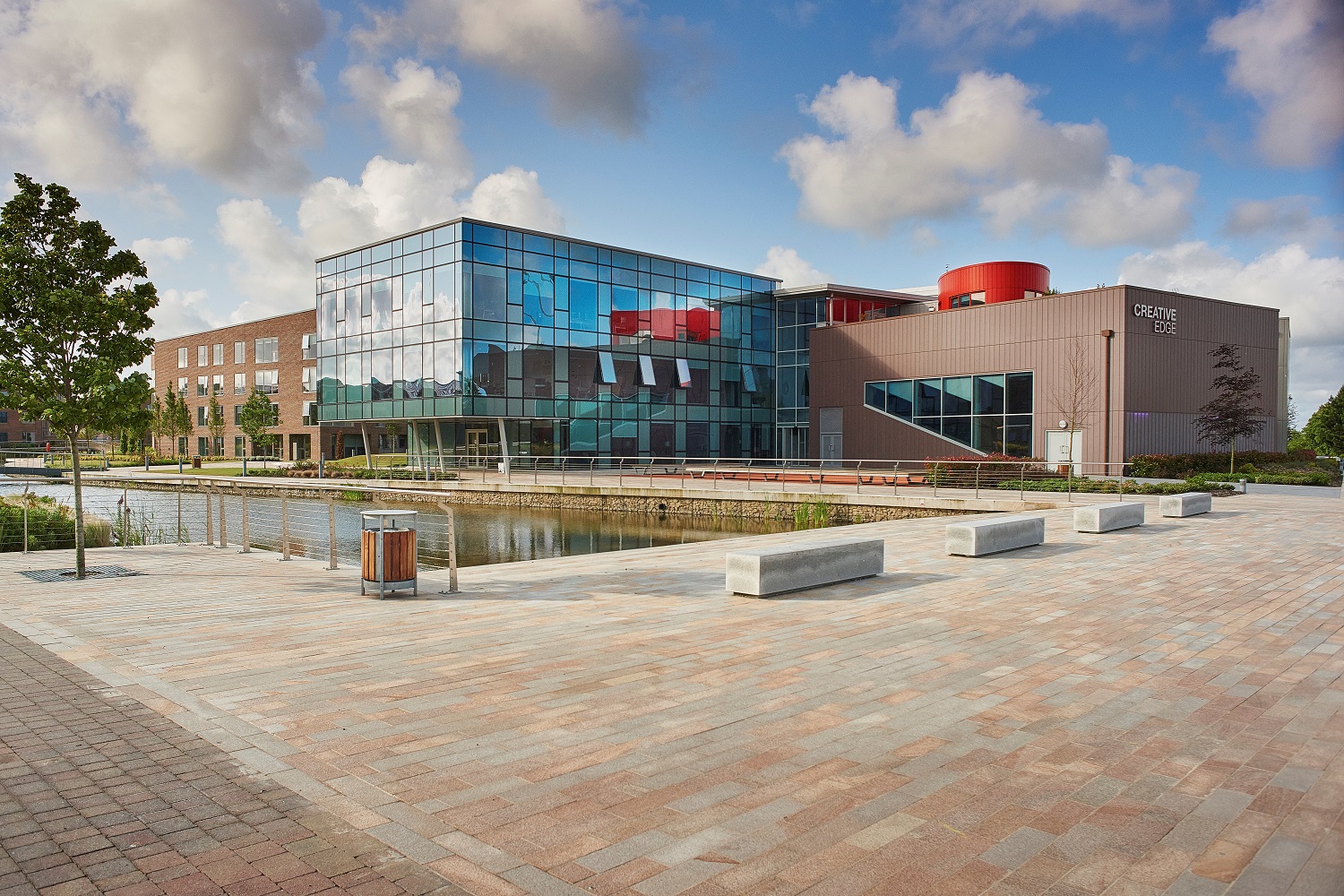
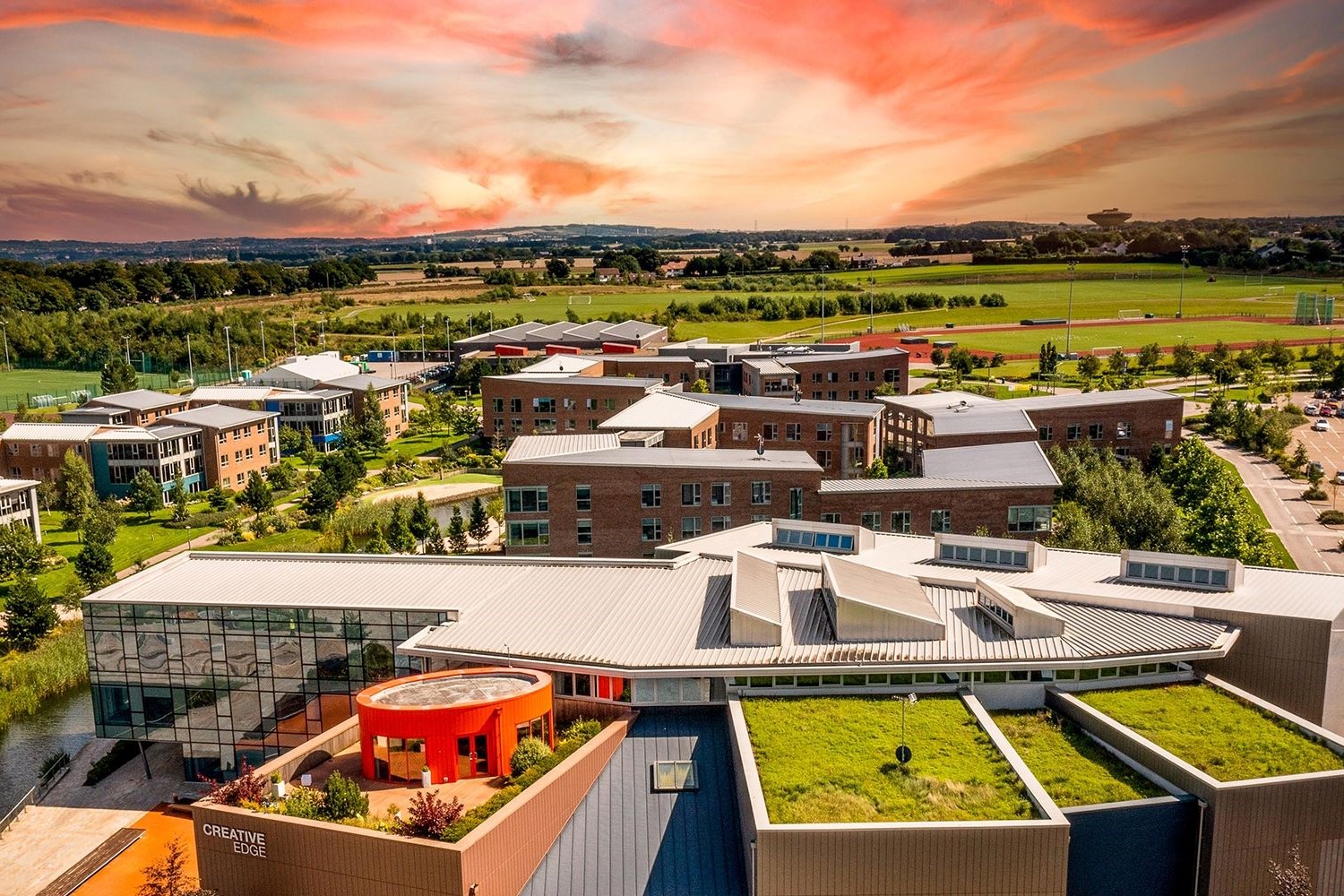
The Department of English and Creative Arts is based in Creative Edge, a state-of-the-art £17million building offering highly contemporary facilities.
The £17 million Creative Edge building features a lecture theatre, seminar rooms, IT facilities and smaller tutorial spaces. It has everything you need to become a capable, versatile, creative writer and thinker. Creative Edge’s social learning spaces are ideal for passionate discussion with like-minded creatives.
You’ll develop the practical skills, analytical tools and confidence for wherever your creative flair and insight takes you.
For the academic year 2026/27 the UK Full-Time tuition fee is currently set to £9,790. Please note this is subject to Parliamentary approval and is likely to be increased in line with inflation (RPIX). There may be further inflationary increases in your subsequent years of study. Further details can be found at ehu.ac.uk/fees.
EU/EEA and Swiss students who have settled or pre-settled status under the EU Settlement Scheme, as well as Irish nationals, may be eligible for the UK tuition fee rate.
Financial support
Subject to eligibility, UK students joining this course can apply for a Tuition Fee Loan from the Government to cover the full cost of tuition fees. UK students enrolling on the course may also be eligible to apply for additional funding to help with living costs.
Scholarships
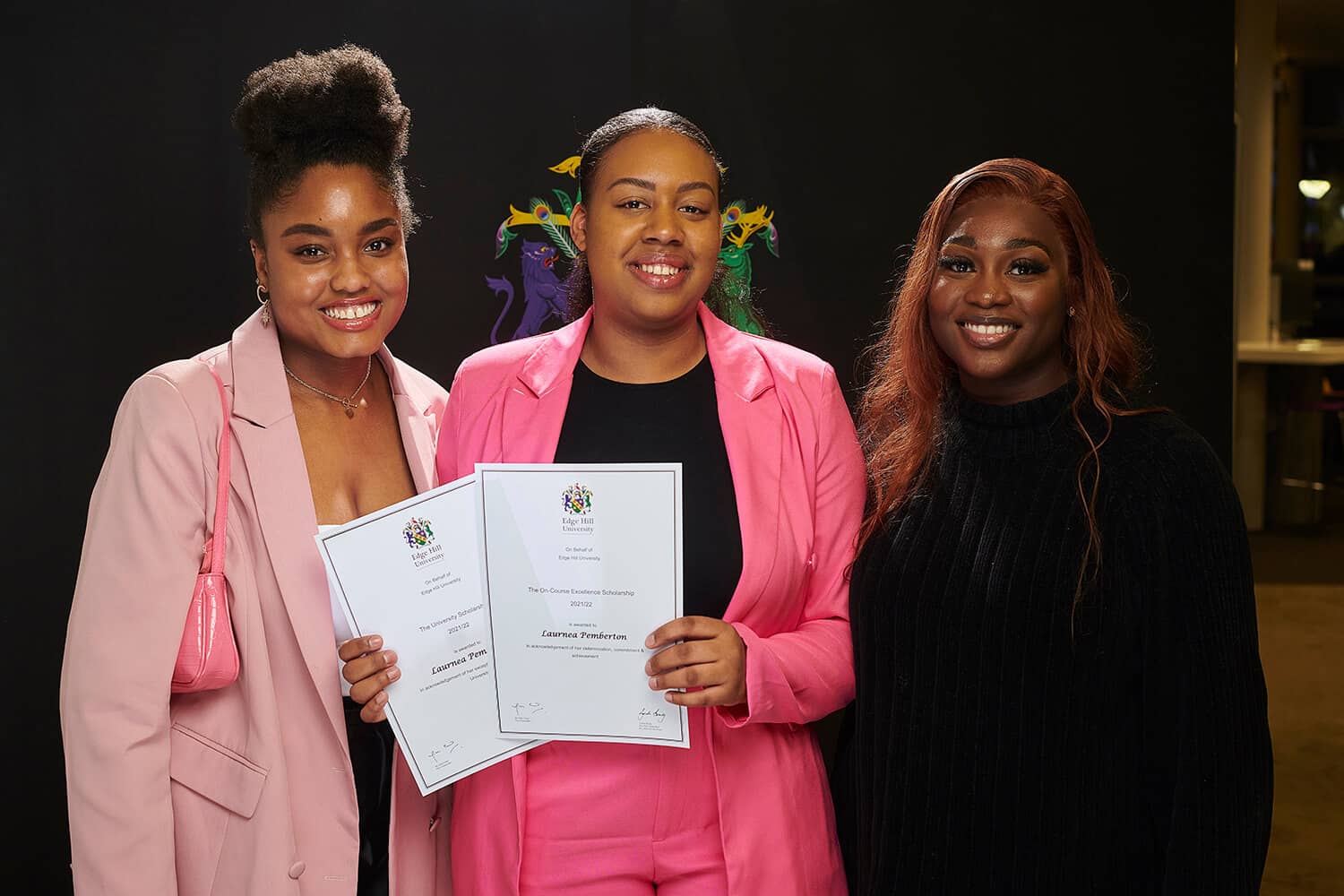
We offer a range of scholarships, which celebrate the determination, commitment and achievement of our students. Many of our scholarships are awarded automatically. There are some however, where you will need to be involved in an application or nomination process. To find out more about our scholarships and check your eligibility, please visit our dedicated scholarships pages.
Money Matters
Please view the relevant Money Matters guide for comprehensive information about the financial support available to eligible UK students.
EU/EEA and Swiss students who have settled or pre-settled status under the EU Settlement Scheme may be eligible to apply for financial support. Irish nationals can ordinarily apply to Student Universal Support Ireland (SUSI).
If you are an EU student who does not have settled or pre-settled status, or are an international student from a non-EU country, please see our international student finance pages.
Your future career
So what can you become with a degree in English? There are many options available to English graduates, who are empowered to forge their own paths. The skills gained during our degree are transferable across a myriad of industries and careers, such as:
publishing
marketing and social media
hospitality
business management and consultancy
law
journalism
public and voluntary sectors
teaching (further training required)
language or speech therapy (further training required)
Many go on to further study at Masters level and PhD, while some have filled excellent roles such as:
Senior production editor
Communications assistant
Whole school literacy coordinator
Talent coordinator
Our graduates are trained to be excellent communicators and critical thinkers. This course is a great foundation for a diverse range of careers and industries.