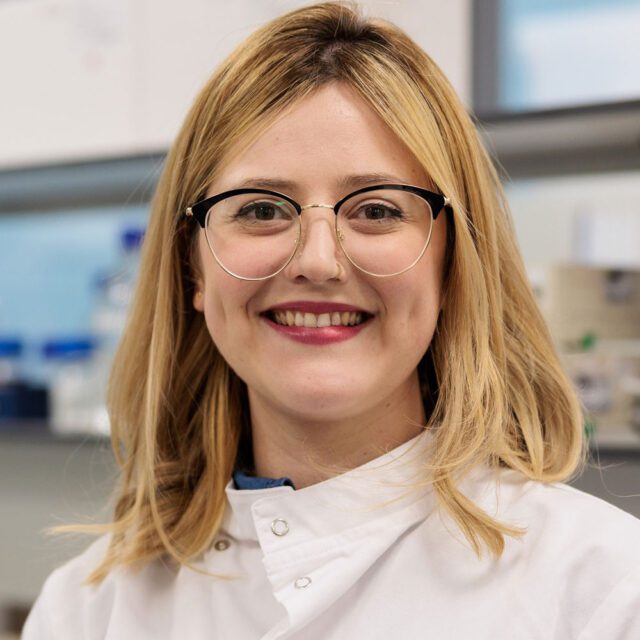
Dr Amanda Thomaz
Senior Lecturer in Biochemistry
Biology
 https://orcid.org/0000-0002-8671-5124
 Profile
Biography
In 2024, I joined the Department of Biology at Edge Hill University to establish my independent research group. I am currently a Senior Lecturer in Biochemistry, Biochemistry Programme Lead, and Head of the Cancer Neurobiology and Proteolysis Research Group. My research focuses on the molecular mechanisms driving cancer progression and treatment resistance, particularly cancer neurobiology, centrosome amplification and disruptions in proteostasis.
My scientific journey began with a degree in Pharmacy (2013), followed by a Master’s in Medical Sciences (2015) and a PhD in Cellular and Molecular Biology (2019) in Brazil. My doctoral research investigated neurotrophin signalling in medulloblastoma, focusing on the anticancer effects of selectively inhibiting the BDNF/TrkB signalling pathway. This work contributed to my broader interest in understanding the molecular mechanisms that support the growth, survival and treatment resistance of brain tumours.
Following my PhD, I joined Lancaster University, where I worked as a Senior Research Associate and Senior Teaching Associate in Biomedical and Life Sciences. My postdoctoral research focused on the chemical biology and molecular cell biology of cancer, particularly the development of targeted protein degradation approaches against proteins involved in centrosome clustering. This included investigating KIFC1 as a potential cancer-specific therapeutic target and studying the cellular mechanisms that regulate its stability and function.
I remain a Visiting Researcher at Lancaster University and continue to collaborate with researchers in the UK and internationally. In 2022, I received the North West Cancer Research Rising Star in Research Award in recognition of my contribution to cancer research. Beyond research, I am committed to public engagement and science communication. I actively collaborate with cancer charities in the UK and Brazil, and regularly participate in outreach activities, including school visits, educational talks, and lab tours, to make science more accessible and inclusive.
Research Interests
I am particularly interested in understanding the molecular adaptations that allow cancer cells to survive, develop resistance to treatment and exploit cellular processes that are less critical to healthy cells.
A major area of my research concerns centrosome amplification, a common feature of cancer cells that can contribute to chromosomal instability, tumour heterogeneity and treatment resistance. Cancer cells with amplified centrosomes depend on clustering mechanisms to avoid lethal multipolar cell division. My work investigates the proteins that support this process and explores whether they can be targeted using small molecules and targeted protein degradation technologies.
My current research examines whether centrosome amplification contributes to therapy resistance in glioblastoma and whether centrosome-associated proteins represent targetable vulnerabilities in resistant cancer cells. This work combines molecular and cellular approaches, including gene-expression analysis, immunofluorescence and confocal microscopy, protein analysis, functional cell-based assays and bioinformatic analysis.
I am also interested in the relationship between cancer and the nervous system. Building on my earlier work on neurotrophin and glutamate receptor signalling in medulloblastoma and glioblastoma, I am developing research exploring cancer–neural interactions and their potential roles in tumour progression, plasticity and treatment response.
More broadly, my research interests include:
- Glioblastoma and paediatric brain tumours
- Centrosome amplification
- Targeted protein degradation and proteostasis
- Mitotic vulnerabilities in cancer
- Mechanisms of treatment resistance
- Neurotrophin and glutamate receptor signalling
- Cancer Neurosciences
Teaching
I am Programme Lead for Biochemistry and Module Leader for Biochemistry and Metabolism and Techniques in Biochemistry. I also contribute to teaching Cell Biology and Advanced Tissue Applications and supervise research projects at undergraduate, MRes and PhD levels.
My research-informed teaching emphasises experimental design, quantitative data analysis, scientific communication and critical evaluation, helping students develop the practical and analytical skills required to work confidently as scientists.
- Moonlighting role of meiotic SYCP1 in breast cancer: A chromatin-bound regulator of DNA repair, transcription, and drug resistance
- Subgroup-Specific Associations of GRIA Genes Encoding AMPA Glutamate Receptor Subunits with Patient Survival in Medulloblastoma
- OTUD6B regulates KIFC1-dependent centrosome clustering and breast cancer cell survival
- Comment on Karaulic et al. Exploring Novel Applications: Repositioning Clinically Approved Therapies for Medulloblastoma Treatment. Cancers 2025, 17, 3659
- Possible mechanisms and biomarkers of resistance to vismodegib in SHH medulloblastoma
- Neurotrophin signaling in medulloblastoma
- Expression and pharmacological inhibition of TrkB and EGFR in glioblastoma
- Combined Inhibition of HDAC and EGFR Reduces Viability and Proliferation and Enhances STAT3 mRNA Expression in Glioblastoma Cells
- Antitumor activities and cellular changes induced by TrkB inhibition in medulloblastoma
- Targeting tyrosine receptor kinase B in gliomas