Jarod Purvis
Bioinformatics Software Engineer for Pierian Biosciences, Liverpool
Computing (Networks, Cybersecurity, and Digital Forensics)
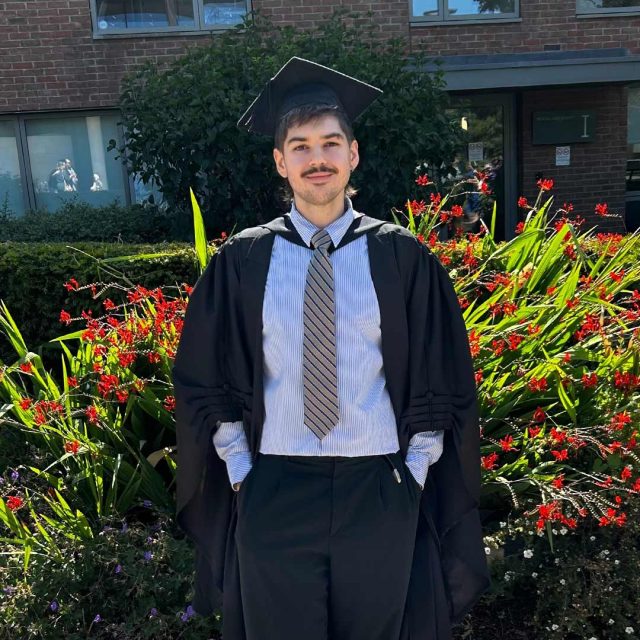
During my internship at Pierian, I started asking to take on more complex programming tasks beyond what was initially expected of me. The cybersecurity knowledge I gained from my degree helped me identify improvements to some of the company's in-house applications. As I took on more responsibility, I was offered the opportunity to progress into a software engineering role, which I've held ever since and will be continuing full-time after graduation.
As a mature student, my biggest inspiration and priority was getting a degree in a field that would help me build a long-term career in tech. I’d spent most of my life working around or with computers, so I knew the general subject I wanted to get into, but I wanted to find a niche rather than just general computer science. Cybersecurity, in particular, stood out to me as a field that will always stay relevant. I felt this was especially important in a world where advancements in AI could impact the job market.
My favourite part of my degree was my final-year R&D project. I built an automated prompt-engineering tool with Python that applies industry-standard security requirements to LLM coding prompts. It was great to conduct research in a relatively new topic and build a tool that effectively didn’t exist in industry yet. I loved that the work I put into this project was more than just uni coursework. Because of the effort I put into this project, I now get to use the tool I built at work every day to help Claude Code write more secure code.
The Three top skills I gained from my degree were critical thinking, security conscious planning and communication. 1: Critical Thinking – A lot of the digital forensics and ethical hacking coursework forces you to draw conclusions based on your findings. This directly impacted how I approach specific tasks in my job, such as debugging code or reviewing logs, and helped improve both my problem-solving and critical thinking in general. 2: Security Conscious Planning – A lot of this degree pathway covers the underlying issues that cause cybersecurity incidents. Ultimately, this made me overall more security-conscious, which has had an impact on how I go about my everyday work. Whether I’m planning a new project or updating existing applications, I always consider the security risks and implications before I start. 3: Communication – The amount of group coursework on my degree pathway really improved how I convey information about my projects to colleagues. It’s also helped me stay on top of monitoring and communicating progress so everyone is on the same page. This has helped me tremendously at work, whether that’s writing documentation for software I build or effectively discussing projects in meetings.
The Computer Science Department as a whole helped me improve my core employability skills over my three years at Edge Hill. For example, my second-year professional practice module helped me draft the CV that landed me an internship at Pierian Biosciences. I was also able to use my coursework in networking and database systems as evidence of my skills for the position I applied for at the time.
I made some great friends in my time at Edge Hill, which was really important when going to uni as an international student, being away from all my friends and family. I think my favourite thing about the degree programme I took was the flexibility it gave me to work towards a full-time career. I wasn’t in 5 days a week for lectures, which for me meant I had more time to focus on progressing in my internship. The lecture content was broad enough that you got a good general understanding of topics in the field of computing and cybersecurity, which gave me the opportunity to go and research and explore the ones that interested me the most in more detail during my free time. This helped me tremendously in both my studies and my internship.
Throughout my time at Edge Hill University, as an international student, I regularly spoke with both the international support and visas team and have only positive things to say. They were extremely helpful in answering any of my questions regarding my student visa and how I will now transition to either a skilled worker or graduate visa.
Computer Science and Computing, in general, are such broad fields. And the cybersecurity-based pathway I chose is no different. I think it’s really important to explore different branches of your degree field to find your niche. Once you do, really focus on it and try to incorporate any of that topic back into your uni work to build experience and a portfolio of that kind of work before you even finish uni. I found that software engineering as a whole was more of the route I wanted to go down rather than traditional security analyst roles. Cybersecurity easily ties into that, so I started building security or forensics-based Python scripts to submit alongside some of my 3rd-year coursework. The rubrics may not have asked for it, but when you go into interviews or applications in the future, you already have something you can provide as evidence of your problem-solving skills.
Now, I work as a Bioinformatics Software Engineer for Pierian Biosciences in Liverpool.
I found a part-time data analyst internship at Pierian on LinkedIn and applied for it during my second year at Edge Hill. Once I became more comfortable in my role, I started asking to take on more complex programming tasks beyond what was initially expected of me. The cybersecurity knowledge I gained from my degree helped me identify improvements to some of the company’s in-house applications, and I was given the freedom to work across a range of different projects. As I took on more responsibility, I was offered the opportunity to progress into a software engineering role, which I’ve held ever since and will be continuing full-time after graduation.
A typical day for me involves working on the informatics codebase I’ve rebuilt from the ground up for the lab team at Pierian. I’ve developed several automated programs to streamline lab processes, including data pipelines, various file handlers, and AI workflows. More recently, I’ve started developing an AI-assisted Flow Cytometry tool that the lab team can use to save time in their clinical research.
Personally, I love knowing that the work I do could help the scientists at Pierian make a difference in someone’s life. Cancer research is a demanding but very important field, and I’m excited to help assist in progressing the research in this sector.
Currently, my plan is to continue focusing on improving my overall software engineering skills. I’d really like to master building AI-assisted applications, as this is where most things in industry are headed. Beyond that, I’m planning to take additional cloud and security engineering courses to prepare for some of my long-term goals. Ultimately, I’d like to develop and maintain Software as a Service (SaaS) platforms in my long-term career plans.
The modules and assessments I completed during the second and third years of my degree were by far the biggest factors in preparing me for my career. Many of the coursework projects allow a “how far do you want to take this” approach, which has directly influenced how I approach problem-solving and software development in my job today. At the end of your degree, the coursework you complete is the best portfolio of your skills that you can provide to an employer. Long term, it’s much more important to understand the work that went into your submissions rather than just the final mark you got.