Michael Cartmell
BSc (Hons) Sports Development and an MSc in Sport, Physical Activity and Mental Health
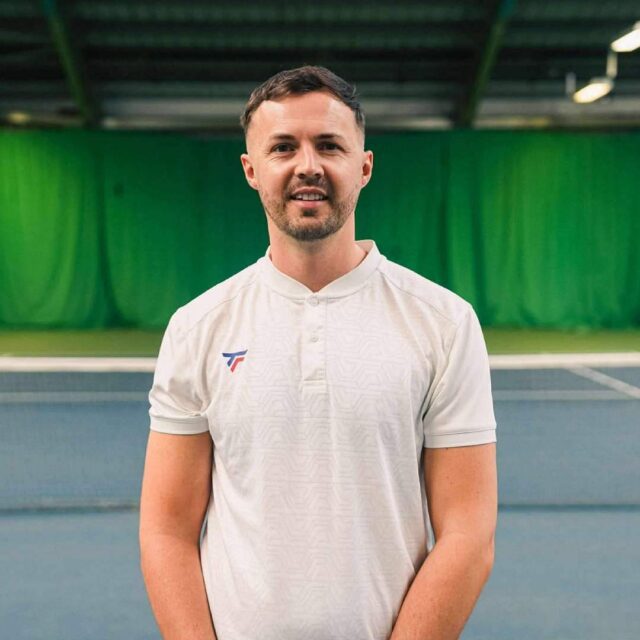
My favourite thing about studying at Edge Hill was how practical and well-rounded the course was. It wasn’t overly classroom-based, which really suited me and there was a strong focus on coaching, academic safeguarding, and gaining hands-on experience.
Former Edge Hill University student Michael Cartmell’s inspiring story of resilience has seen him overcome adversity to represent his country at para-standing tennis and become a qualified coach.
Michael attended Edge Hill University between 2013 and 2017, studying BSc (Hons) Sports Development and an MSc in Sport, Physical Activity and Mental Health.
Aged 16, Michael suffered an acute subarachnoid haemorrhage and a blood clot on his brain as a result of a serious head trauma whilst playing football. He had to relearn how to read, walk and talk.
The injury has not stopped Michael from reaching his goals despite being hold he would never play sport again. In addition to playing para-tennis on the world stage, he also runs Cartmell Tennis Coaching.
Michael, who is from Lancaster but now lives in Garstang, looks back on his time at Edge Hill with pride, where he founded the University tennis team and received the Gold Award for Volunteering and the Chancellor’s Scholarship. He said: “I chose to study at Edge Hill University because I’d always wanted to start my own business and the Sports Development degree felt like the right fit for me. It combined my interest in sport with practical skills around leadership, organisation, and working with people, which I knew would be useful for the career I wanted to build,” Michael explained.
“After finishing my undergraduate degree, I decided to stay on and complete the MSc in Sport, Physical Activity and Mental Health. This gave me the chance to build on what I’d already learned and really focus on how sport and physical activity can support people’s mental health and wellbeing.
“Both courses were very practical and hands-on, and they helped shape the direction I’ve taken since including my ambition to run my own business in the sport and physical activity sector.
“One of my proudest achievements was founding the University tennis team and setting up the tennis society, as there wasn’t one before I arrived. I also volunteered over 250 hours delivering tennis sessions through the Sports Centre, which led to me receiving the Gold Award for Volunteering. Those experiences helped shape my coaching style, built my confidence, and allowed me to meet loads of new people.
“I was also incredibly grateful to receive a Sports Scholarship for representing England in disability football, as well as the Chancellor’s Scholarship for my volunteering work. Both meant a lot to me, not just financially, but because they recognised the effort I was putting into my sport, my studies, and giving back to the University.”
At Edge Hill, Michael was provided with a platform to develop his confidence and practical skills.
Tennis played an important role in Michael’s wellbeing, which kept him focused and something to look forward to.
Michael continued: “My favourite thing about studying at Edge Hill was how practical and well-rounded the course was. It wasn’t overly classroom-based, which really suited me and there was a strong focus on coaching, academic safeguarding, and gaining hands-on experience. We were involved in organising sports events, such as refereeing football tournaments, and had opportunities to work with professional organisations including Everton Football Club. All of this helped prepare me for life beyond university and gave me skills and experiences that I still use in my career today.
“Edge Hill was really supportive when it came to work experience and employability. A big part of that was the lecturers, particularly Andy Smith, who had strong industry connections through his work with the mental health team at Everton Football Club. Those links helped open doors to real opportunities and showed how what we were learning could be applied in professional sport.
“Sport and physical activity played a massive role in my wellbeing while I was at Edge Hill. Being active helped both physically and mentally, and it gave me structure and purpose alongside my studies. Tennis in particular was huge for me, it kept me motivated, helped with my recovery and gave me something positive to focus on.”
Through determination and rehabilitation, Michael has built his successful coaching business, across Lancashire, Cumbria and the Fylde Coast, and has competed at national and international tournaments including the World Championships, creating “incredibly special” moments along with working for Sported UK, a charity supporting young, disadvantaged people to get into sport.
He added: “Competing nationally and internationally as a para-standing tennis athlete means a huge amount to me. After my brain injury, just getting back on court was a big achievement, so being able to compete at that level is something I’m really proud of. It represents resilience, progress, and showing what’s possible with the right mindset and support. Para-standing tennis also gives people like me a chance to compete on a level playing field after my injury, my options were either mainstream tennis or wheelchair tennis, and para-standing provides that important middle ground where athletes can compete fairly and confidently.
“Representing England in the Anglo-Hibernian Cup was incredibly special. Being selected to represent your country is something I’ll never take for granted. It was a proud moment for me personally and a chance to represent para-standing tennis on an international stage.
“Competing at the World Championships was a major highlight of my journey. Playing against the best players in the world really pushed me and showed me the standards needed to compete at the highest level. I learned a lot about preparation, mindset, and consistency.
“Balancing elite competition with coaching, work and everyday life takes organisation and discipline. I’m very structured with my time and realistic about recovery and rest.”
Michael has ambitions to further progress his para-standing tennis and coaching business.
“Over the next few years, my main goal in sport is to continue progressing as a para-standing tennis athlete and compete consistently at the highest international level. I want to keep improving my ranking, perform strongly at major tournaments, and show what’s possible after a brain injury. Alongside this, I am already the para-standing tennis lead in the North of England and have established the first dedicated para-standing tennis hub in England, which I’m continuing to develop and grow,” Michael concluded.