Mark Lewis
BSc (Hons) Software Engineering
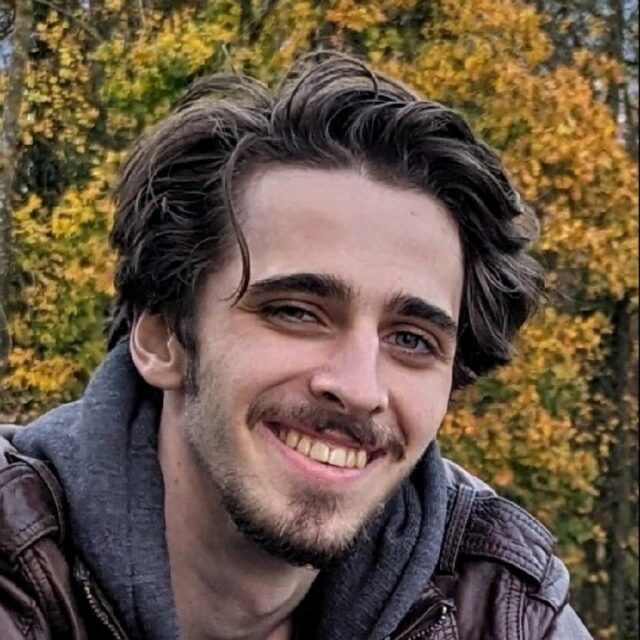
My placement year was honestly one of the most valuable parts of my degree, where I worked as a Product Security Engineer. I was working on live defence programmes, applying security frameworks and actually contributing to projects, which gave me hands-on experience I wouldn’t have been able to get otherwise and helped build my confidence in tackling real-world challenges.
I’ve been interested in technology since I was a kid, reading books about space travel, robotics and computer graphics, and tinkering around with my dad’s poor old laptop. I’ve always been fascinated by space as well, everything from Hubble images of distant nebulae to space weather and how the sun affects the Earth, and things like the SR-71 Blackbird and the English Electric Lightning, which could climb faster than most aircraft could fly straight. What really got me into software engineering was realising that you can just… create programs to solve your own problems. And when I found out software was used to control the Apollo 11 Lunar Module, that was it for me. I knew software engineering was what I wanted to do, and that going to university would give me the structured knowledge and support that self-teaching alone couldn’t.
Edge Hill stood out to me for a few reasons. The campus was a big part of it — the greenery, the layout, the facilities. It felt like somewhere I’d actually want to spend three or four years. But what really sold it was meeting the lecturers. They were genuinely passionate about what they taught and took the time to have proper conversations, rather than just pitching the course. The balance of practical and theoretical work was exactly what I was after too.
One of the best things about my degree was how project-based it was. We weren’t just learning abstract theory — we were constantly applying it to real problems, working in different languages and environments. That’s definitely helped me build confidence in problem-solving, especially when being thrown into something unfamiliar. Communication is another big one for me. Presenting my work in front of others was nerve-wracking every single time, but it’s made a huge difference in how confidently I can now explain technical ideas clearly to people who don’t necessarily have a technical background.
My placement year was honestly one of the most valuable parts of my degree. I worked as a Product Security Engineer at BAE Systems, which gave me the chance to apply what I’d learned in a real-world environment. I was working on live defence programmes, applying security frameworks and actually contributing to projects. It was challenging, but it confirmed for me that defence and security engineering is exactly where I want to be. The careers team was instrumental in helping me prepare for my placement applications and interviews – they looked over my CV and even did mock technical interviews which was really helpful.
The highlight of my degree has to be winning the Computer Science End-of-Year Showcase in my final year. My project on machine learning for space weather prediction was selected to be presented alongside students from all years, including postgraduates, and being recognised as one of five winners is something I’m really proud of. Seeing people genuinely engage with the 3D aurora visualisation I built on the day made all the late nights worth it. The project itself came from my interest in space weather and how the sun affects the Earth. Geomagnetic storms can have real impacts on things like satellites, GPS and power infrastructure, but predicting them in the short term is still a really hard problem. I wanted to see if machine learning could help with that. Extending prediction windows and presenting the results in a way that’s accessible, through a live forecast and interactive visualisation, not just for scientists but for anyone interested.
One thing that surprised me about studying software engineering is how creative it actually is. Before I started, I assumed it would be quite rigid and logical, but it’s not like that at all. There’s loads of room to experiment, try different approaches and build things your own way. And there’s something really satisfying about writing code that just works, especially when it solves a real problem.
The best thing about Edge Hill is the balance between independence and support. You’re not mollycoddled like you were in school, you’re expected to figure things out for yourself, but the support is always there when you actually need it. The staff are genuinely accessible, not just lecturers but support staff too, and that makes a big difference. I also really appreciated the campus itself. When you’ve been staring at code or debugging for hours, it helps to step away for a bit. My favourite place was honestly wherever the swans, ducks and other wildlife were. I’ve always been interested in birds, and even from an engineering perspective they’re fascinating. A lot of aircraft design is inspired by them, so it didn’t feel that unrelated!
Looking ahead, I’m keeping an open mind. I’m really interested in defence, aerospace and space, but I’m also considering continuing my studies with a master’s or MRes to build on my final-year project. There’s still a lot more I’d like to explore with it, and the foundation I’ve got from Edge Hill has given me the confidence to see what’s out there.
My advice to anyone thinking about studying software engineering is to be prepared to put the time in, it’s not something you can cram the night before. Start experimenting early with different types of software, whether that’s games, apps or embedded systems, and don’t be afraid to ask questions. There’s always more to learn in this field. And if you get the chance to do a placement year, definitely take it, it made a massive difference to me.
The support at Edge Hill really helped along the way as well. The Careers team were brilliant when I was applying for placements. They helped with my CV and did mock technical interviews, which made a big difference. My lecturers were always approachable and happy to explain things differently if something didn’t click, and having access to library and online resources meant I always had what I needed, whether I was on campus or working from home.