Want to work on the tech that powers electric vehicles, wind turbines, smart homes and more? Our Electrical Engineering lab gives you the chance to get real, hands-on experience with motor control, power conversion, and renewable energy systems. And what’s more, our Engineering Centre is brand new, so you’ll be confident in the knowledge that you’re learning with the most up to date equipment on the market in line with industry trends.
You won’t just learn the theory. You’ll get stuck into the kind of practical projects that employers love to see.
What you’ll do here
- Run, control and test motors just like those used in modern vehicles and machinery
- Design and simulate inverters to manage energy efficiently
- Monitor and control renewable energy systems in real-time
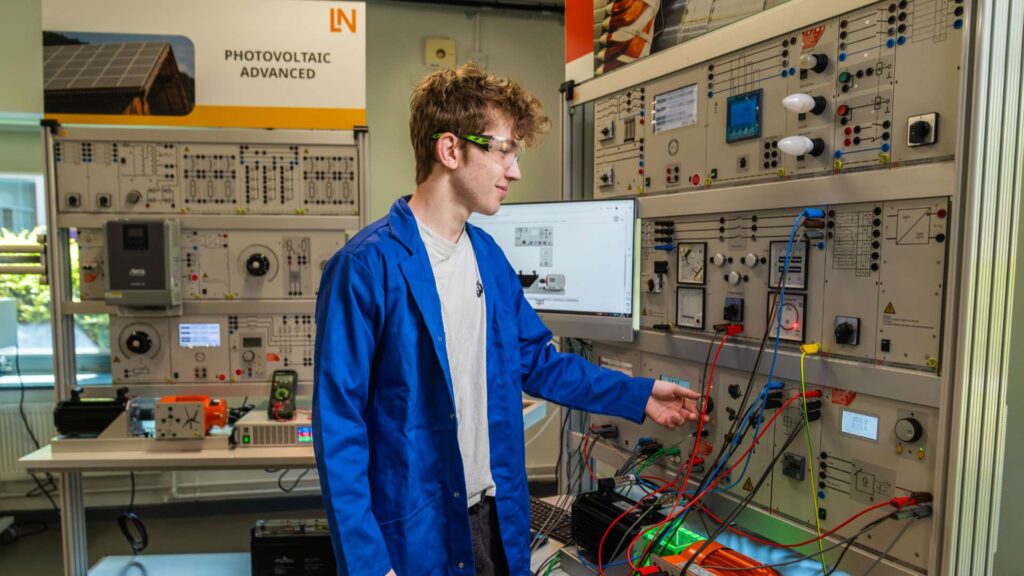
If you’re into clean energy, automation or electrical engineering, this is your space to experiment, innovate and build a career-ready skillset.
All our equipment is supported by Lucas-Nuelle’s SCADA Power Lab software. This means you’ll be able to engage in real-time monitoring, remote control, data logging, and virtual instrumentation. You’ll gain direct experience in controlling industrial systems, interpreting electrical parameters, and validating simulations with physical experiments.
There are two forms of electricity – DC and AC. DC is Direct Current, which is produced from batteries. AC is an Alternating Current, which is available from wall sockets. We use power converters to convert from AC to DC or vice-versa. Our electrical engineering lab lets you explore this further.
What does this mean in everyday life?
| Wind Turbines | What it does: A wind turbine is a machine that converts the kinetic energy of the wind into electrical energy. Real life: It’s like a modern version of a windmill, but instead of grinding grain or pumping water, it generates electricity. |
| Electric Car Battery (DC to AC Converter/Inverter) | What it does: Converts battery current from DC to operate an AC motor. Real life: The motors in most electric cars (like Tesla) runs on AC, but the battery stores DC, so an inverter is needed to drive the car. |
| Solar Panels (DC to AC Converter/Inverter) | What it does: Converts solar energy (DC) into household power (AC). Real life: Your solar panels on the roof generate DC electricity, but your home uses AC – an inverter makes the switch. |
| Transformers | What it does: A transformer is an electrical device that changes the voltage of alternating current (AC), either increasing it (step-up) or decreasing it (step-down), without changing the frequency. Real life: A transformer lets us safely use electricity from the power station in our everyday appliances. |
Shaping your future career
So how would you use this equipment in your future career? Our facilities prepare you for numerous career options.
You’ll perform real-time experiments using DC and AC drive systems, offering insights into industrial motor control using electrical machines and drives. These are used by Ship or Marine Engineers.
Analyse power electronics principles as you mirror the work of Power Plant Engineers, Sub-station Engineers or Motor Drive Engineers.
Investigate energy flow management across distributed generation sources using Hybrid PV, Battery or Wind Renewable Energy Systems simulating real-life microgrid scenarios. Renewable Energy Engineers would use similar equipment to this.
You’ll experiment on interactive UniTrain Electronic Training Kits across multiple topics in analogue and digital electronics, preparing you for a career as an Electronics Engineer.
September 3, 2025