Fresh perspectives. New angles. Creative potential. That’s what you get when you bring Edge Hill University’s film and broadcast production undergraduates onto your film set.
“Set in Victorian times, a family hires a medium to entertain them for the evening, unaware of what they’re about to create.”
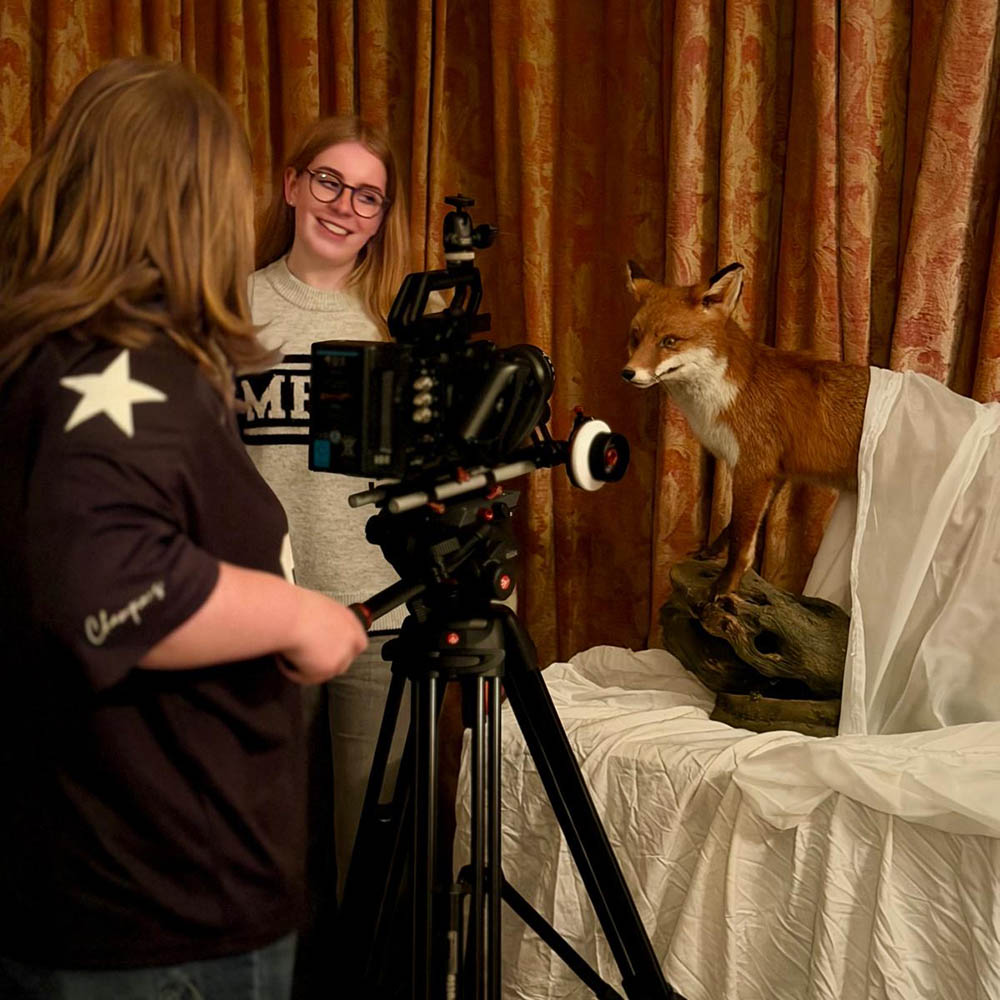
Emma Coombes, a student on our BA (Hons) in Film & Broadcast Production, is describing ‘Vulpine’, the short film she’s been working on, alongside fellow Edge Hill students and graduates.
The students have been taking advantage of placement opportunities on a working film set with Liverpool-based professional filmmakers Old Swan Films, as part of their respective courses.
“At Old Swan Films, our ethos is very much about paying it forward,” says director Thomas Elliot Griffiths, another Edge Hill film production alumnus. Ever since graduation, he’s looked to develop this relationship between his production company and his alma mater, using the Uni as a film location and providing placements.
“As we continue to build our experience and opportunities within the film industry,” continues Thomas, “it’s crucial that we give that back to those now just entering these circles, and offer creative opportunities that we’d have wanted at that time. We found their talent, creativity and discipline on the set of Vulpine to be really impressive, and we’ve offered further opportunities to some of the students we worked with.”
So Edge Hill students have first refusal on the best seats in the house from which to see exactly what goes into the production of a professional film.
Having yet to see the final cut, Emma and her coursemates are also unaware of what they’ve created. The three creatives are looking forward to the film’s premiere and their moments on the red carpet. Or taking their place on the ‘reserved’ front row of the cinema, anyway.
As 1st Assistant Director, Emma helped manage the shooting schedule and acted as the conduit between the director and the rest of the crew. It gave her a first-hand view of a professional film shoot, and how everyone works together on set:
“It was really great. I got to work with people who gave me advice and passed on their knowledge. It was also a really good opportunity to network with other film creators.”
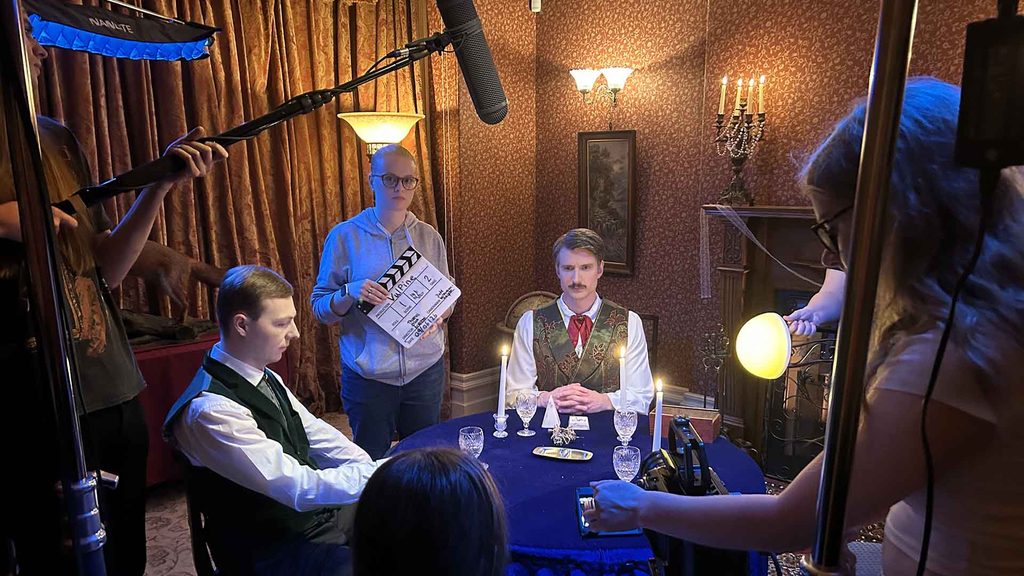
“A Victorian couple hire a medium and things go wrong.”
Jade Brooks, BA (Hons) Film, was the shadow director, and “just helped as much as I could while giving advice to actors when prompted and directing a few B roll scenes,” she says modestly (B roll is additional footage used to build or flesh out scenes, jargon busters). Spending time on set, was a really valuable learning experience, keenly observing Vulpine’s director Tom and how he interacted with his actors. The commercial nature of the production meant it was “a lot more intense” than the university projects she was accustomed to. Did that intensity put her off pursuing a career in filmmaking? Certainly not:
“If anything, [the experience] just reinforced my goal of directing my own projects. Having that weight given to a project really helped people understand what was at stake when we’re on set. There were no extra days for reshoots so we did as best as we could.”
As a fan of both David Lynch and Guy Ritchie, two very different directors, it’ll be very interesting to see which way Jade takes her own filmmaking.
“Paranormal. It’s set in two different time periods and things from the past haunt the present.”
Gabrielle Van Den Berg, another BA (Hons) Film student, was a runner, often the entry-level role for budding filmmakers and producers. It’s your introduction to professional sets and the people that work on them. There’s no job too big or too small for the runner:
“I would cook the cast’s meals, and I helped put up and take down the set dressing. I also helped with lighting – a light held out over the actors for one scene, or moving a flashlight to create a shine on a cord.”
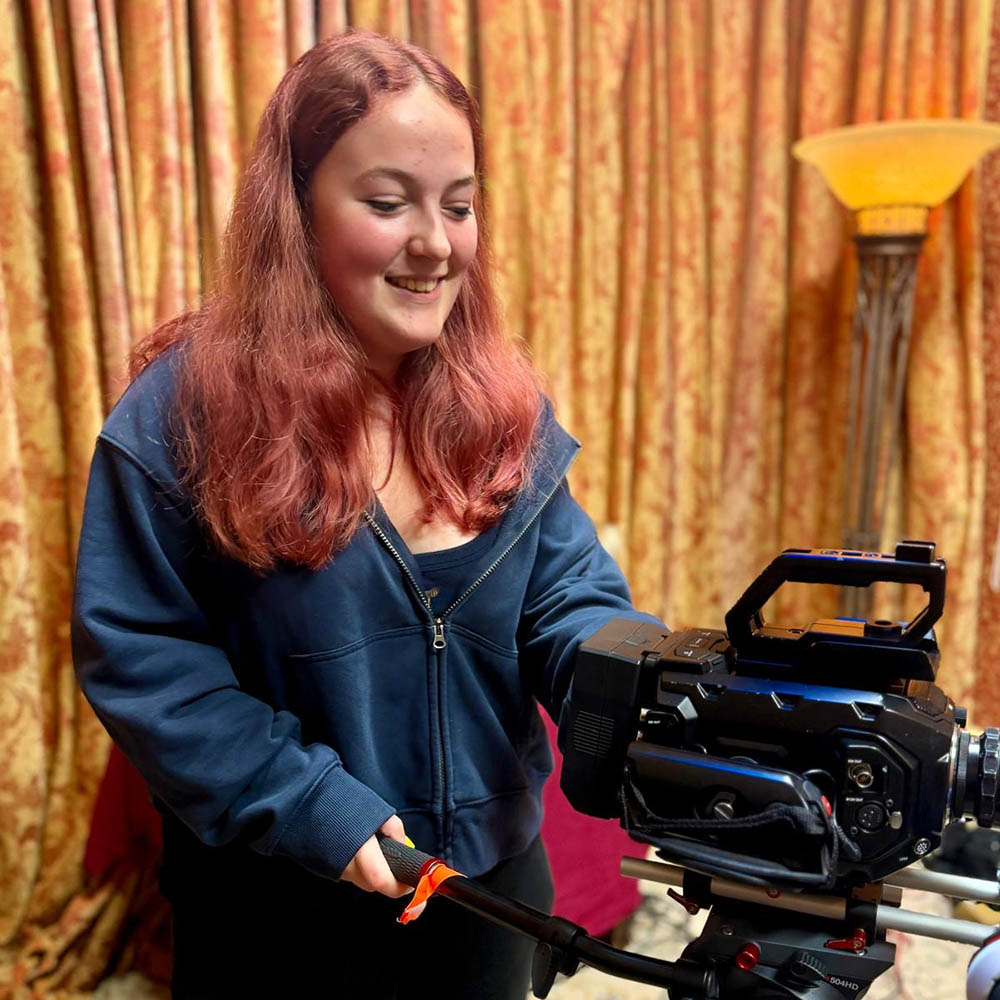
Exposure to professional workplaces is designed to help you in several ways. One, it real-worlds relevant practical skills. Two, it helps you fine-tune your career goals. And three, it opens your eyes to the realities of the workplace – and heightens your awareness of other opportunities within the industry:
“Working on a professional production felt strange at first,” admits Gabrielle. “It was more busy and serious, but I fell into a rhythm of what needed to be done. There was a sense of urgency and seriousness, whereas [course] assignments feel more casual and are spread out more.”
The experience also helped Gabrielle to reflect on where she really wanted to make a difference:
“I took away more communication skills, and what to expect on a film set. It did influence my career goals because I did find it stressful. I figured I didn’t want to work on a film set unless I was in charge or a screenwriter behind the scenes.”
This was more validation than revelation for Gabrielle, a voracious consumer of all things fantasy, who had begun to nurture her real passions on a course module from her first year:
“In ‘Storytelling on Screen’ we had a guest speaker, the writer of Game of Thrones, Buffy. It was what kickstarted my passion for writing…and wanting to go into screenwriting.”
Emma has a deep love for the work of another filmmaker who started young, Steven Spielberg. Like him, and in slight contrast to Gabrielle, she’s looking to stay ahead of the technical game:
“The best part of the BA (Hons) Film and Broadcast Production is how practical it is. You get hands-on experience with equipment that are industry-standard. My favourite module is Short Films for Curious Minds. I get the opportunity to learn specific skills in depth and complete a project around some really cool effects and techniques.”
Inevitably, Emma has spent plenty of time in the company of the Edge Hill technical team. They run the Media Store, which allows students to hire out hi-spec production equipment. They run the studios where they learn the tricks of a trade they have also spent time in. And they’re always around to pass those tricks on:
“When developing skills for my career,” says Emma, “the department is really good at expanding my knowledge. There’s always someone around to ask for help, really supportive.”
And Jade and Gabrielle agree with that:
“It’s very easy to talk to the lecturers in the film and media departments,” says Jade. “Having access to lecturers in their office hours and after class helps a lot.”
“It’s so easy to talk with my lecturers,” continues Gabrielle. “Access to them definitely does improve the experience as they explain the assignments and just put my brain at ease.”
One of those people always around will be Film & Television Technician Jude Wilkinson, who was instrumental in promoting placement opportunities with Old Swan Films:
“Following on from the success of the short film project Carve (2025),which has currently made the official selection at twelve film festivals, we wanted to give more students the opportunity to practice their skills in a pro environment, and enjoy professional mentoring,” says Jujde. “They’ll receive a professional reference and an IMDB screen credit, which has become an industry standard for career progression.”
Thomas at Old Swan Films also has his eyes on the festival circuit prizes, and steering Vulpine towards a global audience. He thinks “it would be wonderful if any of the students who worked so hard on it could experience a cinema of people watching their work on the big screen.”
His plans for the next twelve months also include development of their first feature film: Edge Hill students will be on stand-by.
Our students are supported in other ways. The University’s Department Opportunity Fund enables us to help students overcome some of the obstacles which can prevent them from accessing opportunities, such as travel costs and work-related expenses. So, an enhanced CV to reflect their workplace-ready technical skills, an IMDB screen credit, and a new raft of industry contacts to turn to. Not bad for their first short film. Long careers beckon.
November 5, 2026