Skip to content Skip to section specific navigation Edge Hill University

BSc (Hons) Psychology

Summary 2012/13

  • Join a Psychology department ranked top in the North West for overall student satisfaction (National Student Survey, 2011);
  • Study a degree accredited by the British Psychological Society;
  • Discover everything you wanted to know about the science of mind and behaviour;
  • Explore the differences that make each one of us unique;
  • Link theoretical concepts of psychology into real world situations.

Psychology is the scientific study of how humans function biologically, socially and mentally. On this programme you will learn about a diverse range of issues such as how children learn to think like adults, why mental illnesses occur, why racism occurs and why some people make poor witnesses to crimes. In addition to this, you will also learn the research skills necessary to investigate the human mind and human behaviour.

Campus: Ormskirk Campus, Edge Hill University
UCAS: C800
Course Type: Undergraduate Degree
Attendance & Study Mode:
3 years: Full Time
Start Date: September 2012

2012 Entry Requirements

280 UCAS tariff points overall, plus GCSE Mathematics at grade C or equivalent.

Details

Who is this course for?

This BSc (Hons) Psychology is for those with an interest in all aspects of human thought and behaviour. There are a number of influential theoretical approaches to the subject and this programme will allow you to explore them thoroughly - giving you the opportunity to learn something about yourself as well as others.

What will I gain from this programme?

Our students gain a broad understanding of the different, yet interrelated approaches towards the psychological study of human behaviour. All modules on the programme emphasise the applied aspects of the course and our students learn valuable transferable skills that will help future employability both within psychology and/or the wider jobs market.

What will I study?

Year 1 introduces you to all the basic areas in psychology, including social psychology, personality and individual differences. The course then progresses into cognitive, developmental and biological psychology, exploring topics such as the relationship between brain and behaviour, perception, memory, intelligence and cognitive development. You will look at research methods and data analysis and be involved in practical work. A dedicated module will improve your study skills.

Year 2 builds on the core areas from Year 1. You will also study a module in applied psychology. You will study five major, interrelated areas of psychology. These will help you to develop a critical awareness, improve interpersonal and social skills and enable you to understand human behaviour in a social context. You will also look at aspects of biological development and psychological development from infancy to adolescence. More advanced research methods will be introduced and you will work in groups to conduct qualitative and quantitative research. There is an emphasis on the use of computers when applying statistical analysis to quantitative data. Year 2 offers the opportunity to study an applied module where you will consider professional issues in areas such as occupational, educational, health and forensic psychology.

Using the methods mastered in Year 2, the individually supervised Year 3 dissertation allows you to conduct your own research into an area of psychology that interests you and report and discuss the implications. You will also have the opportunity to study options in specialised areas of psychology, which generally reflect the research interests of staff and thus presents cutting edge knowledge in the field.

How will I study?

Our teaching methods vary from traditional style lectures to tutorials, seminars and workshops. There is a well-equipped laboratory facility consisting of a teaching lab, audio-visual suite and soundproof cubicles for conducting experiments. We have a wide range of IT facilities, including spreadsheet and statistical packages, Internet access, electronic journals and abstract databases.

Who will be teaching me?

The Psychology team currently has 15 members of staff who are all research active, particularly in the areas of thinking and reasoning, educational psychology, work psychology, psychological aspects of substance abuse, health psychology, close relationships and the functioning of working memory.

Team members have been published in major national and international peer reviewed journals such as the British Journal of Psychology, Counselling Psychology Quarterly, the Quarterly Journal of Experimental Psychology, The Journal of Experimental Psychology and The Journal of Experimental Child Psychology.

How will I be assessed?

Assessment in the first year determines whether you have reached the necessary standard to proceed to years 2 and 3. Most modules are assessed by a mixture of examination and coursework though some are assessed solely by coursework. Coursework assignments might be essays, research project reports, group presentations or the critical analysis of research papers. In addition, in Year 3 you complete a dissertation module.

What are my career prospects?

There are two clearly identifiable career routes. Firstly, successful completion of this programme will open up a number of postgraduate training and career opportunities, notably educational psychology, clinical psychology, work psychology, health psychology and teaching and research in further and higher education. Secondly, you will be well qualified to enter a wide range of professions from advertising and the caring professions, through to personnel or teaching (plus many other diversified occupations). The Psychology Unit at Edge Hill has a strong record of research and encourages new graduates to register for higher degrees such as MPhil and PhD.

Professional Accreditation

This programme is accredited by the British Psychological Society (BPS) as conferring eligibility for the Graduate Basis for Chartered Membership (GBC), provided the minimum standard of a lower second class honours is achieved. This is the first step towards becoming a chartered psychologist.

Students must recognise that training in Psychology is acquired through postgraduate education and supervised practice, not through an undergraduate degree. On completion of this programme students are not qualified to practice as a psychologist without further training.

Related Programmes

A Great Study Environment

Based in 160 acres of beautifully landscaped grounds, the Ormskirk Campus is a unique and inspirational place to study. Industry standard resources and cutting edge technology combine to make an interactive and highly advanced teaching and learning environment. Everything you could want is on one site with 25 acres of sport and leisure facilities, more than 1,000 rooms in halls of residence and fantastic modern spaces in which you can study and socialise.

The University library gives you access to thousands of books, journals, online resources and extensive PC and media provision. You'll get all the support you need to succeed, reflected in Edge Hill University being ranked in the top two in England for students' personal development, and the top three in the country for assessment and feedback, in the 2011 National Student Survey. The University is also featured in the top four in England for graduate employment.

How do I apply?

Apply online through UCAS at www.ucas.ac.uk.

See our How to Apply pages for more information on the application process and our Admissions criteria.

Fees and Finance

For academic year 2012/13, Edge Hill University will charge £9,000 for full-time BA, BSc and LLB degrees. Eligible students will not have to pay upfront for their tuition. The cost of tuition will be paid by a loan which you will only start to repay once you have finished the course and are earning over £21,000.

Eligible full-time students can also apply for a maintenance grant, subject to household income, and a non-means-tested loan to help with living costs.

Edge Hill University offers a range of scholarships for prospective full-time students. These include £2,000 Entrance Scholarships rewarding determination, commitment and achievement in creative arts, performing arts, sport and volunteering. Eligible entrants with outstanding grades are recognised through the £1,000 High Achievers Scholarship.

The University will also be offering awards, worth £3,000 in cash benefits and fee/accommodation waivers for academic year 2012/13, to eligible prospective full-time students through the National Scholarship Programme.

For more information on scholarships, including eligibility criteria for each award, visit www.edgehill.ac.uk/scholarships.

To find out more about fees, grants and loans for academic year 2012/13, visit www.edgehill.ac.uk/undergradfees2012.

Please note, the above information is for UK and eligible EU students only. International students should check the fees and finance information at www.edgehill.ac.uk/internationalfees2012.

Not got the entry requirements?

Students returning to education may present their previous experience in work (paid or unpaid) to support their application.

Students with relevant study through either a professional body or appropriate academic course can apply to join the programme at an advanced stage.

If you do not have the required Mathematics GCSE, you can sit an Edge Hill equivalency test to gain the equivalent qualification.

For personalised advice based on your circumstances, please contact us or come to an event.

Where can I find out more?

If you would like to receive a copy of our prospectus or be kept updated about forthcoming events, contact the Course Information, Advice and Guidance Team by emailing study@edgehill.ac.uk or calling 01695 657000.

If you want to attend one of our open events held throughout the year, visit www.edgehill.ac.uk/opendays to book your place.

You will also find Edge Hill University staff at many national careers fairs and UCAS events.

Still want more?

If you have any questions you would like to ask the programme leader about this course, please contact:

  • Debbie Pope, Department of Psychology, Faculty of Arts and Sciences, Edge Hill University, St Helens Road, Ormskirk, Lancashire, L39 4QP
  • Tel: 01695 650940
  • Email: debbie.pope@edgehill.ac.uk

Overseas students should visit www.edgehill.ac.uk/international or email international@edgehill.ac.uk for further information.

Modules

Year 1

PSY1111 Introduction to Personality, Social and Developmental Psychology will familiarise you with the approaches and concepts central to the study of behaviour. The module explores the historical and theoretical concepts of personality and individual differences, social cognition and social and cognitive development.

PSY1112 Introduction to Cognitive and Biological Psychology considers the processes underlying behaviour (such as perception, sensation and memory) and how human beings are embedded in their world (e.g. by way of their shared biology and learned knowledge). In this way, the module aims to equip you with a broad understanding of basic theories and concepts and a range of interrelated approaches towards the psychological study of human behaviour.

PSY1113 Investigating Psychology provides background and training in the skills necessary to plan, conduct, analyse and report psychological research. You will receive training, support and practice in the use of SPSS software to conduct psychological research and learn the skills necessary to produce descriptive and inferential statistics, providing the building blocks for the more advanced research methods encountered later in the programme.

PSY1114 Real World Psychology takes a more 'hands on' approach to studying some of the core topics in psychology. You will learn to relate your understanding of psychological theories, concepts and research methods to real-world situations (e.g. topical issues in the news) and engage with current research activities being conducted within the department.

PSY1108 Essential Skills in Psychology develops a range of academic, personal and interpersonal skills designed to enhance your potential both within and beyond university. The focus is on harnessing key undergraduate skills such as academic reading, writing and critique, group working, finding and presenting information, time management, self-awareness and reflection, and applying them in the context of the degree subject. The module takes a holistic approach to applications of theory.

Year 2

PSY2112 Developmental Psychology addresses the processes involved in key aspects of human development and their relevant applications in real world settings. It will focus mainly (though not exclusively) on development in childhood including areas such as cognition, memory, language, emotional, and social development. Emphasis will be placed on the evaluation of key theories and psychological research that have informed our understanding of development in these areas.

PSY2113 Social Psychology reveals the extent to which social influences and interactions are pervasive in affecting individual behaviour, while also considering how the actions of an individual in turn affect other individuals and groups. You will develop an awareness of the relationship between person and situation and examine how this dynamic relationship both influences, and is crucial to, the understanding of behaviour.

PSY2114 Cognitive Psychology will examine both classic and contemporary research that has led to the development of theories regarding how attention, perception and memory all function. The module will also examine how each of these components interact during everyday tasks. You will consider how thinking, language and emotion enable us to reason about, and interact meaningfully with, the external world, gaining an understanding of the processes used to communicate, comprehend, and use information and knowledge.

PSY2115 Biological Psychology studies the human nervous system, including its structure and functioning. There will be a particular focus upon the brain. You will learn in detail the processes by which messages are passed through the system and the way the brain interacts with the hormones of the endocrine system in order to preserve life. The methods by which the brain is commonly researched will also be explored in order to provide a basis for understanding much current research and theorising in psychology.

PSY2116 Research Methods and Data Analysis provides you with the skills necessary to design, execute and report your own research. A particular emphasis is placed on data analysis: quantitative techniques (analysis of variance and regression) and qualitative techniques (grounded theory and phenomenological analysis). These data analysis skills will be essential for carrying out dissertations and are also highly valued by employers.

PSY2117 Applied Psychology develops knowledge in key areas (occupational, health, forensic, educational, sports) enabling you to understand, discuss and critically evaluate research, both within a framework of psychological theory and in terms of practical implications. You will learn to apply knowledge in developing ideas for community initiatives based on psychological theory in an applied area of interest.

Year 3

PSY3101 Dissertation is required for programme accreditation by the British Psychological Society. The dissertation requires you to carry out a piece of research for which, with tutorial support, you have responsibility for designing, gathering data, analysing data, and reporting the findings. You will work independently and demonstrate a high degree of autonomy and initiative in managing your work.

PSY3105 Mind, Body and Consciousness considers the constraints and contributions that have been supplied by psychological research, with particular emphasis on the relationship between body, mind and world and the nature of consciousness. In doing this, the module focuses on research problems that exemplify historical constraints in psychology (e.g. consciousness, emotion and embodiment). By critically evaluating the subject-method relationship and the constraints on a successful psychology of how mind, body and behaviour relate, this module empowers you to reason about current directions in psychological science.

PSY3129 Personality and Individual Differences is a module designed to develop your appreciation of individual differences in the study of human behaviour. In particular, the module will examine how individual differences interact in almost every example of psychological research with experimental or situational paradigms to produce results differing profoundly for individuals of different personalities, different capacities and different motivations.

In addition to the Year 3 modules above, you will also need to study three of the following optional modules. Please note, the choice of optional modules may vary depending on student demand and staff expertise.

PSY3120 Work Psychology develops your understanding of the application of psychology to people in terms of their lives at the workplace, their economic and work-relevant behaviour, and as participants in organisations. The module builds on knowledge acquired in earlier modules such as knowledge, skill, and decision making in cognitive psychology, individual differences in social psychology, and motivation. Many of the themes identified are explored in an applied context in this module.

PSY3121 Evolutionary Psychology offers knowledge about the origins of behaviour that challenges traditional assumptions about humans, their minds, and collective interaction. The aim is to empower your critical evaluation of personal, social and cultural issues in both future vocation and everyday life.

PSY3122 Psychology of Substance Misuse examines various aspects of substance misuse (including the misuse of alcohol) from a psychological perspective which will also be informed by other academic perspectives, such as those of brain science and sociology respectively. A broad range of psychological consequences of substance misuse, such as memory impairments, will be studied and the psychological interventions for substance misuse will be examined.

PSY3123 Clinical and Abnormal Psychology introduces you to the study of abnormal psychology and psychiatric disorders. The module will provide you with a thorough understanding of a variety of perspectives in psychology and how they apply to specific mental disorders. You will also develop your understanding and assess the relative merits of a medical/clinical model (diagnosis and treatment) of specific disorders, which will include schizophrenia (and other personality disorders), attention-deficit/hyperactivity disorders, bipolar-mood disorders and cognitive disorders related to aging and autism. Overall, the module will encourage you to critically analyse the medical model of mental disorders, as seen from the historical, social, psychopharmacological (neuroscience/neuropsychological) and medical perspectives.

PSY3124 Critical Perspectives in Developmental Psychology uses key arguments from critical psychology to evaluate traditional models and images of childhood, normative goals of development, and research methods that underpin much of traditional developmental psychology and educational policy. The module will provide a theoretical and practical framework for contemporary research practice.Ethical issues associated with carrying out research within a range of settings, and particularly with children, will be discussed, especially in relation to carrying out research 'with' children and also from a 'reflexive' practitioner perspective.

PSY3125 Memory in the Real World specialises in an area of cognitive psychology. The module also encompasses conceptual and historical issues, research design and methods in psychology - all areas that are core to the British Psychological Society's (BPS) curriculum – and gives you a strong basis to study Cognitive Psychology, Clinical Psychology or Research Methods at postgraduate level.

PSY3126 Understanding Genocide: The Social Psychology of the Holocaust critically examines the behaviour of 'perpetrators', 'bystanders', 'rescuers', 'resistors', victims and survivors (including child survivors) with the aid of a range of social psychological concepts. These include social conformity, obedience, authoritarianism, aggression, denial, prejudice, dehumanisation, 'the authoritarian personality' and 'the altruistic personality', lying, self-deception and leadership. The module will also critically examine post-war coping strategies and therapeutic perspectives.

PSY3127 The Developing Memory: From Infant to Adolescence is a distinct module specialising in the cognitive development of human memory. The module encompasses developmental, cognitive, biological and social psychology, as well as design and methodology research issues in the area of cognitive development. All these areas are core to the British Psychological Society's (BPS) curriculum. Due to the key topics covered, this module will suit the vocational and academic goals of the students interested in cognitive and developmental psychology, educational psychology, clinical psychology and forensic psychology.

PSY3128 Applying Psychology to Lifestyle Behaviour will explore the role of psychology, applied to the context of lifestyle. Specifically, the module considers the application of theory and evidence-based research to better understand, predict and change lifestyle-related behaviours. In addition, this module will elucidate how psychological concepts are linked to both healthy and unhealthy lifestyles in the real-world.

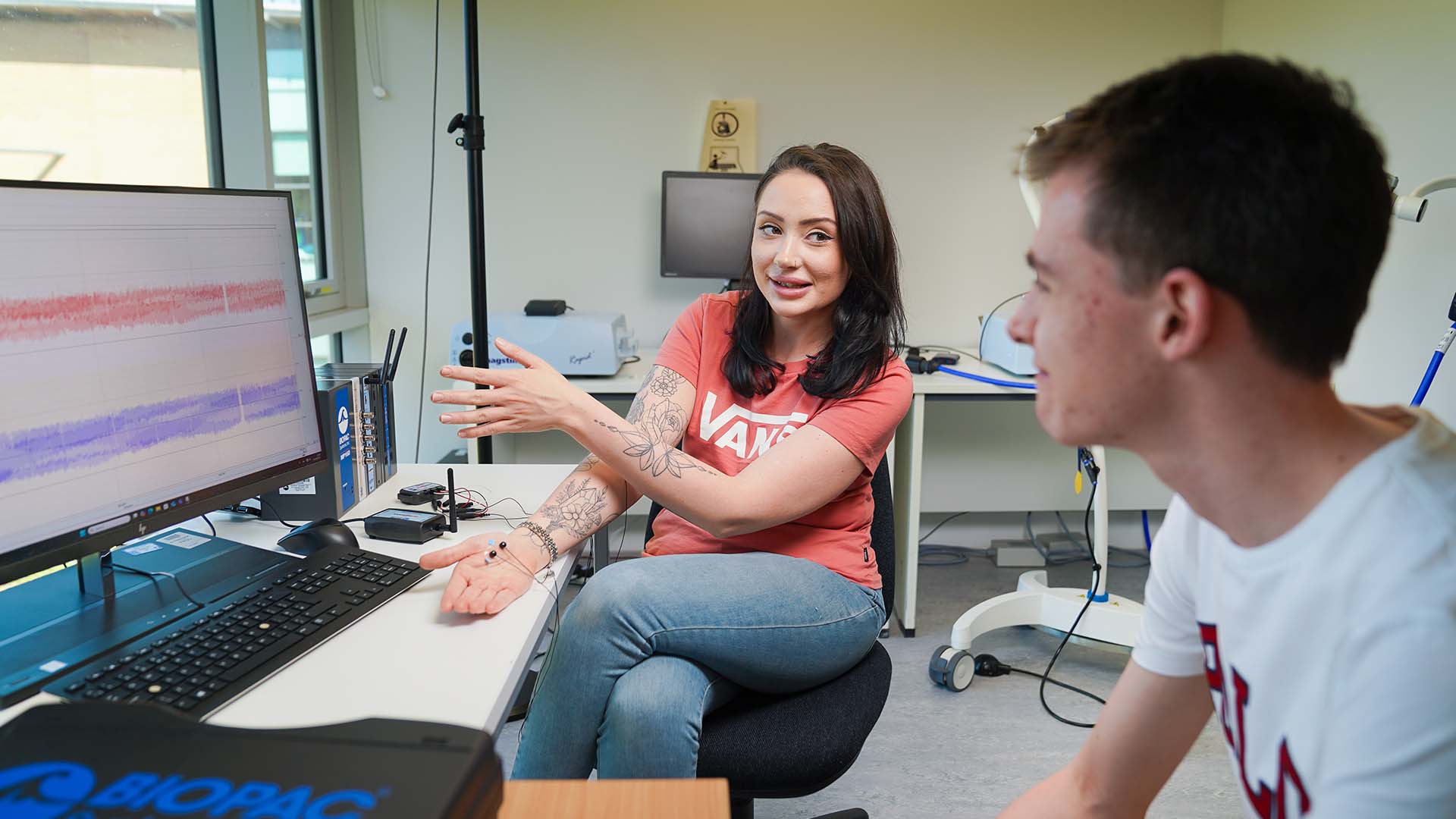
PSY3129 Research Technologies and Tools gives you practical experience of using research technologies commonly used within the discipline such as E-Prime (an experimental presentation software used for measuring reaction times), Biopac (a physiological arousal measurement tool) and diagnostic tools (such as the Wechsler Abbreviated Intelligence Scale). These skills will be useful for all students wishing to conduct further Postgraduate studies in Psychology, where an understanding of research technologies will be advantageous.

PSY3130 Psychology in the Virtual World will examine psychological underpinnings and experiences associated with a range of different virtual environments. These include video gaming, internet use and social networking. There will be a particular focus on the application of recent psychological research and how it provides an insight into the technological experiences which comprise a substantial part of modern day life.

EDP3102 The Psychology of Movement, Mark-making and Music in Education examines the psychological importance of pre-school experiences in drawing and mark-making, movement and play, and music to a child's understanding of the world and readiness for school. Psychological knowledge in these areas is compared to the current school curriculum.

EDP3103 Psychological Predictors of Learning and Achievement will examine how psychological factors can influence, and are in turn influenced by, learning and achievement. In this module we will focus on the beliefs of students about themselves as learners (including individual perceptions of one's own abilities and competencies), academic motivation, academic emotions (particularly a fear of failure) and the classroom environment.

EDP3004 Special Educational Needs (SEN) examines SEN within the school system by providing an understanding of psychological research and its applicability to this area. The module will take into consideration the policies and strategies behind supporting SEN in school, with particular attention to autism and dyslexia. In addition, this module will explore both the history of SEN and the new direction it is taking.

Contact

Edge Hill University
St Helens Road
Ormskirk
Lancashire
L39 4QP
United Kingdom
GEO: 53.559704; -2.87388
+44(0)1695 575171
+44(0)1695 579997

Location