Skip to content Skip to section specific navigation Edge Hill University

DipHE Paramedic Practice

Summary 2012/13

  • Study a programme delivered in collaboration with The North West Ambulance Service (NWAS )and accredited by the Health Professions Council (HPC);
  • Qualify as a paramedic to the required clinical, professional and academic standards;
  • Work and study in placements throughout the Greater Manchester area;
  • Benefit from course fees paid by the NHS.

Please note, this programme is now closed for September 2012 entry.

Paramedics are highly skilled practitioners who work in challenging, exciting and dynamic environments at the frontline of the NHS. Their expert knowledge and skills are vital in ensuring that patients are provided with the best possible care in the pre-hospital and wider community setting. The wide scope of the role requires paramedics to have a broad knowledge and skill base in areas such as anatomy and physiology, illness and disease, clinical assessment and treatment therapies, legal and ethical issues and communication and teamwork. This programme is for anyone seeking an exciting career in the frontline of healthcare.

Alternatively, if you are already qualified and working as a paramedic, registered with the Health Professions Council, our continuing professional development DipHE Paramedic Studies programme is for you.

Campus: Armstrong House, Manchester
Central Manchester is the main academic base for this programme, venue(s) to be confirmed, with time also spent at the Ormskirk Campus.
UCAS: B780
Course Type: Diploma of Higher Education
Attendance & Study Mode:
2 years: Full time (45 weeks per year)
Start Date: September 2012

2012 Entry Requirements

Typical offer 240 UCAS tariff points, plus GCSE English Language and Mathematics at grade C or above, or equivalent.

Additional criteria for entry onto this programme includes permanent UK resident status, full manual driving licence and a successful interview. Applicants will also need to undertake a fitness test.

Summary 2013/14

  • Study a programme delivered in collaboration with The North West Ambulance Service (NWAS )and accredited by the Health Professions Council (HPC);
  • Qualify as a paramedic to the required clinical, professional and academic standards;
  • Work and study in placements throughout the Greater Manchester area;
  • Benefit from course fees paid by the NHS.

Please note, this programme is now closed for September 2012 entry.

Paramedics are highly skilled practitioners who work in challenging, exciting and dynamic environments at the frontline of the NHS. Their expert knowledge and skills are vital in ensuring that patients are provided with the best possible care in the pre-hospital and wider community setting. The wide scope of the role requires paramedics to have a broad knowledge and skill base in areas such as anatomy and physiology, illness and disease, clinical assessment and treatment therapies, legal and ethical issues and communication and teamwork. This programme is for anyone seeking an exciting career in the frontline of healthcare.

Alternatively, if you are already qualified and working as a paramedic, registered with the Health Professions Council, our continuing professional development DipHE Paramedic Studies programme is for you.

Campus: Armstrong House, Manchester
Central Manchester is the main academic base for this programme, venue(s) to be confirmed, with time also spent at the Ormskirk Campus.
UCAS: B780
Course Type: Diploma of Higher Education
Attendance & Study Mode:
2 years: Full time (45 weeks per year)
Start Date: September 2013

2013 Entry Requirements

Typical offer 240 UCAS tariff points to include two GCE A level grades CC, or equivalent. In addition, candidates are expected to have GCSE English Language and Mathematics at grade C or above, or equivalent.

Additional criteria for this programme include permanent UK resident status and a full UK manual driving licence. The selection process includes fitness and aptitude tests and an interview.

Details

Who is this course for?

This programme is open to anyone with an interest in working as a paramedic, caring for patients in the community, sometimes in emergency situations, and who has the necessary qualifications and/or experience. You need to have a full UK manual driving licence with no more than six penalty points.

What will I gain from this programme?

This DipHE in Paramedic Practice provides a programme for the education of potential paramedics to the appropriate clinical, professional and academic standard.

How we will support you

Edge Hill offers a comprehensive range of support services. In addition, the programme team will support you through the provision of a module leader, personal tutor and link teacher who are able to offer academic and pastoral support as required.

What will I study?

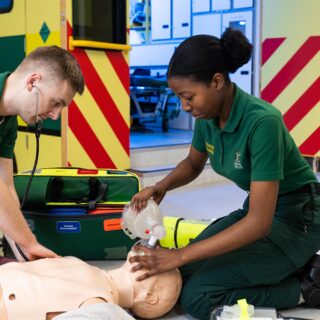
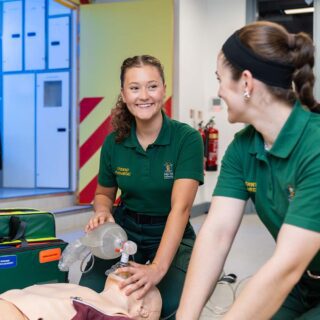
This programme is for the high quality education of paramedic students and integrates theory and practice. Practice placements take place throughout the year and practice experience are analysed and reflected upon within the theoretical modules of study. You will be expected to attend the full range of shifts applicable to the practice placement.

The programme team have developed theory to complement practice and provide a relevant practice experience. This ensures that the programme has not only a strong academic base but recognises the value of a vocational competence and skills base.

Your development of paramedic knowledge and skills will be guided by the programme learning and specific module outcomes. The modules have been designed to develop and assess your intellectual skills, such as the ability to gather and analyse appropriate information; subject specific skills such as the ability to identify, assess, implement and evaluate the health care needs of clients; and key skills such as clinical skills development, communication, learning skills and multidisciplinary learning.

How will I study?

To ensure that you are competent both academically and professionally, a wide range of learning experiences, teaching and assessment methods will be used to facilitate effective learning, including keynote lectures, group discussion and debate, student-led seminars, structured reflection, study, enquiry based learning, skills teaching and learning in practice. You need to be responsible for your practice, be able to recognise the limits of your expertise and be capable of challenging practices and initiating care, which is patient-focused and based upon available evidence.

Placement

Placement areas will include, for example, emergency ambulance teams, day centres, out-patient departments, assessment units, minor injuries units, maternity units, general wards and operating departments. Practice learning has been organised to meet your learning needs and give you supportive and diverse experiences across the health and social care provision, including main hub placements at ambulance stations and spoke placements in NHS hospitals, community trusts, social care services and the independent sector.

Who will be teaching me?

The main teaching team for this programme are paramedics. In addition, nurses, anaesthetists and other academic members will be involved in elements of teaching and assessment. In the workplace you will be supported by paramedic mentors, practice supervisors and qualified paramedics who will guide and supervise you during your training. The programme team will support you through the provision of a module leader, personal tutor and link teacher who are able to offer academic and pastoral support as required.

How will I be assessed?

The assessment process within the programme includes written essays, case studies, written examinations and tests, Objective Structured Clinical Examinations (OSCEs), presentation to peers and practice assessment documentation.

What are my career prospects?

Your career prospects on completion of the programme are good because of a high demand for qualified paramedics.

You will engage in the process of job application, mock interview and feedback as part of the curriculum for this programme and undertake a short period of consolidation (maximum four weeks) in the final semester of the course. Within this period of internship, processes of induction and preceptorship will be developed and integrated by the programme team. This will involve working collaboratively with key stakeholders to support you moving seamlessly as a newly qualified practitioner into a well supported period of induction and preceptorship when you commence employment as a paramedic. Support in finding employment is provided through the Faculty of Health and Social Care Careers Fair, held each year for final-year students.

Professional Accreditation

The programme is accredited by the Health Professions Council (HPC).

Further study at Edge Hill University

Following qualification, it is possible to top-up your qualification to an undergraduate or Master’s degree through Professional Development modules offered by the Faculty of Health and Social Care. Several of these modules are specific to paramedic practice, while other subjects offered include areas such as research, mentorship and leadership.

Related Programmes

Please note, if you are already qualified and working as a paramedic, registered with the Health Professions Council, our DipHE Paramedic Studies programme is for you.

For a comprehensive list of all undergraduate programmes offered by the Faculty of Health and Social Care, including a pre-registration undergraduate professional portfolio incorporating nursing, midwifery and operating department practice, plus a separate range of applied health and social care awards, visit www.edgehill.ac.uk/health/courses.

How do I apply?

Apply online through UCAS at www.ucas.ac.uk.

Visit www.edgehill.ac.uk/apply for more information on the application process and our Admissions criteria.

Fees and Finance

If you are joining this programme in academic year 2012/13, you can expect your tuition fees to be paid by the Strategic Health Authority.

As a paramedic practice student, you may be entitled to receive a non-means-tested bursary of £6,701pa if you will be joining this programme in academic year 2012/13. The bursaries are usually paid monthly.

For further information on the financial support available for students joining this programme in academic year 2012/13, visit www.edgehill.ac.uk/prereghealth2012.

Please note, the above information is for UK and eligible EU students only.

Not got the entry requirements?

Edge Hill University recognises that learning may take place in a wide variety of settings including conventional taught courses, online learning, learning outside of courses, professional and employment experience and self-directed study. You may, therefore, wish to use these experiences and qualifications to gain entry onto the programme. This process is facilitated by the AP(E)L policy, which provides a formal platform for the recognition of learning gained elsewhere and where appropriate, provides for credit to be attached to that learning.

Where can I find out more?

If you would like to receive a copy of our prospectus or be kept updated about forthcoming events, contact the Course Information, Advice and Guidance Team by emailing study@edgehill.ac.uk or calling 01695 657000.

If you want to attend one of our open events held throughout the year, visit www.edgehill.ac.uk/opendays to book your place.

You will also find Edge Hill University staff at many national careers fairs and UCAS events.

Still want more?

If you have any questions you would like to ask the programme leader about this course, please contact:

  • Phil Crompton, Faculty of Health and Social Care, Edge Hill University, St Helens Road, Ormskirk, Lancashire, L39 4QP
  • Tel: 01695 657159
  • Email: phil.crompton@edgehill.ac.uk

Modules

Year 1

HEA1076 Personal Development for Paramedics complements and provides a framework which supports the other Year 1 modules. It supports you in gaining essential study and communication skills, also providing you with knowledge, skills and competence in clinical mathematics.

HEA1077 Bioscience for Paramedics 1 introduces the knowledge of the basic scientific principles that enable an understanding of the structure and function of the body in health and disease.

HEA1078 Preparation for Paramedic Practice prepares you for undertaking inter-professional practice in the context of health and social care. The module will cover your accountability and responsibility in the areas of ethics, legislation and professional duty of care.

HEA1079 Patient Assessment in Paramedic Practice 1 will develop your knowledge, understanding and psychomotor skills in pathophysiology and patient assessment, enabling you to begin to safely and accurately assess a patient in the out-of-hospital care environment.

HEA1080 Paramedic Skills Development 1 enables you to develop the knowledge, skills and understanding required to achieve the standard of clinical competence expected of a student paramedic in the first year of this programme. You will also begin to understand the scope of clinical practice undertaken by a paramedic.

Year 2

HEA2091 Bioscience for Paramedics 2 begins to develop your understanding of the biological processes underlying decreased states of wellbeing.

HEA2092 Patient Assessment in Paramedic Practice 2 further develops your knowledge, skills and understanding of patient assessment and management appropriate to recognised key stages of the developmental human life cycle.

HEA2093 Applying Evidence in Paramedic Practice builds on the Personal Development for Paramedics module and helps you gain an understanding of the core methods that underpin quantitative and qualitative research designs and the application of research evidence to practice.

HEA2094 Exploring the Scope of Paramedic Practice enables you to function efficiently in the practice setting through demonstrating desirable professional traits and appropriate communication strategies.

HEA2095 Paramedic Skills Development 2 helps you to further develop the knowledge, understanding and skills required to achieve the standard of clinical competence expected of a student paramedic in the second year of this programme. You will also explore and analyse issues relating to professional practice as a paramedic.

Contact

Edge Hill University
St Helens Road
Ormskirk
Lancashire
L39 4QP
United Kingdom
GEO: 53.559704; -2.87388
+44(0)1695 575171
+44(0)1695 579997

Location