Skip to content Skip to section specific navigation Edge Hill University

BA (Hons) Film and Television Production

Summary 2012/13

  • Work with some of the best technical facilities for film and television production in the country;
  • Learn to write, shoot and edit your own unique productions.

Making exciting and innovative productions, in both film and television, is at the heart of this degree course. The programme is distinguished by its emphasis on the development of high level technical, creative and professional skills and its critical focus on film and television practice.

Campus: Ormskirk Campus, Edge Hill University
UCAS: W600
Course Type: Undergraduate Degree
Attendance & Study Mode:
3 years: Full Time
Start Date: September 2012

2012 Entry Requirements

280 UCAS tariff points overall, preferably to include creative arts subjects. The production of a creative arts portfolio can be credited with contributing up to 80 UCAS tariff points towards the total. The selection process normally includes an interview workshop.

Details

Who is this course for?

This programme is perfect for anyone wishing to develop their camerawork, lighting, scriptwriting, editing, sound and post-production skills. Some previous production experience would be an advantage but for anyone with an interest in communicating with audiences, whatever your medium or message, we will help you develop the academic and professional skills to realise that ambition.

What will I gain from this programme?

Film and Television Production allows you to apply your learning to a range of production work, which will give you vital skills for pursuing a career in film and television or further study. You will also be kept up-to-date with the rapidly changing production technologies, making you ideally placed to enter the industry the minute you graduate. You will also develop a range of transferable skills which will give you an advantage in the job market.

What will I study?

This programme is designed around three core themes: Craft and Technique, Creativity, and Critical Analysis. Each year includes all the core themes but with a different emphasis as you progress through the degree.

Year 1 provides you with essential skills in camera work, lighting, script writing, editing and sound. At the end of the year these modules culminate with a practical production project. You will also examine basic production theories and get an introduction to research methods.

In Year 2 the focus is on industry and professional practice, critical analysis and developing your research skills. Modules cover advanced production, changing technology and analysing audiences. You can also choose practical modules to develop your technical skills, craft and creativity. These cover a diverse range of genres including television drama, documentary and factual, music video, short film and children's television.

In Year 3, you will undertake two major practical projects - one in film and one in television. You will also study emerging technologies in film and TV production and the issues and debates around them, and complete a dissertation on a topic of your choice.

How will I study?

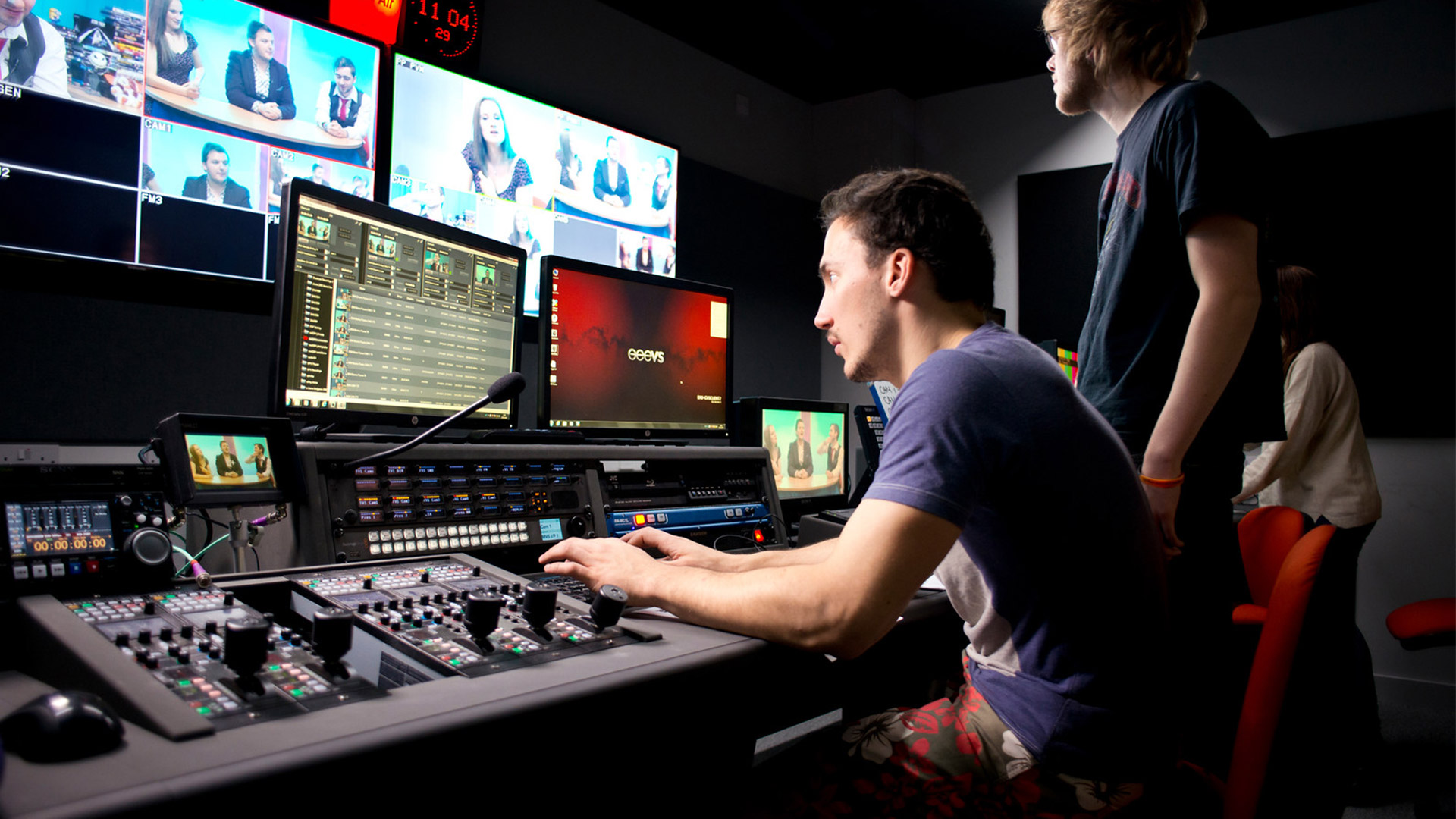
Teaching and learning takes place through workshops, lectures, seminars and screenings. We have a television studio and editing suites in our Learning Innovation Centre and other facilities allowing you to study films in detail. Other facilities include Apple Mac suites, special effects booth and training rooms, an extensive collection of film on DVD and two large theatres where films are screened regularly. You are encouraged to get involved with, and contribute to, our annual film festival, Tinnes, and our student film review magazine, Iris.

Who will be teaching me?

The course is staffed by enthusiastic lecturers, who have many years' industry experience and are also actively involved in production. Visiting media professionals add an extra external dimension to the programme.

How will I be assessed?

Assessment is varied, ranging from film and television production projects, pitches, presentations and reflective essays to traditional exams.

What are my career prospects?

Any student who takes Film and Television Production will become technically proficient to a professional standard but will also be a highly creative problem solver with a good academic background in film and television theory.

You will be technically proficient to a professional standard but will also be highly creative problem solvers with a good academic background in film and television theory. You will be capable of pursuing a wide variety of careers including film, video, television and new media production.

A Great Study Environment

Based in 160 acres of beautifully landscaped grounds, the Ormskirk Campus is a unique and inspirational place to study. Industry standard resources and cutting edge technology combine to make an interactive and highly advanced teaching and learning environment. Everything you could want is on one site with 25 acres of sport and leisure facilities, more than 1,000 rooms in halls of residence and fantastic modern spaces in which you can study and socialise.

The University library gives you access to thousands of books, journals, online resources and extensive PC and media provision. You'll get all the support you need to succeed, reflected in Edge Hill University being ranked in the top two in England for students' personal development, and the top three in the country for assessment and feedback, in the 2011 National Student Survey. The University is also featured in the top four in England for graduate employment.

There are many opportunities for developing your TV and film production skills. The Learning Innovation Centre will give you access to the Television Studio and a wide range of on-location equipment. The CMIST building, where you will do most of your production work, features a state-of-the-art Mac Lab with edit stations and edit suites currently running Final Cut Pro, a special effects booth and training rooms.

The Media Department is an Education Partner of the BBC and JVC and, while on the course, you will have access to JVC High Definition cameras as well as a large number of industry standard Sony camcorders.

There are two large theatres on campus which are used to screen films and television programmes. The Media Department runs its own annual film festival, Tinnes, each year. The University also has its own student film review magazine, Iris, waiting for your contributions.

How do I apply?

Apply online through UCAS at www.ucas.ac.uk.

See our How to Apply pages for more information on the application process and our Admissions criteria.

Fees and Finance

For academic year 2012/13, Edge Hill University will charge £9,000 for full-time BA, BSc and LLB degrees. Eligible students will not have to pay upfront for their tuition. The cost of tuition will be paid by a loan which you will only start to repay once you have finished the course and are earning over £21,000.

Eligible full-time students can also apply for a maintenance grant, subject to household income, and a non-means-tested loan to help with living costs.

Edge Hill University offers a range of scholarships for prospective full-time students. These include £2,000 Entrance Scholarships rewarding determination, commitment and achievement in creative arts, performing arts, sport and volunteering. Eligible entrants with outstanding grades are recognised through the £1,000 High Achievers Scholarship.

The University will also be offering awards, worth £3,000 in cash benefits and fee/accommodation waivers for academic year 2012/13, to eligible prospective full-time students through the National Scholarship Programme.

For more information on scholarships, including eligibility criteria for each award, visit www.edgehill.ac.uk/scholarships.

To find out more about fees, grants and loans for academic year 2012/13, visit www.edgehill.ac.uk/undergradfees2012.

Please note, the above information is for UK and eligible EU students only. International students should check the fees and finance information at www.edgehill.ac.uk/internationalfees2012.

Not got the entry requirements?

Students returning to education may present their previous experience in work (paid or unpaid) to support their application.

Students with relevant study through either a professional body or appropriate academic course can apply to join the programme at an advanced stage.

For personalised advice based on your circumstances, please contact us or come to an event.

Where can I find out more?

If you would like to receive a copy of our prospectus or be kept updated about forthcoming events, contact the Course Information, Advice and Guidance Team by emailing study@edgehill.ac.uk or calling 01695 657000.

If you want to attend one of our open events held throughout the year, visit www.edgehill.ac.uk/opendays to book your place.

You will also find Edge Hill University staff at many national careers fairs and UCAS events.

Still want more?

If you have any questions you would like to ask the programme leader about this course, please contact:

  • Dr Mark Fremaux, Media Department, Faculty of Arts and Sciences, Edge Hill University, St Helens Road, Ormskirk, Lancashire, L39 4QP
  • Tel: 01695 584023
  • Email: fremauxm@edgehill.ac.uk

Overseas students should visit www.edgehill.ac.uk/international or email international@edgehill.ac.uk for further information.

Modules

Year 1

Visual Cultures introduces you to a variety of approaches to analysing a range of media. It engages with media histories, technologies, narrative, genre and aesthetics and will introduce you to a range of different media and how they relate to each other. On completion, you will be able to provide a detailed analysis of any media text and critically engage with some core approaches to media such as semiotics, structuralism, convergence theory, auteurism, visual persuasion, medium specific criticism and different aspects of aesthetics, including mise-en-scène, sound design, editing, aspects of convergence and new media aesthetics (CGI, special effects, etc).

Single and Multi Camera introduces you to technical theory and the professional language of camera operation within multi and single camera operation contexts. The module examines the theory and practice of camera operation and the importance of using ‘manual modes’ to enable greater control of the camera, utilisation of the equipment’s potential and the practical knowledge to execute creative ideas. Framing, white balance, aperture control, depth of field and shutter speed will be covered in detail. Whilst many aspects of camera operation are similar in both single and multi-camera operation, there are important differences that you will be made aware of. You will apply your knowledge to practice with a series of assignments that involve the two different modes of operation.

Scriptwriting introduces you to the theory and craft of scriptwriting, which includes consideration of story, narrative, structure, character, setting and dialogue. You will engage in research and development and practice the process of rewriting and layering in order to adhere to established industry conventions of format and presentation. Within this module you will demonstrate your creative potential through the development of and reflection on your ideas and scripts.

Editing provides a sound Introduction to the practical and conceptual understanding of digital non-linear editing, using industry standard software.

Practical Production gives you the opportunity to combine technical skills and aesthetic considerations in pre-production, camera operation, lighting, sound and editing to produce your first complete piece of creative work. You will develop your own production and, working in teams, gain an understanding of how each role within a production team functions to produce a finished product.

Year 2

TV Drama. Form and function of television drama are a key element of this module together with the more practical skills of developing a script, pre-production planning and working with actors. The elements of post-production (trailer making) and marketing will also be considered.

Multimedia Sport. Major broadcasters are developing the multimedia and multi-platform delivery of their product both as a result of financial advantages and because of audience anticipation and modes of accessing product content. This module focuses on sport for two reasons – firstly, the BBC is moving its sport department to Salford and secondly, because of the opportunities the genre presents for multimedia/multi-platform delivery.

Music Video introduces you to the academic theory of popular music and cultural theory, which will be applied to the production of music videos. By synthesising your understanding of the industrial contexts in which music videos are produced with the development of technical skills gained in year 1, you will produce music videos appropriate to an agreed creative brief which will satisfy the various needs of multi-channel, niche-audience music television.

Documentary will offer you the opportunity to research, develop and produce a short documentary film for submission to a festival, competition or for exhibition over an alternative platform. The overarching theme of this module is the development of your understanding of creativity and the creative processes in relation to documentary production.

Client-led Brief centres on the key relationship between client (commercial company, commissioning editor etc) and the production team. You will apply your creative and professional knowledge and skills in response to the brief set by the client.

Children’s TV. Children’s Television production and programming is pivotal to the remit of all major broadcasters and now involves some twenty percent of all television production. Dedicated channels – national and international, terrestrial, cable and satellite, are constantly searching for new and innovative content. It is an area which demands a clear understanding of the different types and age groups of the young audience, whether producing educational content for pre-school, news shows for adolescents, or drama for young teens.

TV Light Entertainment will explore the historic and changing light entertainment industry and its importance within contemporary television. The issues within light entertainment, such as audiences, production values and participants will give you the opportunity to relate the theory and creative practice of the genre.

Digital Shorts gives you the opportunity to make your own short film for submission to a festival or competition or for exhibition over an alternative platform. The module will develop your understanding of creativity and the creative processes in relation to film production.

Screen Adaptation. The adaptation of previously produced written material for the screen is a long standing tradition in both film and television. This module gives you the opportunity to adapt material from one format into another type of product.

SFX and Post-production provides a practical and theoretical insight into the use of visual special effects within film, animation and TV. Through the exploration and analysis of practice and process from current SFX techniques to the camera tricks used by early filmmakers, you will produce theoretical and practice projects based on what can be described as the 'grand illusion'. This is something which has fascinated viewing audiences since the creation of the moving image. The module will discuss the impact of this illusion on the social, economic and cultural fabric of society. You will develop specialist skills relating to moving image production including blue-screen techniques, compositing and particle generation for visual effects.

Media Genres and Narrative Theory. Genre plays an important role in the study of film, television and other media forms. It has long been recognised that output in these fields can be grouped into categories, and that each category or class is marked by a particular set of conventions, features and norms. However, genre is more than simply a form of classification – it is not a neutral category but rather an ideological construct that needs to be situated within larger systems of power. Similarly, narrative – another key function across a range of media – is not natural or universal but it has to be historically and culturally positioned. In this module, we will investigate – through a variety of topical examples – how genres are formed and reworked and how narratives are constructed within the complex interrelations among texts, industries, audiences and historical contexts.

Analysing Audiences engages you with a variety of approaches and methodologies to studying audiences. You will encounter a range of theorisations of audiences and discover key media theories in relation to audiences, critically evaluating them in their historic context and design, developing your own approach. By doing this, the module offers you the chance to conduct primary research, enhance your interview skills and experience research development.

Spectacles, Bodies and Other Pleasures: Concepts in Television, Animation and Film develops the work undertaken in Understanding Visual Cultures by offering a range of approaches to the analysis of media. The focus here is on contemporary media theories, which will inevitably change as time progresses but currently revolves around issues of spectacle, viewing film and television, the spectacle of new technologies, convergence, aesthetics and viewing pleasures.

Fact to Fiction engages with key ideas regarding film and television in relation to the factual and fictional representation of the world. It emphasises that fact and fiction are part of a scale of representations which include documentary formats, reality television, drama documentaries, dramatisations of factual content, and fiction films and television drama. It examines the impact of new technologies on how ‘the real’ is constructed and highlights changes to the concept of ‘witness’ (Ellis 2000) due to an increase in mobile recording technologies.

Film Authorship conducts an in-depth consideration of a range of authorship approaches to cinema. It familiarises you with the values and flaws of such approaches as the ‘auteur theory’ from Andrew Sarris and the debates of the Cahiers du cinema critics by applying them to the films of specific directors. At least two core studies of directors will be conducted, providing you with detailed knowledge of at least two oeuvres.

Censorship & the Cinema introduces you to the concept of film regulation and censorship, its history in Anglo-American cinema, the theoretical debates surrounding the subject, and several key films that have been contested throughout motion picture history as relevant case studies. In this way, it provides you with historical, contextual, academic and theoretical knowledge which will inform your own opinions and attitudes towards censorship.

Advanced Camera and Lighting helps you develop the technical skills in advanced camera operation and lighting. During the module, you will practice the skills required to produce finished pieces of work to both professional technical standards and also expressing a high degree of creativity.

Live Broadcast Sound introduces you to the theory and practice associated with live broadcast sound. As well as engaging with relevant theory, you will also exercise practical skills with relevant technology. You will be assessed by two pieces of interrelated coursework. You will record sound in three different environments, including a theatre and a TV studio, and deal with the acoustic and technical problems associated with these environments. You will also keep a production diary which reflects your ability to analyse and apply knowledge within the context of the subject.

The Politics of Representation. The production and communication of meaning relies upon systems of representation. Representational systems determine the expression of cultural beliefs, values and ideas, and, on an individual level, organise understandings of self, others and identity. Whilst it is clearly important to interrogate ‘how’ representation works, this module also concerns itself with the consequences of representational forms and practices to encourage you to critically interrogate ‘the politics of representation’.

Work Placement. This module is designed to enable you to apply the theoretical and practical skills you have acquired in the first year of the course by undertaking an initial placement in a real-world professional environment. Working in conjunction with industry, the Department of Media will place you with one of our ‘placement partners’, where you will establish professional contacts and gain valuable experience to enhance your CV.

Year 3

Independent TV Project offers the opportunity to compliment your work on an independent film production with a television-based project. The aim is to ensure you graduate multi-skilled and the production of a major piece of work is considered essential to enhance employment potential after graduation.

Independent Film Project allows you to work independently to produce a longer length film at a professional level.

Showreel is focused on the production of an industry standard showreel which provides you with the opportunity to present your best work in formats suitable for potential employers to judge.

Dissertation allows you to demonstrate your progression in academic skills and professional achievement to degree level. The dissertation involves working autonomously with limited supervision to explore areas of academic interest, consider issues of contemporary practice and critically analyse case studies or products within a specific context. This will be informed by your engagement with product and critical theory throughout the programme, as well as research methodology and industrial practice.

Media Policy and Political Communication invites you to take a wider view of media systems and events and to understand the relationship between political, social, cultural and technological change and media performance within both national and international contexts. The module seeks to develop awareness and understanding of a variety of issues relating to policy making in Britain, Europe and further afield. The module also encourages you to explore political and philosophical issues such as ethics, power, ideology, public sphere, public interest, and censorship.

Identities and Creative Citizenship. How are identities formed? To what extent can we shape our identities? What is the relationship between public / national identity and private / personal identity? How do changes in social, cultural and political life affect contemporary constructions of identity and citizenship? What effect does cultural and media production have on conceptions of identity? These are some of the questions that you will have the opportunity to explore on this module. Drawing on a range of theoretical approaches to the ‘subject’, we will investigate the formation, representation and production of identity in relation to issues such as gender, class, ethnicity, sexuality, nationality and politics.

Global Convergence rehearses some key developments in media in relation to film and television fictions. In particular, it examines how new developments in media – such as convergence technologies, multi-platform environments, new distribution technologies and aspects of global/glocalisation - impact on film and television drama.

Media Futures allows you to study contemporary media practices, the impact of technology on creative industries, developments in global and local media, and changing paradigms of media production and audience consumption. As a media student, it is essential for you to be able to demonstrate to employers that you understand contemporary working practices and have an awareness of future developments. This module aims to engage you with the dominant themes present within media and culture industries, also being flexible in order to accommodate contemporary developments.

Contact

Edge Hill University
St Helens Road
Ormskirk
Lancashire
L39 4QP
United Kingdom
GEO: 53.559704; -2.87388
+44(0)1695 575171
+44(0)1695 579997

Location