Skip to content Skip to section specific navigation

Edge Hill University

History

Originally welcoming 41 students to Liverpool in 1885, over 23,000 are now enrolled on Edge Hill University ’s courses across the North West, enjoying a unique, high quality and inclusive university experience.

Across more than a century of social and economic change, Edge Hill has developed from a non-denominational college to a university with an outstanding campus and student experience, reflecting academic and professional excellence.

Early Years

Edge Hill opened its doors in Liverpool on 24th January 1885, named after the district in which it was sited. Offering teacher training without required membership of a specific religious denomination, the progressive social values of Edge Hill in the late 19th century were a precursor to the modern day Widening Access schemes.

With a well-earned reputation for innovation today, in 1892 Edge Hill was one of only two colleges pioneering the combination of teacher training and degree course study.

The Student Experience

Original Students Bedroom

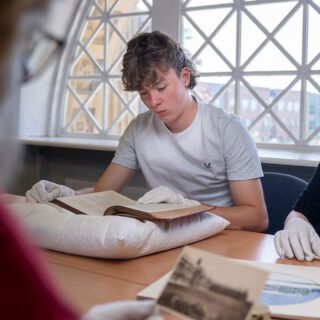
Whilst a 9am lecture is often the earliest start for our current students, a century ago the typical day began at 6:15am. Prayers and class work preceded breakfast before the majority of the day was occupied with a mixture of instruction, schoolwork, private study, industrial work and cooking, with a two and a half hour break for dinner and recreation. A light evening meal was typically followed by a walk and two hours of further study before prayers and lights out by 10pm.

Although we no longer expect lights out by ten and studying before dawn, providing a variety of teaching and learning methods remains a key part of the course experience at Edge Hill. Modern day students enjoy innovative learning techniques and industry-standard facilities, with a variety of opportunities to undertake field trips and work placements, gaining skills valued highly by prospective employers.

New Surroundings

Quickly outgrowing its original site in Liverpool, the institution moved to a site near the market town of Ormskirk in 1933. The campus buildings were prime examples of 1930s architecture, including a library, craft rooms, music rooms, gymnasium, lecture rooms, assembly hall, halls of residence and dining area.

Apart from time at Bingley when the campus was requisitioned during the Second World War, Edge Hill’s main site has remained in West Lancashire. By the 1960s, however, spiralling student numbers led to significant expansion of the Ormskirk Campus which has continued to the present day.

In the last ten years, around £60 million has been invested in the campus facilities, providing students with everything they could want on one site and ensuring Edge Hill provides an excellent learning environment.

Original buildings have been complemented by state-of-the-art modern resources, situated in picturesque landscaped grounds, including £4m of sport and leisure amenities. As the campus has expanded, Edge Hill has not lost sight of its desire and obligation to care for the individual student and has a strong ongoing commitment to student support.

End of an Era

1973 saw Edge Hill degrees validated by Lancaster University, bringing to an end 24 years in the Liverpool Institute of Education. In subsequent years, three-year honours degrees and then higher degrees were developed. Edge Hill achieved Taught Degree Awarding Powers and University Status in 2006, followed by Research Degree Awarding Powers in 2008.

The Lancaster connection finally came to end in 2009, which saw the last Edge Hill graduation ceremonies take place on their campus. Today, the University's portfolio of courses includes over 300 undergraduate routes, pre-registration health qualifications, initial teaching training, PGCEs, Graduate Diplomas, Masters and Research degrees, in addition to extensive provision in Professional Development.

Further Afield

As Edge Hill’s popularity and reputation grew, demand for courses led to programmes being delivered across the North West. The acquisition of space within the Woodlands Centre in Chorley in 1981 signalled a future direction, with the establishment of a fully operational in-service and conference centre, offering programmes for professionals working in education and practising teachers. The institution progressed to a third site in 1990, with the Faculty of Health established in the grounds of University Hospital Aintree.

It is now possible to study selected Edge Hill courses on additional sites in Manchester, Liverpool, Winsford, Bromborough and Shrewsbury, with several partner colleges also teaching and delivering various Foundation Degrees.