Skip to content Skip to section specific navigation Edge Hill University

BSc (Hons) Midwifery

Summary 2012/13

  • Department of Health funded tuition fees with means-tested bursaries also available;
  • Gain excellent career prospects that allow you to work within the UK and abroad;
  • Enables you to register with the Nursing and Midwifery Council (NMC).

Please note, this programme is now closed for September 2012 entry.

This degree is for anyone who has no previous nursing experience but wishes to gain a comprehensive education in midwifery. It will enable you to develop into a competent, autonomous and accountable midwife, with the professional, leadership and management skills that make you eligible to register with the Nursing and Midwifery Council.

You will become an evidenced based and research-aware practitioner, able to respond to the expressed needs of mothers, babies, their families and the midwifery profession. This degree has a distinct inter-professional emphasis to provide you with excellent career prospects that allow you to work within the UK and abroad.

Campus: Ormskirk Campus, Edge Hill University
UCAS: B720
Course Type: Undergraduate Degree
Attendance & Study Mode:
3 years: Full Time
Start Date: September 2012

2012 Entry Requirements

Typical offer 280 UCAS tariff points, including 160 points from two A levels at grade C or above, or equivalent qualifications. In addition, candidates are normally expected to have a minimum of five GCSE passes (or equivalent) at grade C or above to include English Language and Mathematics, together with evidence of academic study within the last five years. The selection process includes an interview.

If you accept a formal offer from Edge Hill University you will be required to apply for a Criminal Records Bureau Enhanced Disclosure indicating that you meet the mandatory criteria of 'Clearance to Work with Children and/or Vulnerable Adults'. Further information will be sent to you after you have firmly accepted an offer.

Summary 2013/14

  • Department of Health funded tuition fees with means-tested bursaries also available;
  • Gain excellent career prospects that allow you to work within the UK and abroad;
  • Enables you to register with the Nursing and Midwifery Council (NMC).

Please note, this programme is now closed for September 2012 entry.

This degree is for anyone who has no previous nursing experience but wishes to gain a comprehensive education in midwifery. It will enable you to develop into a competent, autonomous and accountable midwife, with the professional, leadership and management skills that make you eligible to register with the Nursing and Midwifery Council.

You will become an evidenced based and research-aware practitioner, able to respond to the expressed needs of mothers, babies, their families and the midwifery profession. This degree has a distinct inter-professional emphasis to provide you with excellent career prospects that allow you to work within the UK and abroad.

Campus: Ormskirk Campus, Edge Hill University
UCAS: B720
Course Type: Undergraduate Degree
Attendance & Study Mode:
3 years: Full Time
Start Date: September 2013

2013 Entry Requirements

Typical offer 300 UCAS tariff points required from 3 A levels (grade BBB), to include one of Biology, Human Biology, Psychology, Sociology, Health and Social Care. In addition, candidates are expected to have a minimum of five GCSE passes (or equivalent) at grade C or above to include English Language, Mathematics and a science subject (preferably Biology), together with evidence of study within the last three years. Access to HE Diploma candidates will achieve 45 credits at Level 3, of which 5 credits to be at Distinction grade and the remaining 40 at Merit, and should include Biology or Human Biology. BTEC candidates should refer to the UCAS website for specific entry requirements. The selection process includes an interview.

If you accept a formal offer from Edge Hill University you will be required to apply for a Criminal Records Bureau Enhanced Disclosure indicating that you meet the mandatory criteria of 'Clearance to Work with Children and/or Vulnerable Adults'. Further information will be sent to you after you have firmly accepted an offer.

Details

What will I gain from this programme?

You will develop, through an innovative approach to learning and extensive clinical experience, an appreciation of the social, political and cultural factors in the provision of maternity care.

How we will support you

As well as your placement mentor you will have a personal tutor who will support you throughout the programme. You will also have module leaders to support you for each module you study.

What will I study?

This programme comprises approximately 50% theory and 50% practice.

Opportunities to achieve national outcomes and standards of proficiency related to professional and ethical practice, woman centred care, case-loading and personal and professional development are provided within a supportive learning environment. Successful students will achieve 120 credits at Levels 4, 5 and 6 (degree) and professional registration.

How will I study?

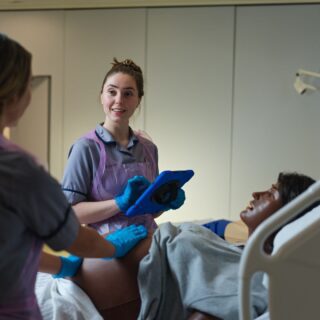
You will learn via a 50% split of theory and midwifery practice components. Theory is taught through a variety of methods, such as seminars, lectures and tutorials, which is then utilised in clinical practice.

Placement

You will spend 50% of your time in practice which will be undertaken in hospitals and community settings. During this time you will have a practice placement mentor who will support your learning and development.

How will I be assessed?

Assessment in both theory and practice is continuous. Practice is assessed against national outcomes and you are required to demonstrate evidence of your achievement. A range of assessment of theory procedures is in place including assignments, seminar presentations, advanced notice examinations, worksheets, portfolio work and poster presentation.

What are my career prospects?

On successful completion you will be able to work as a midwife in a variety of clinical settings, including hospitals, the community and birth centres.

Further opportunities are available in many varied roles including children's centres, Sure Start, teenage pregnancy, infant feeding, ultrasound specialist midwives and midwifery consultants.

Further study at Edge Hill University

Once you have successfully completed this programme, there are a range of additional midwifery modules available within the Faculty of Health and Social Care's professional development portfolio.

Related Programmes

Pre-Registration Undergraduate Professional Portfolio

This programme is part of the Faculty of Health and Social Care's pre-registration undergraduate professional portfolio. Other courses in the portfolio are:

For a comprehensive list of all undergraduate programmes offered by the faculty, including DipHE Paramedic Practice, BA (Hons) Social Work, and a range of applied health and social care awards, visit www.edgehill.ac.uk/health/courses.

A Great Study Environment

Based in 160 acres of beautifully landscaped grounds, the Ormskirk Campus is a unique and inspirational place to study. Industry standard resources and cutting edge technology combine to make an interactive and highly advanced teaching and learning environment. Everything you could want is on one site with 25 acres of sport and leisure facilities, more than 1,400 rooms in halls of residence and fantastic modern spaces in which you can study and socialise.

The University library gives you access to thousands of books, journals, online resources and extensive PC and media provision. You'll get all the support you need to succeed, reflected in Edge Hill University being ranked in the top two in England for students' personal development, and the top three in the country for assessment and feedback, in the 2011 National Student Survey. The University is also featured in the top four in England for graduate employment.

How do I apply?

Apply online through UCAS at www.ucas.ac.uk.

Visit www.edgehill.ac.uk/apply for more information on the application process and our Admissions criteria.

Fees and Finance

If you are joining this programme in academic year 2012/13, you can expect your tuition fees to be paid by the Department of Health.

As a pre-registration midwifery student, you may be entitled to receive a means-tested NHS-funded bursary which for academic year 2012/13 is up to £3,351pa if living at home with parents or up to £4,395pa if living elsewhere. The bursaries are usually paid monthly by the NHS Business Services Authority. Additional means-tested payments may be made, for dependants for example, but each case is viewed on an individual basis.

For academic year 2012/13, pre-registration midwifery students may also be entitled to apply for a £1,000pa non-means tested grant and a non-means-tested student loan. The loan amount for the first two years of the programme is £1,744pa if living at home with parents or £2,324pa if living elsewhere. The loan amount available in year 3 is £1,324pa (living at home) or £1,811pa (living elsewhere).

For further information on the financial support available for students joining this programme in academic year 2012/13, visit www.edgehill.ac.uk/prereghealth2012.

Please note, the above information is for UK and eligible EU students only.

Not got the entry requirements?

If you do not have the GCSEs required for this programme, Edge Hill offers equivalency tests in english and mathematics.

Where can I find out more?

If you would like to receive a copy of our prospectus or be kept updated about forthcoming events, contact the Course Information, Advice and Guidance Team by emailing study@edgehill.ac.uk or calling 01695 657000.

If you want to attend one of our open events held throughout the year, visit www.edgehill.ac.uk/opendays to book your place. You will also find Edge Hill University staff at many national careers fairs and UCAS events.

To find out more about what it's like to be an operating department practitioner, together with further information on the programme team and the support you will receive while training at Edge Hill University, visit www.edgehill.ac.uk/health/odp.

To find out more about what it's like to be a midwife, together with further information on the programme team and the support you will receive while training at Edge Hill University, visit www.edgehill.ac.uk/health/midwifery.

Still want more?

If you have any questions you would like to ask the programme leader about this course, please contact:

  • Catherine McEvilly, Faculty of Health and Social Care, Edge Hill University, St Helens Road, Ormskirk, Lancashire, L39 4QP
  • Tel: 01695 657042
  • Email: mcevillc@edgehill.ac.uk

Alternatively, you can contact the Midwifery Admissions Tutor Jane Knibbs by calling 01695 657041 or emailing knibbsj@edgehill.ac.uk.

Modules

Year 1

Midwifery Practice and Skills (40 credits) facilitates the building of competence in clinical and midwifery skills that are relevant to the requirements of the profession (Nursing and Midwifery Council (NMC, 2009). You will experience a variety of clinical placements in more than one partner Trust, exposing you to a diversity of clinical situations and service delivery. Theory will underpin both simulated practice in the skills laboratory and clinical experience in the practice area and will be related to normality during the childbirth continuum, whilst acknowledging that you may encounter women experiencing complications.

Preparing for Midwifery (20 credits) introduces you to the art and science of midwifery. The focus is on normality across the childbirth continuum, with an emphasis on biological sciences and altering physiology. Historical perspectives of the midwifery profession will also be explored.

The Developing Midwife Practitioner (20 credits) continues to develop your knowledge in the science of midwifery and also introduces the social, cultural, psychological and political issues which impact on childbirth. By consolidating and expanding your learning and understanding of the normal continuum of childbirth and the factors that affect it, this module will enable a foundation from which you can begin to develop high quality, evidence-based midwifery practice in line with Department of Health policies (DH, 2007).

Breastfeeding and Health (20 credits). Breastfeeding can make a major contribution to infant health and development. The UK falls short of the World Health Organisation's recommendations that all babies should be exclusively breastfed for the first six months of life (WHO, 2002). The module's learning outcomes and formative breastfeeding clinical skills document have been developed with the Baby Friendly Initiative (BFI) in mind. The BFI is a worldwide programme which encourages maternity hospitals to implement a ten-step programme to successful breastfeeding and practise in accordance with the International Code of Marketing of Breastmilk Substitutes.

Year 2

Diversities in Childbirth and Women’s Health (40 credits). Exploring the diversity of the reproductive life of women, the module will build on clinical skills and offer you an initial venture into the specialist areas of neonatology, gynaecology and theatre. This formative experience will ensure that you fulfil the requirements of the Nursing and Midwifery Council (2009) as you gain experience of caring for women with pathological conditions in the field of gynaecology, including an initiation into the fields of medicine and surgery. Through these experiences you will develop transferable skills that will help you to provide holistic woman-centred care. You will also develop the ability to recognise health issues that need referral to specialist advisors as you work collaboratively with other practitioners and agencies.

Factors Affecting Neonatal Health and Women's Reproductive Health (20 credits) underpin the knowledge required to provide evidence-based care in the areas of complications in women's reproductive health, the childbearing continuum and neonatology. Appreciating the diversity of the reproductive life of women and the specialism of neonatology, the module will introduce you to obstetric complications and specialist areas. There will be an emphasis on collaborative care provision for mothers and neonates with altered homeostasis.

Enhancing Midwifery Proficiency (20 credits) extends your evidence-based knowledge and skills in potentially abnormal midwifery care during the postnatal period. The module will enhance your clinical skills and offers you the opportunity to develop your ability to recognise and manage obstetric emergencies. Practice will mainly involve the provision of postnatal and neonatal care and you will be encouraged to consider contemporary and flexible approaches to care delivery.

Year 3

Critical Analysis of Midwifery (30 credits). As midwives practice in different care settings, this module will enable you to critically analyse contemporary maternity care settings, service provision and current issues in midwifery practice. Developing critical awareness by using a questioning approach is a transferable skill required as a graduate midwife and underpins lifelong learning and reflexivity. This module aims to create learning opportunities that will scaffold an ability to critically comment on midwifery using a journal style of writing.

Culturally Sensitive Holistic Care (20 credits). The UK is now a multiracial, multicultural society, and in the North West of England midwives increasingly need to provide ethnically and culturally sensitive maternity services for women from diverse cultures. The module will highlight that midwifery practice lies within a larger sociological context and help to raise awareness of how culture may affect midwives’ practice from local, national and global perspectives. The observational elective placement associated with this module gives you the opportunity to consider a specific midwifery topic or related area in depth.

The Competent Midwifery Practitioner (20 credits) prepares you to reach a level of practical competence recognised as ensuring a midwife is fit for purpose. Therefore, the module provides you with the opportunity to practise with minimal/indirect supervision when the childbirth process is without complication and under direct supervision from a mentor in other cases. Although you will continue to be supervised by a midwife mentor, you will be encouraged to develop a greater degree of autonomy in your practice.

Caseload Midwifery (20 credits) introduces you to a holistic model of one-to-one, woman-centred continuity of care and carer. The module spans the three trimesters of the final year of study, enabling you to follow your caseload through the continuum of pregnancy. During the module you will acquire experience of autonomous practice within a framework of careful supervision and support. This will facilitate the development of confidence, competence and expertise in midwifery care, contributing to preparation for autonomous practice and independent practice at the point of entry to the professional register.

Contact

Edge Hill University
St Helens Road
Ormskirk
Lancashire
L39 4QP
United Kingdom
GEO: 53.559704; -2.87388
+44(0)1695 575171
+44(0)1695 579997

Location