Nutrition & Health BSc (Hons)
UCAS code: B400
Join us to explore and unravel the fascinating role of food and nutrition in health promotion and disease prevention. Gain eligibility to apply for Direct Entry as a Registered Associate Nutritionist with the Association for Nutrition. You’ll study at a university that is in the top 10 in the UK (Complete University Guide 2026 – Health Studies).
Overview
| Course length: | 3 years full-time 5 years part-time |
|---|---|
| Start dates: | September 2026 September 2027 |
| Location: | Edge Hill University |
| Example offers: | BCC-BBC (A Level) or DMM (BTEC)104-112 UCAS Tariff points View full entry criteria |
| Subject(s): | Nutrition, Food and Health |
| Faculty: | Health, Social Care and Medicine |
| Department: | Medical School |

With obesity and malnutrition rising, the role of nutrition in ensuring we maintain a well-balanced diet and exercise regularly to keep healthy has never been more critical. Food sustainability is rapidly becoming a pressing issue too. Our nutrition and health degree covers these challenges and so much more.
Our course equips you to succeed in the field of nutritional science. Tailor your studies with optional modules such as Exercise, Diet and Health Promotion, Psychological Approaches to Health and Social Wellbeing, and Therapeutic Approaches to Nutrition.
You’ll get practical, hands-on experience in our excellent Biosciences laboratories and dedicated food skills area. Test how certain foods are made, investigate their physical properties, and use microbiology to assess the antimicrobial properties of food. You’ll also get the chance to wear bariatric and geriatric suits to experience mobility restrictions, as well as the opportunity to use different types of equipment to measure anything from energy expenditure and heart rate to exercise duration and sleep quality.
Apply everything you’ve learnt on a work placement, and participate in live research projects and a range of professional development activities to stand out to employers.
An accredited degree
Accredited by the Association for Nutrition (AfN) (subject to reapproval), successful completion of this degree will enable you to apply for direct entry as a Registered Associate Nutritionist (ANutr). Registration with the AfN demonstrates that you’ve received a sound underpinning of scientific knowledge in evidence-based nutrition. It also enables you to join the UK Voluntary Register of Nutritionists, the only register of qualified nutritionists recognised by Public Health England, NHS Choices and NHS Careers.
 Association for Nutrition
Accredited Programme
Association for Nutrition
Accredited Programme
Course features
-
International students can apply
-
Professional accreditation
-
Sandwich year option available
-
Work placement opportunity

What you'll study
You’ll establish the foundation for your degree within the first year of study. You will develop key professional and academic skills and start to build on employability skills. You’ll be introduced to issues such as lifestyle and dietary habits in different societies and cultures. We’ll also unpack the psychology behind behaviour in relation to holistic wellbeing associated with nutritional knowledge. Interactive laboratory sessions will improve your understanding of anatomy, physiology and key nutritional science theories. You will also be introduced to the importance of nutrition in relation to food and be able to apply the knowledge gained in a practical manner.
In Year 2 you’ll explore social science and dietary research methods. Food sciences are a key area in contemporary nutrition, and you’ll be able to get a taste for the topic in our core module. Develop your research skills and tailor your degree with optional modules that satisfy your interests and career aspirations. You’ll also study the nutritional requirements fundamental to each stage of human growth and development throughout the lifespan.
Year 3 focuses on public health and wellbeing, and you’ll learn about the importance of educating society in this area. Explore personalised nutrition, therapeutic approaches to nutrition and factors contributing to obesity. Alongside your dissertation, you’ll complete a personal career development module which includes real-world experience on a placement in an area of your choice. Employability is key within this final year and so there will be guidance and support provided throughout.
Please note, if you complete a sandwich year placement between Years 2 and 3, HUG3273 Personal Career Development will typically become optional rather than compulsory in the final year of the course. In these circumstances, an additional optional module would usually be selected from the options above in its place.
How you'll study
Learning will be facilitated by discussion, groupwork, tutorials, practical laboratory and food skills work, workplace experience and taught classroom sessions.
Weekly laboratory classes in Year 1 are designed to support practical teaching in nutrition and equip you with the knowledge and skills to work safely and effectively in a laboratory environment. You will carry out a wide range of laboratory techniques including microbiology techniques to assess the antimicrobial properties of food. You will also gain experience utilising equipment such as spectrophotometers to measure glucose concentrations in solution.
In the final year of the programme you will undertake a compulsory module (Personal Career Development) based around a workplace setting which will enhance your learning experience and your future employability opportunities.
How you'll be assessed
Assessment methods are varied and include a combination of essays, presentations, portfolios, OSCEs, coursework, exams and posters.
Who will be teaching you
The degree is managed by a programme leader with each module having an individual module coordinator. You will also be assigned a Personal Tutor from the outset to support your learning experience.
Academic staff from the Faculty of Health, Social Care and Medicine, who are specialists in the fields of health, biology, nutrition and psychology, will be teaching this degree. Nutrition tutors include registered nutritionists or dietitians. Some staff are actively engaged in nutrition related health research and consultancy in the UK and will use this expertise to support and enhance your learning experience.
Where your course includes optional modules, these are to provide an element of choice within the course curriculum. The availability of optional modules may vary from year to year and will be subject to minimum student numbers being achieved. This means that the availability of specific optional modules cannot be guaranteed. Optional module selection may also be affected by timetabling requirements. Some restrictions on optional module choice or combinations of optional modules may apply.
Entry criteria
Typical offer 104-112 UCAS Tariff points. No specific subjects are required. You will also need GCSE English Language, GCSE Mathematics and GCSEs in two Science Subjects (or a GCSE Double Science Award) at Grade C or Grade 4 or above (or equivalent).
Example offers
| Qualification | Requirement |
|---|---|
| A Level | BCC-BBC. |
| UCAS Tariff points | 104-112 points. |
| BTEC Extended Diploma (or combination of BTEC QCF qualifications) | Distinction, Merit, Merit (DMM). |
| T Level | Overall grade of Merit. |
| International Baccalaureate (IB) | We are happy to accept IB qualifications which achieve the required number of UCAS Tariff points. |
| Access to Higher Education Diploma | 45 credits at Level 3, for example 9 credits at Distinction and 36 credits at Merit or 15 credits at Distinction and 30 credits at Merit. The required total can be attained from various credit combinations. |
Please note, the above examples may differ from actual offers made. A combination of A Level and BTEC awards may also be accepted.
If you have a minimum of two A Levels (or equivalent), there is no maximum number of qualifications that we will accept UCAS points from. This includes additional qualifications such as Extended Project Qualification (EPQ), AS Levels that haven't been continued to A Level, and General Studies AS or A Level awards.
English language requirements
International students require IELTS 6.0, with a score no lower than 5.5 in each individual component, or an equivalent English language qualification.
Fair Entry Criteria
Our new Fair Entry Criteria is a Contextual Admissions Policy that takes an applicant’s personal and educational background into account. This policy will allow eligible applicants to receive up to a two-grade reduction in their entry requirements for this course. Find out more and see if you qualify.
How to apply
Apply full-time
Read our guide to applying through UCAS to find out more about the application process.
International
Please see our international student pages for further information about how to apply as a prospective international student.
Should you accept an offer of a place to study with us and formally enrol as a student, you will be subject to the provisions of the regulations, rules, codes, conditions and policies which apply to our students. These are available at www.edgehill.ac.uk/studentterms.
If you join a full time undergraduate degree at Edge Hill University, we will guarantee you the offer of a room in our halls of residence for the first year of your course.
Discover our accommodation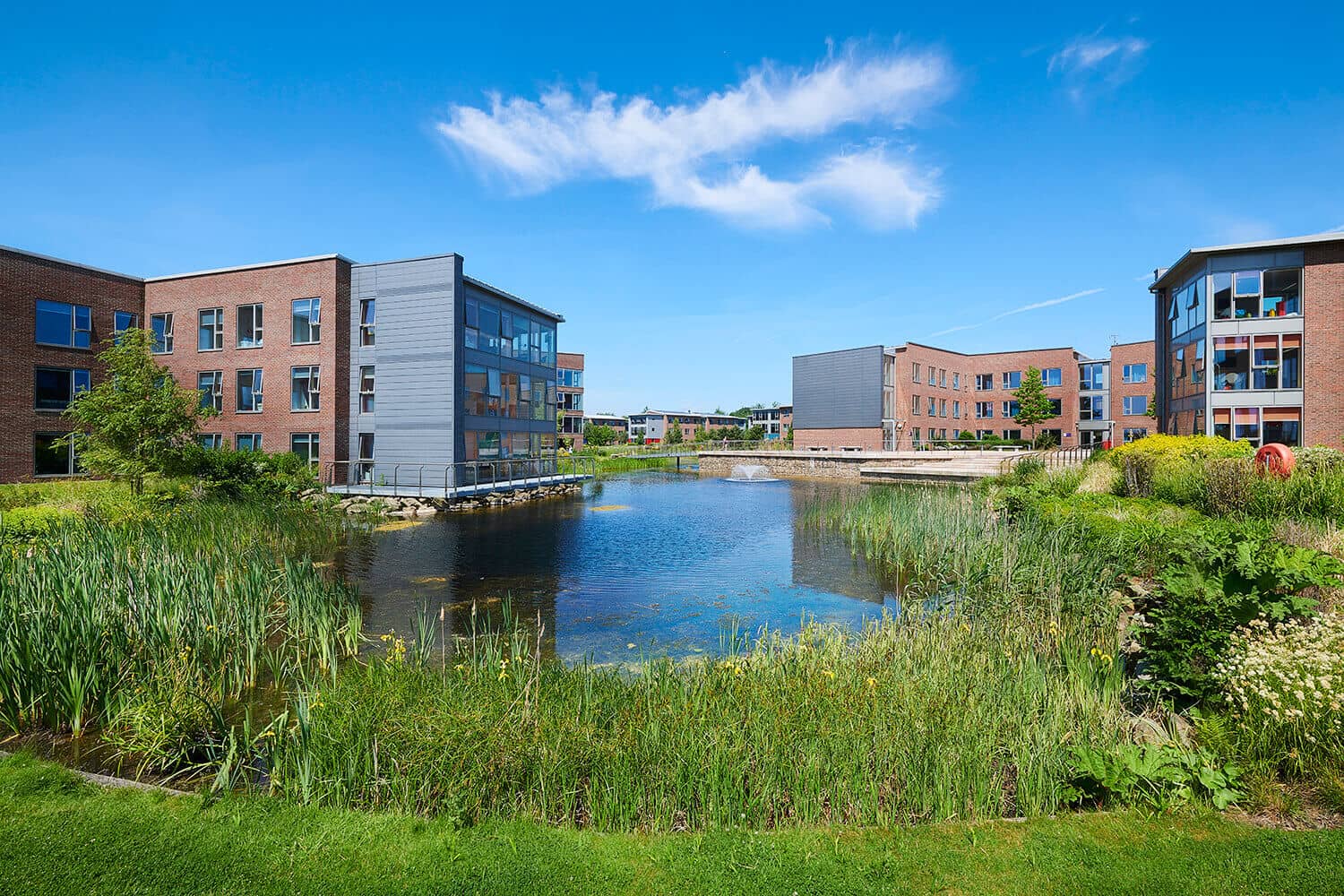
Facilities

The Faculty of Health, Social Care and Medicine offers outstanding facilities for the education and training of health and social care professionals.
The contemporary teaching and learning resources include leading edge clinical skills facilities, an 860-seat lecture theatre, and a variety of teaching rooms and social learning spaces.
A professional food skills and kitchen space enables Nutrition students to undertake a variety of practical work with foods in a purpose-built environment.
This dedicated space and the University’s modern Biosciences laboratories are used to test how certain foods are manufactured and produced, investigate the physical properties of food, and conduct sensory evaluations. You will also have opportunities to participate in enterprise initiatives and research activity using the Nutrition facilities.
Where you'll study
Learning resources
Learning resources for Nutrition students include a variety of anthropometric equipment to measure health status, sphygmomanometers for measuring resting blood pressure to indicate cardio vascular risk, bariatric and geriatric suits to experience physical and mobility restrictions, wrist-based global positioning systems (garmin devices) that measure exercise duration, energy expenditure and heart rate, and actigraphs which estimate exercise intensity and track sleep quality and duration.
Finance
Tuition fees
UK Full-Time
£9,790
a year
UK Part-Time
£81.50 per credit
for 360 credits
International
£14,500
a year
EU/EEA and Swiss students who have settled or pre-settled status under the EU Settlement Scheme, as well as Irish nationals, may be eligible for the UK tuition fee rate.
Financial support
Subject to eligibility, UK students joining this course can apply for a Tuition Fee Loan from the Government to cover the full cost of tuition fees. UK students enrolling on the course may also be eligible to apply for additional funding to help with living costs.
Scholarships
We offer a range of scholarships, which celebrate the determination, commitment and achievement of our students. Many of our scholarships are awarded automatically. There are some however, where you will need to be involved in an application or nomination process. To find out more about our scholarships and check your eligibility, please visit our dedicated scholarships pages.
Money Matters
Please view the relevant Money Matters guide for comprehensive information about the financial support available to eligible UK students.
EU/EEA and Swiss students who have settled or pre-settled status under the EU Settlement Scheme may be eligible to apply for financial support. Irish nationals can ordinarily apply to Student Universal Support Ireland (SUSI). If you are an EU student who does not have settled or pre-settled status, or are an international student from a non-EU country, please see our international student finance pages.
Your future career
After completing this course there are a wide range of career pathways open to you. Previous students have set out as freelancers or found themselves in a broad variety of organisations both in the public and private sectors, such as:
- clinical nutrition companies
- local authorities
- charitable organisations
- the NHS
- parenting organisations
- health promotion
- schools
- food industry, e.g. new product development, quality assurance.
- sports nutrition, e.g. elite sports, supplement companies
Our nutrition and health course is also a great foundation for postgraduate study in compelling areas such as public health nutrition, teaching and psychology.
Successful completion of this degree will enable you to apply for direct entry as a Registered Associate Nutritionist (ANutr) with the Association of Nutrition (AfN).
Registration of the AfN demonstrates that you have received a sound underpinning of scientific knowledge in evidence-based nutrition. It also enables you to join the UK Voluntary Register of Nutritionists, the only register of qualified nutritionists recognised by Public Health England, NHS Choices and NHS Careers.
Course changes
Every effort has been made to ensure the accuracy of this information, however our courses are subject to ongoing review and development. Changing circumstances may necessitate alteration to, or the cancellation of, courses.
Changes may be necessary to comply with the requirements of professional bodies, revisions to subject benchmarks statements, to keep courses updated and contemporary, or as a result of student feedback. We reserve the right to make variations if we consider such action to be necessary or in the best interests of students.