Early Childhood Studies with Graduate Practitioner Competencies BA (Hons)
UCAS code: L520
What is the nature of early childhood? How has our understanding changed over time and how does it differ across cultures and societies? Study early childhood with us to explore the perceptions and realities of young children’s lives and consider how we can bring about positive change.
Subject to revalidation
Overview
| Course length: | 3 years full-time |
|---|---|
| Start dates: | September 2026 September 2027 |
| Location: | Edge Hill University |
| Example offers: | BCC-BBC (A Level) or DMM (BTEC)104-112 UCAS Tariff points View full entry criteria |
| Subject(s): | Education and Teaching |
| Faculty: | Education |
| Department: | Early Years Education |

On this degree, you’ll explore the nature of childhood, of young children and their families, and the provision made for them. You will also reflect on your own childhood in order to understand how it has been shaped by wider social and cultural influences. You will study the latest developments in the field with academics whose research will inform your studies, in order to analyse children’s lives and consider how we can positively influence their outcomes.
You will apply theories from disciplines including sociology, psychology and philosophy and subjects including education studies and social policy to critically analyse issues around policy and legislation for young children. You’ll also engage with diverse and alternative theories which will allow you to consider the multiplicity of experiences of young children and families locally, nationally and internationally and how this knowledge can be applied in your future practice.
There are lots of job opportunities in the early years sector. This course will help you expand your interest in children’s early years development, or prepare for a career working with children aged 0-8.
You’ll have the chance to achieve an Early Childhood Graduate Practitioner Certificate (ECGPC) , giving you a competitive edge. This nationally-recognised certificate opens the door to professional early education roles up to level 6. You’ll be a step ahead of graduates who don’t have the certificate.
Throughout the degree, you’ll develop valuable transferable skills, from critical thinking to communication and reflective practice, opening pathways to a variety of careers or further study options beyond working with early years.

What you'll study
The degree starts with an introduction to early childhood studies to equip you with the analysis tools you need for Year 2 and 3. We’ll talk about childhood in the broad context of world development and change. We’ll also introduce you to social and developmental psychology, social policy, and education studies. In Year 1, you will enrol on the Early Childhood Graduate Practitioner Certificate (ECGPC) which you’ll complete across all three years of your degree.
Year 2 is about developing your academic and research skills, investigating contemporary perspectives on early childhood education and care and researching early childhood in a range of contexts. You will explore a range of topics around early years education, health and wellbeing. If you’re working towards the ECGPC as part of your Graduate Practitioner Certificate, you’ll do more work placements and use the knowledge you’re gaining from your modules to add to your portfolio.
Year 3 of the course lets you focus on critical theory and practice of the early years sector. Explore ways of working with young children in an anti-oppressive and inclusive way. In this year you can also study theory and practice with babies to three year olds and critical autism studies. You will complete a supervised dissertation on a topic of your choice and complete your final placement for the Graduate Practitioner Certificate.
How you'll study
The programme is taught via lectures, presentations, seminars, workshops, small group work and tutorials. Sessions are often interactive and make use of tutor and student presentations, video recordings, newspaper articles, ICT-based learning and research evidence. The emphasis is on student-centred learning, which encourages you to raise questions, evaluate sources, critique theoretical debate and develop your own analyses.
How you'll be assessed
Progress and achievement are assessed using a variety of methods, such as essays, case studies, portfolios, scrapbooks, blogs, posters and oral presentations, analysis of interview findings, completion of directed tasks, and enquiry reports.
There are no formal written examinations as part of the current assessment methods on this degree.
Who will be teaching you
Staff are engaged in cutting-edge research in a number of crucial areas of social science, including subjects of contemporary significance, such as child protection, disability, mental health and sexuality, special educational needs, early years pedagogy and international perspectives.
Your degree will be supplemented by a series of research seminars and other talks. These will feature academic staff and visiting guest speakers from a range of professions and organisations.
Where your course includes optional modules, these are to provide an element of choice within the course curriculum. The availability of optional modules may vary from year to year and will be subject to minimum student numbers being achieved. This means that the availability of specific optional modules cannot be guaranteed. Optional module selection may also be affected by timetabling requirements. Some restrictions on optional module choice or combinations of optional modules may apply.
Entry criteria
Typical offer 104-112 UCAS Tariff points. No specific subjects are required.
5 GCSEs at Grade C or Grade 4 or above, including GCSE English Language and GCSE Mathematics.
Students will need to successfully complete a DBS check. All relevant, current statutory guidance relating to keeping children safe shall be tracked and applied to this course.
Example offers
| Qualification | Requirement |
|---|---|
| A Level | BCC-BBC. |
| UCAS Tariff points | 104-112 points. |
| BTEC Extended Diploma (or combination of BTEC QCF qualifications) | Distinction, Merit, Merit (DMM). |
| T Level | Overall grade of Merit. |
| International Baccalaureate (IB) | We are happy to accept IB qualifications which achieve the required number of UCAS Tariff points. |
| Access to Higher Education Diploma | 45 credits at Level 3, for example 9 credits at Distinction and 36 credits at Merit or 15 credits at Distinction and 30 credits at Merit. The required total can be attained from various credit combinations. |
Please note, the above examples may differ from actual offers made. A combination of A Level and BTEC awards may also be accepted.
If you have a minimum of two A Levels (or equivalent), there is no maximum number of qualifications that we will accept UCAS points from. This includes additional qualifications such as Extended Project Qualification (EPQ), AS Levels that haven't been continued to A Level, and General Studies AS or A Level awards.
English language requirements
International students require IELTS 6.0, with a score no lower than 5.5 in each individual component, or an equivalent English language qualification.
Fair Entry Criteria
Our new Fair Entry Criteria is a Contextual Admissions Policy that takes an applicant’s personal and educational background into account. This policy will allow eligible applicants to receive up to a two-grade reduction in their entry requirements for this course. Find out more and see if you qualify.
How to apply
Apply full-time
Read our guide to applying through UCAS to find out more about the application process.
International
Please see our international student pages for further information about how to apply as a prospective international student.
Should you accept an offer of a place to study with us and formally enrol as a student, you will be subject to the provisions of the regulations, rules, codes, conditions and policies which apply to our students. These are available at www.edgehill.ac.uk/studentterms.
If you join a full time undergraduate degree at Edge Hill University, we will guarantee you the offer of a room in our halls of residence for the first year of your course.
Discover our accommodation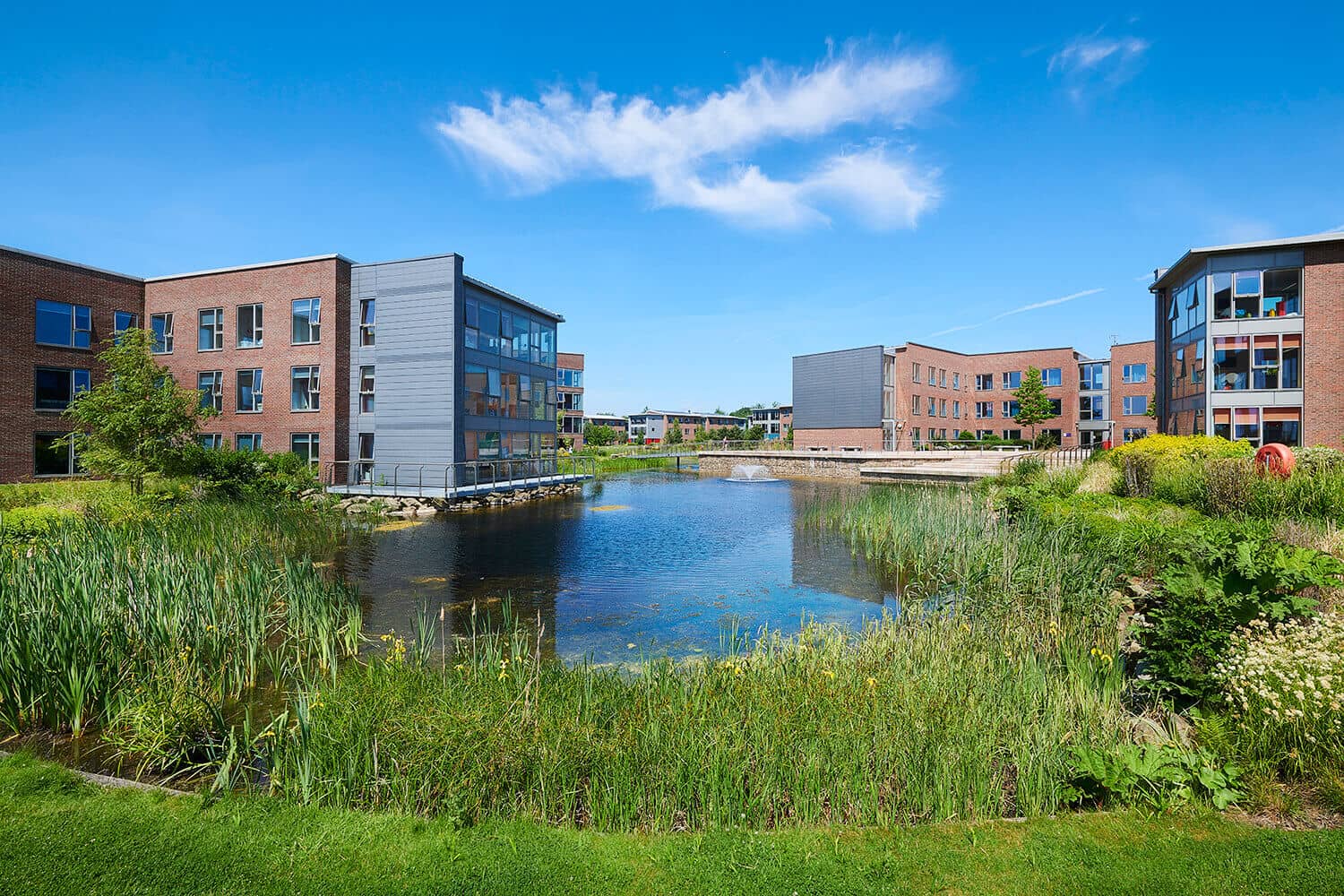
Finance
Tuition fees
UK Full-Time
£9,790
a year
International
£14,500
a year
EU/EEA and Swiss students who have settled or pre-settled status under the EU Settlement Scheme, as well as Irish nationals, may be eligible for the UK tuition fee rate.
Financial support
Subject to eligibility, UK students joining this course can apply for a Tuition Fee Loan from the Government to cover the full cost of tuition fees.
Scholarships
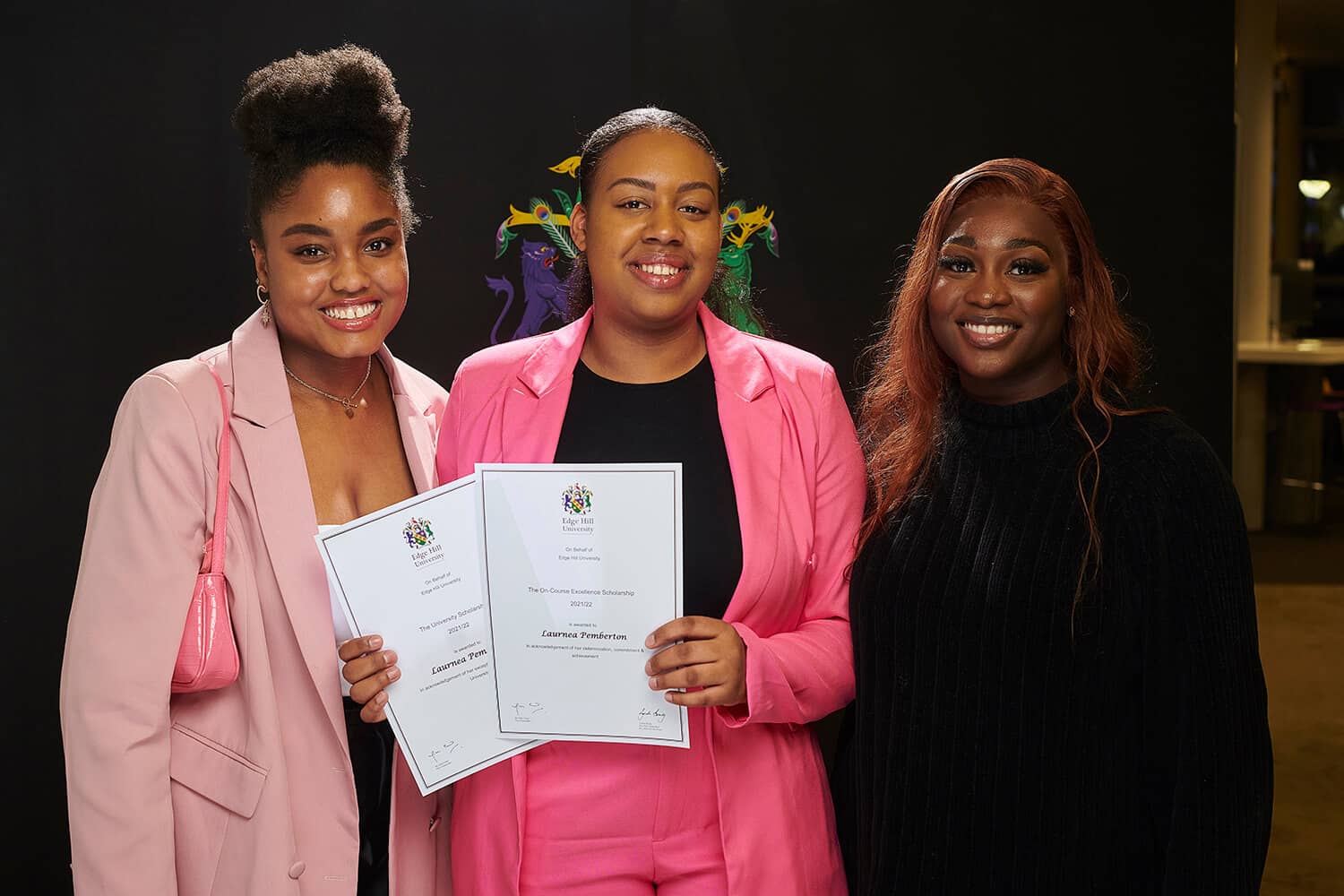
We offer a range of scholarships, which celebrate the determination, commitment and achievement of our students. Many of our scholarships are awarded automatically. There are some however, where you will need to be involved in an application or nomination process. To find out more about our scholarships and check your eligibility, please visit our dedicated scholarships pages.
Money Matters
Please view the relevant Money Matters guide for comprehensive information about the financial support available to eligible UK students.
EU/EEA and Swiss students who have settled or pre-settled status under the EU Settlement Scheme may be eligible to apply for financial support. Irish nationals can ordinarily apply to Student Universal Support Ireland (SUSI). Please see our EU student finance page for further details.