Untangle the relationship between learning, development and psychological disorders. Understand the core concepts of psychology and what makes humans tick. Apply your learning with work placements in educational settings on this degree accredited by the British Psychological Society (BPS).
Discover the learning and development of children and young people on our educational psychology degree.
We’ve designed this course to focus on psychology and the human brain, with some modules looking at the core theory through an educational lens. You’ll explore how conditions like autism and ADHD impact behaviour, social interaction and learning.
Unravel the human mind
Investigate the four key areas of psychology (social, developmental, biological and cognitive), as well as the relationship between brain and behaviour. Delve into the fascinating functions of the brain including memory, intelligence, personality and individual differences.
How do thinking, language and emotion enable us to process what goes on around us? And how do social influences alter our individual behaviour? We’ll investigate the answers to these questions and more during your time on this course.
Apply your skills on placement
As you discover what influences motivations and behaviours in an educational setting, you’ll test your skills hands-on. The BSc (Hons) Educational Psychology course includes a work placement. Bring techniques and strategies for learning, teaching and assessments to life in a school or other educational-based setting.
Our introductory psychology modules delve into the relationship between brain and behaviour, perception, memory and intelligence. We’ll introduce you to research methods and data analysis that help problem solving in the real-world. There’s a focus on key undergraduate skills like academic reading, group work and critical writing. We’ll also build your personal development. What’s more, your introduction to educational psychology will involve examining the issues facing education today.
Essential Skills in Applied Psychology develops a range of academic, personal and interpersonal skills designed to enhance your potential both within and beyond university. The focus is on harnessing key undergraduate skills such as academic reading, writing and critique, group working, finding and presenting information, time management, self-awareness and reflection, and applying them in the context of the degree subject. The module takes a holistic approach to applications of theory.
Module code: PSY1109
Credits: 20
Introduction to Cognitive & Biological Psychology
Introduction to Cognitive & Biological Psychology considers the processes underlying behaviour (such as perception, sensation and memory) and how human beings are embedded in their world (for example, by way of their shared biology and learned knowledge). In this way, the module aims to equip you with a broad understanding of basic theories and concepts and a range of interrelated approaches towards the psychological study of human behaviour.
Module code: PSY1112
Credits: 20
Introduction to Educational Psychology
Introduction to Educational Psychology provides an overview of a range of key topics relevant to the practice of educational psychology, educational psychology research and interventions informed by psychological theory. The module will examine the psychology which underpins the learning of children and adolescents, explore what motivates children to learn and perform at school, and consider a range of barriers to children’s learning.
Module code: EDP1001
Credits: 20
Introduction to Personality, Social & Developmental Psychology
Introduction to Personality, Social & Developmental Psychology will familiarise you with the approaches and concepts central to the study of behaviour. The module explores the historical and theoretical concepts of personality and individual differences, social cognition and social and cognitive development.
Module code: PSY1111
Credits: 20
Investigating Psychology 1
Investigating Psychology 1 demonstrates the key approaches to research in cognitive, developmental, social, and biological psychology. You will develop your skills in experimental design, data analysis and data interpretation, and receive training, support and practice in the use of SPSS software to examine psychological research. The module will also enable you to prepare written research reports on studies conducted.
Module code: PSY1118
Credits: 20
Investigating Psychology 2
Investigating Psychology 2 demonstrates the key approaches to research in cognitive, developmental, social, and biological psychology. You will develop your skills in experimental design, data analysis and data interpretation, and receive training, support and practice in the use of SPSS software to examine psychological research. The module will also enable you to prepare written research reports on studies conducted. You will receive additional training in the use of interviews in research and how to analyse qualitative data.
Module code: PSY1119
Credits: 20
You’ll study four major areas of psychology (social, developmental, biological and cognitive) to develop critical awareness and improve your interpersonal skills. We’ll introduce you to research methods where you’ll use your findings to better understand human behaviour. A work placement at the end of Year 2 of your educational psychology degree will give you practical experience in a school setting or in other educational settings.
Biological Psychology studies the human nervous system, including its structure and functioning. There will be a particular focus upon the brain. You will learn in detail the processes by which messages are passed through the system and the way the brain interacts with the hormones of the endocrine system in order to preserve life. The methods by which the brain is commonly researched will also be explored in order to provide a basis for understanding much current research and theorising in psychology.
Module code: PSY2115
Credits: 20
Cognitive Psychology
Cognitive Psychology will examine both classic and contemporary research that has led to the development of theories regarding how attention, perception and memory all function. The module will also examine how each of these components interact during everyday tasks. You will consider how thinking, language and emotion enable us to reason about, and interact meaningfully with, the external world, gaining an understanding of the processes used to communicate, comprehend, and use information and knowledge.
Module code: PSY2114
Credits: 20
Developmental Psychology
Developmental Psychology addresses the processes involved in key aspects of human development and their relevant applications in real world settings. It will focus mainly (though not exclusively) on development in childhood including areas such as cognition, memory, language, emotional, and social development. Emphasis will be placed on the evaluation of key theories and psychological research that have informed our understanding of development in these areas.
Module code: PSY2112
Credits: 20
Research Methods & Data Analysis
Research Methods & Data Analysis provides you with the skills necessary to design, execute and report your own research. A particular emphasis is placed on data analysis: quantitative techniques (analysis of variance and regression) and qualitative techniques (grounded theory and phenomenological analysis). These data analysis skills will be essential for carrying out dissertations and are also highly valued by employers.
Module code: PSY2116
Credits: 20
Social Psychology
Social Psychology reveals the extent to which social influences and interactions are pervasive in affecting individual behaviour, while also considering how the actions of an individual in turn affect other individuals and groups. You will develop an awareness of the relationship between person and situation and examine how this dynamic relationship both influences, and is crucial to, the understanding of behaviour.
Module code: PSY2113
Credits: 20
The Psychology of Teaching, Learning and Instruction
The Psychology of Teaching, Learning and Instruction questions what actually constitutes ‘learning’ and ‘teaching’ along with psychological theory and research about how this is best achieved in practice. An important part of this module will be for you to gain experience of the application of theory and research in practice, achieved by conducting a micro-teaching exercise with peers and reflecting on the experience.
Module code: EDP2004
Credits: 20
Use research to explore specific areas of educational psychology for your dissertation. You’ll consider how to apply your knowledge of educational psychology in practice to prepare you for future employment or further study. We’ll give you a range of optional modules in your final year, where you can really focus in on educational development. Learn how autism, dyslexia and ADHD impact behaviour and learning. Or explore how you can use theories of motivation to help you be a successful student.
Dissertation requires you to carry out a piece of research for which, with tutorial support, you have responsibility for designing, gathering data, analysing data, and reporting the findings. You will work independently and demonstrate a high degree of autonomy and initiative in managing your work.
Module code: PSY3135
Credits: 30
Personality and Individual Differences
Personality and Individual Differences influence all aspects of human behaviour. Knowledge and understanding of the nature of individual differences and the processes by which they influence our behaviours and motivations in everyday life is at the very essence of human psychology. Such knowledge is relevant in key disciplines such as clinical and forensic psychology, as well as to individuals generally in their efforts to understand what makes people ‘tick’. This module will explore and evaluate theories and research that have advanced our knowledge and understanding of this key area of psychology. It will develop your capacity for critical thinking, for active and independent learning, and for effective communication and teamwork.
Module code: PSY3129
Credits: 20
Psychology Placement: Linking Theory to Practice
Psychology Placement: Linking Theory to Practice represents the academic component of a work-based placement. It is an extended piece of critical reflection conduced through independent study and supported by tutorials.
Module code: EDP3101
Credits: 20
Reflections & Future Directions
Reflections & Future Directions considers the historical and conceptual issues in psychology from an informed perspective, using knowledge and understanding acquired throughout the degree. You will learn to acknowledge your own individual role as a prospective psychology graduate within a wider context, recognising and maximising the skills acquired throughout the programme, in preparation for future employment or further study.
Applied Psychopharmacology examines the mechanisms by which drugs, both legal and illegal, exact their effects once consumed. Examples of illegal drugs to be covered include cannabis, ecstasy (MDMA) and cocaine, whilst coverage of legal drugs will include alcohol and caffeine. Consideration will also be given to some common food ingredients such as polyphenols.
Module code: PSY3133
Credits: 20
Applying Psychology to Lifestyle Behaviour
Applying Psychology to Lifestyle Behaviour explores the role of psychology applied to the context of lifestyle. Specifically, the module considers the application of theory and evidence-based research to help you better understand, predict and change lifestyle-related behaviours. In addition this module will elucidate how psychological concepts are linked to both healthy and unhealthy lifestyles in the real-world.
Module code: PSY3132
Credits: 20
Clinical Psychology and Mental Health
Clinical Psychology and Mental Health introduces you to the exciting world of clinical psychology and the biopsychosocial model of mental health. The module will provide you with a thorough understanding of a variety of perspectives in psychology and how they apply to mental health. You will develop your understanding and consider psychological assessment, formulation and therapeutic approaches to mental health difficulties such as anxiety, depression, eating disorders and psychosis. Overall, the module will provide you with strong academic skills useful in a variety of vocational roles, and provides a foundation for further training in professional psychology.
Module code: PSY3150
Credits: 20
Cognitive Neuroscience
Cognitive Neuroscience explores an area that aims to understand the mechanisms of human thought by asking how mental processes such as perception, memory, language and emotion are implemented within the brain. An explosion of new methods dependent on computers and brain imaging has led to enormous progress in this field and allows an array of new problems to be tackled directly. This module provides you with an understanding of how research in cognitive neuroscience has informed our understanding of cognitive processes in the brain. You will discover how to describe and critically evaluate the experimental methods most frequently used by psychologists working in cognitive neuroscience and explore their relative suitability in a variety of domains.
Module code: PSY3143
Credits: 20
Evolutionary Psychology
Evolutionary Psychology explores adaptive influences on behaviour and equips you with an understanding of evolutionary science and the contributions of evolutionary psychology to our current understanding of the brain and behaviour. Most psychologists and psychology researchers believe that the neural mechanisms that underpin our psychological abilities and propensities are the product of evolution – of natural, kin, and sexual selection. Furthermore, the general principles of evolution can be applied not only at species level but also at an individual level in terms of how a person’s neural and functional processing evolves as a function of their environment. By studying evolutionary psychology, you will gain knowledge of the origins of behaviour that challenges traditional assumptions about humans, their minds, and their collective interaction. The module will empower your critical evaluation of personal, social and cultural issues in your future employment and everyday life.
Module code: PSY3146
Credits: 20
Forensic Psychology: Eyewitnesses and Suspects
Forensic Psychology: Eyewitnesses and Suspects examines the expanding field of forensic psychology. The aim is to help you understand human behaviour and its underlying thoughts, feelings and motivations, with particular reference to criminal behaviour. You will develop the expertise to assess evidence about human behaviour and garner a wide range of skills in relation to forensic investigation. You will be introduced to some of the skills that forensic psychologists use when investigating eyewitness reports and offenders and consider related theories and associated research evidence.
Module code: PSY3139
Credits: 20
Foundations for Learning
Foundations for Learning examines some of the key areas in early years education from a psychological perspective. The primary focus will be on communication and language development, physical education, and personal, social and emotional development. The module will critically evaluate how development in these areas may be enhanced via play, movement activities, music, song and drawing. The concept of school readiness will be critically evaluated, with particular reference to international comparisons in the development of pre-school foundation skills, as well as the longer term impact on subsequent academic attainments and socio-emotional development.
Module code: EDP3105
Credits: 20
Learning to Thrive
Learning to Thrive pulls together all the key aspects of multiple psychological approaches in pursuit of life opportunities. The module takes a 360 degree approach, including both blockers and enablers for personal development, from foundations in neuroplasticity to applications in positive psychology, with the aim of helping you to acquire the necessary self knowledge, psychological knowledge, and experiential learning required to thrive in the 21st century. Key topics include positive psychology, goal setting, understanding stress, 21st century skills, and self-actualisation. A further distinctive component of the module is the opportunity to undertake the first stage of the Zing Performance neurodevelopmental programme which will be provided free of charge. Students who complete further Zing Performance activities may be eligible for accreditation for personal neurodevelopment with Zing.
Module code: PSY3147
Credits: 20
Mind, Brain & Behaviour: The Foundations of Psychological Explanation
Mind, Brain & Behaviour: The Foundations of Psychological Explanation is concerned with psychological explanation in two contexts: first, in our everyday use of psychological concepts, and secondly, as it is informed by research in disciplines such as psychology, cognitive neuroscience, philosophy, linguistics and artificial intelligence.
Module code: PSY3138
Credits: 20
Psychology and the Virtual World
Psychology and the Virtual World will examine psychological experiences and impacts associated with a range of different online and digital environments. These include video gaming, social media and other aspects of the Internet. There will be a particular focus on the application of recent psychological research and how it provides an insight into the online experiences which comprise a substantial part of modern day life.
Module code: PSY3131
Credits: 20
Psychology in the Courtroom
Psychology in the Courtroom specialises in the area of ‘applied’ forensic psychology and examines psychological underpinnings and experiences associated with a range of factors that influence decision-making in the courtroom. These include jury decision-making, expert witness testimony, witness credibility, defendant appearance and cross-examination techniques. Across the module, there will be particular focus on how psychological theory and research has aided our understanding of real-world issues in an applied context.
Module code: PSY3140
Credits: 20
Psychology of Language
Psychology of Language provides you with the fundamental issues in the psychological study of language. The issues include language production and comprehension, first and second language acquisition on the oral and sign domains, language disorders, and various applied topics (such as embodiment, and language in the internet). The module also introduces research methods in psycholinguistics.
Module code: PSY3144
Credits: 20
Psychology of Substance Misuse
Psychology of Substance Misuse examines various aspects of substance misuse (including the misuse of alcohol) from a psychological perspective which will also be informed by other academic perspectives, such as those of brain science and sociology respectively. A broad range of psychological consequences of substance misuse, such as memory impairments, will be studied and the psychological interventions for substance misuse will be examined.
Module code: PSY3122
Credits: 20
Research Technologies and Tools
Research Technologies and Tools gives you practical experience of using research technologies commonly used within the discipline such as E-Prime (an experimental presentation software used for measuring reaction times), Biopac (a physiological arousal measurement tool) and diagnostic tools (such as the Wechsler Abbreviated Intelligence Scale). These skills will be useful for all students wishing to conduct further Postgraduate studies in Psychology, where an understanding of research technologies will be advantageous.
Module code: PSY3130
Credits: 20
Social Neuroscience
Social Neuroscience is a module focused on social interaction, recognising it as a critical aspect of day-to-day life, crucial to how we perceive each other, how we interpret behaviour and intentions, and then plan and react accordingly. It will explore the different processes and abilities that together make social interaction possible, as well as the impairments and deficits that can occur.
Module code: PSY3142
Credits: 20
Special Educational Needs
Special Educational Needs examines special educational needs (SEN) within the school system by providing an understanding of psychological research and its applicability to this area. The module will take into consideration the policies and strategies behind supporting SEN in school, with particular attention to autism and dyslexia. In addition, this module will explore both the history of SEN and the new direction it is taking.
Module code: EDP3104
Credits: 20
Student Motivation and Engagement
Student Motivation and Engagement examines how psycho-educational factors can influence, and are in turn influenced by, learning and achievement. During the module you will explore how these are relevant to contemporary educational psychology in areas including competence belief, academic motivation, academic emotions and the fear of failure. You will discover how these factors have their roots in social psychology and are underpinned by a common socio-cognitive framework. You’ll also learn how these can by utilised by educational practitioners, teachers, school counsellors, educational psychologists and education managers. The module may be of particular interest if you are particularly interested in educational psychology or aim to work in the field of education.
Module code: EDP3106
Credits: 20
Work Psychology
Work Psychology develops your understanding of the application of psychology to people in terms of their lives at the workplace, their economic and work-relevant behaviour, and as participants in organisations. The module builds on knowledge acquired in earlier modules such as knowledge, skill, and decision-making in cognitive psychology, individual differences in social psychology, and motivation. Many of the themes identified are explored in an applied context in this module.
Module code: PSY3120
Credits: 20
Where your course includes optional modules, these are to provide an element of choice within the course curriculum. The availability of optional modules may vary from year to year and will be subject to minimum student numbers being achieved. This means that the availability of specific optional modules cannot be guaranteed. Optional module selection may also be affected by timetabling requirements. Some restrictions on optional module choice or combinations of optional modules may apply.
How you'll study
Our teaching methods vary from traditional style lectures to tutorials, seminars and workshops. There are well-equipped laboratory facilities consisting of IT rooms and research cubicles. We have a wide range of IT facilities, including experiment generation and statistical packages.
You will also complete a work placement at the end of Year 2 within an educational context such as a school, educational psychology service or educational research group. Some placement types are limited and travel may be required.
Timetables for your first week are normally available at the end of August prior to enrolment in September. You can expect to receive your timetable for the rest of the academic year during your first week. Please note that while we make every effort to ensure that timetables are as student-friendly as possible, scheduled teaching can take place on any day of the week. Wednesday afternoons are normally reserved for sports and cultural activities.
How you'll be assessed
Most modules are assessed by a mixture of examination and coursework, though some are assessed solely by coursework. Coursework assignments might be essays, research project reports, portfolios, group presentations, posters, or the critical analysis of research papers. In addition, in Year 3 you will complete a dissertation.
Who will be teaching you
You will be taught by staff with a wide range of interests in psychology. Members of our team have worked previously in schools, colleges and other educational institutions and conduct research in collaboration with schools and local authorities.
The Department of Psychology operates a research internship scheme where you may have the opportunity to volunteer to assist with staff research across a range of exciting projects. Previous projects have focused on subjects including eye movements and memory, alcohol and inhibition, autistic traits, attentional bias to pictures and words, personality and offending behaviour, behaviour change and food awareness, multiple perspective taking, the neural underpinnings of action simulation, and the question of whether emojis reveal true emotions.
Entry criteria
Entry requirements
Typical offer 112 – 120 UCAS Tariff points, for which no specific subjects are required, plus GCSE English and GCSE Mathematics at Grade C or Grade 4 or above (or equivalent).
Please note, for the purposes of studying psychology, level 2 literacy and numeracy qualifications are not considered as equivalent to GCSE Grade C or Grade 4 in English Language and Mathematics.
Example offers
Qualification
Requirement
A Level
BBC-BBB.
BTEC Extended Diploma (or combination of BTEC QCF qualifications)
Distinction, Merit, Merit (DMM).
T Level
Overall grade of Merit.
International Baccalaureate (IB)
We are happy to accept IB qualifications which achieve the required number of UCAS Tariff points.
Access to Higher Education Diploma
45 credits at Level 3, for example 15 credits at Distinction and 30 credits at Merit or 24 credits at Distinction and 21 credits at Merit. The required total can be attained from various credit combinations.
Please note, the above examples may differ from actual offers made. A combination of A Level and BTEC awards may also be accepted.
If you have a minimum of two A Levels (or equivalent), there is no maximum number of qualifications that we will accept UCAS points from. This includes additional qualifications such as Extended Project Qualification (EPQ), AS Levels that haven't been continued to A Level, and General Studies AS or A Level awards.
English language requirements
International students require IELTS 6.0, with a score no lower than 5.5 in each individual component, or an equivalent English language qualification.
If your current level of English is half a band, one band, or one-and-a-half bands lower, either overall or in one or two elements, you may want to consider our Pre-Sessional English course.
Please see our international student pages for further information about how to apply as a prospective international student.
Should you accept an offer of a place to study with us and formally enrol as a student, you will be subject to the provisions of the regulations, rules, codes, conditions and policies which apply to our students. These are available at www.edgehill.ac.uk/studentterms.
Did you know?
If you join a full time undergraduate degree at Edge Hill University, we will guarantee you the
offer of a room in our halls of residence for the first year of your course.
The £6million Law and Psychology building provides contemporary teaching and learning facilities for students in the Department of Psychology and the School of Law, Criminology and Policing.
The three-storey building includes a 250-seat lecture theatre, seminar and tutorial rooms, and social learning areas which encourage a more informal and interactive style of learning. There are also specially designed experimental facilities for psychological research.
Where you'll study
Law and Psychology
Learning resources
Psychology resources include state-of-the-art eye trackers, transcranial direct current stimulation (tDCS) methods, and near-infrared spectroscopy (NIRS) for examining cognitive functioning and brain activity. Other specialist laboratories include a group testing laboratory, bi-directional observation rooms, a ‘bar simulation laboratory’ (for alcohol research), audio-visual suites and dedicated IT facilities equipped with subject specific software installed to support experimental work.
The University may administer a small inflationary rise in tuition fees, in line with Government policy, in subsequent academic years as you progress through the course.
EU/EEA and Swiss students who have settled or pre-settled status under the EU Settlement Scheme, as well as Irish nationals, may be eligible for the UK tuition fee rate.
Financial support
Subject to eligibility, UK students joining this course can apply for a Tuition Fee Loan from the Government to cover the full cost of tuition fees. UK students enrolling on the course may also be eligible to apply for additional funding to help with living costs.
Please view the relevant Money Matters guide for comprehensive information about the financial support available to eligible UK students.
EU/EEA and Swiss students who have settled or pre-settled status under the EU Settlement Scheme may be eligible to apply for financial support. Irish nationals can ordinarily apply to Student Universal Support Ireland (SUSI).
If you are an EU student who does not have settled or pre-settled status, or are an international student from a non-EU country, please see our international student finance pages.
Your future career
This course is accredited by the British Psychological Society (BPS) as conferring eligibility for the Graduate Basis for Chartered Membership (GBC), which is the first step towards becoming a chartered psychologist. Our degree is the perfect foundation on which to build your further education and training.
With this undergraduate degree you’ll be on your way to pursuing career paths such as:
educational psychology
clinical psychology
work psychology
health psychology
teaching
higher education
advertising
care professions
learning coordinator
educational support worker
Our graduates use this initial programme to kickstart their careers in the psychology sector and go on to apply their skills in a range of rewarding roles. It’s important to note that if you want to train as a psychologist, you’ll need to undertake postgraduate education. This undergraduate degree is the perfect first step to becoming a chartered educational psychologist.
Course changes
Every effort has been made to ensure the accuracy of this information, however our courses are subject to ongoing review and development. Changing circumstances may necessitate alteration to, or the cancellation of, courses.
Changes may be necessary to comply with the requirements of professional bodies, revisions to subject benchmarks statements, to keep courses updated and contemporary, or as a result of student feedback. We reserve the right to make variations if we consider such action to be necessary or in the best interests of students.
Track changes to this course
Change of module name - 30 June 2023
PSY3123 (Clinical and Abnormal Psychology) has become PSY3150 (Clinical Psychology and Mental Health). Slight change to module description.
Module change - 11 May 2023
Psychological Predictors of Learning and Achievement (EDP3102) changed to Student Motivation and Engagement (EDP3102). Content remains the same.
Entry requirements amended - 25 April 2023
UCAS tariff points 120-128 added for September 2024 entry.


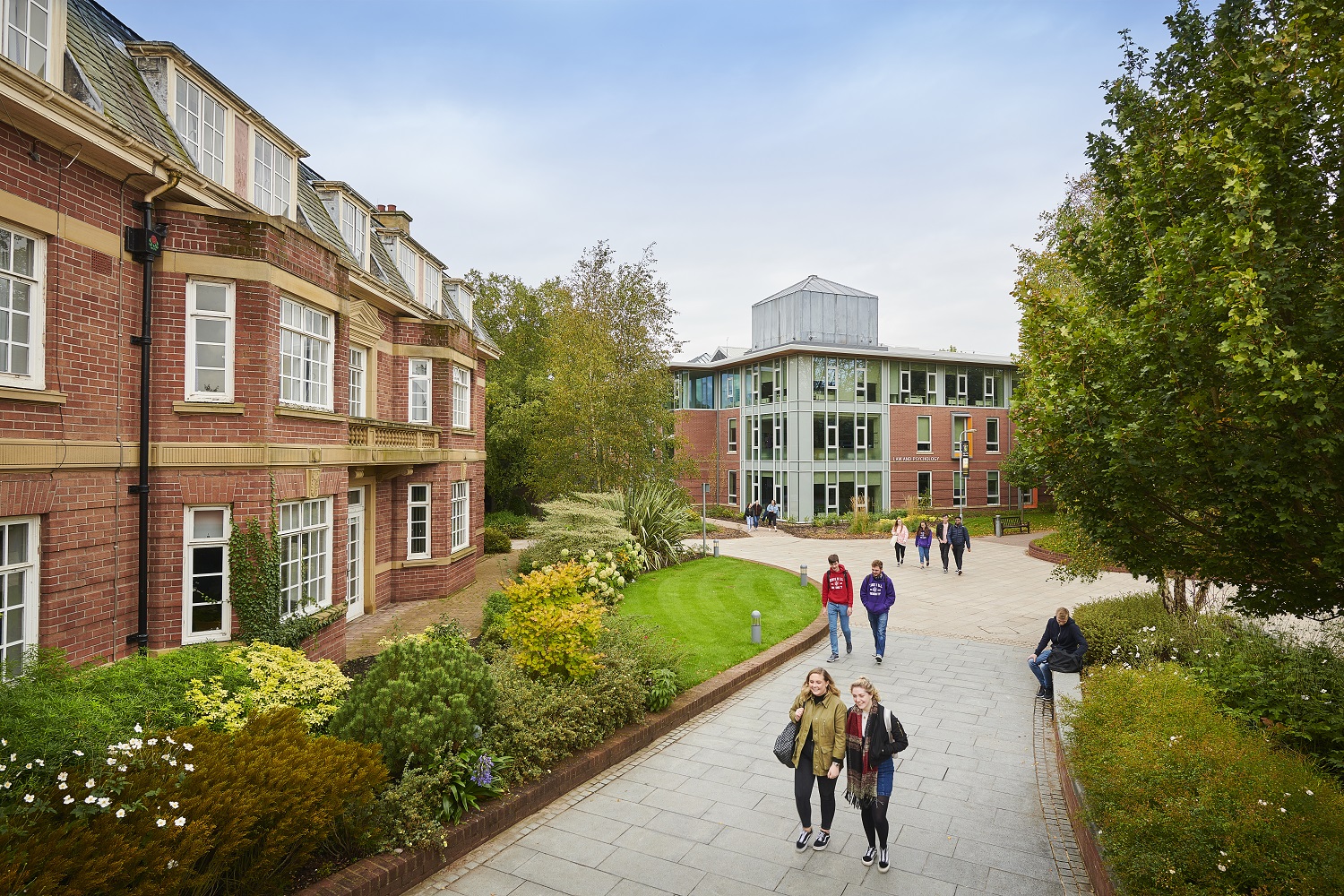 The £6million Law and Psychology building provides contemporary teaching and learning facilities for students in the Department of Psychology and the School of Law, Criminology and Policing.